For many boaters, few moments are more stressful than questioning whether the anchor is actually holding.
Whether spending the night in a crowded Catalina Island anchorage, riding out shifting wind conditions in a remote cove, or simply stopping for a long afternoon on the hook, confidence in an anchoring system often becomes the difference between a relaxing experience and a sleepless one.
As more recreational boaters embrace overnight cruising, multi-day coastal trips, and extended time away from the dock, anchoring systems are receiving renewed attention throughout the boating industry. Conversations increasingly are shifting beyond simply carrying an anchor onboard and toward understanding how anchor design, seabed conditions, scope, and vessel setup all influence holding performance.
Experienced cruisers and offshore sailors often point to seabed variability as one of the biggest factors affecting anchor reliability. Soft mud, sand, clay, rock, grass, and kelp can all dramatically change how an anchor sets and holds, particularly during wind shifts or changing tidal conditions.
According to Alex Tracy and Christie Kellogg of Rocna Anchors, understanding the bottom beneath the boat is often one of the most overlooked parts of anchoring, especially in Southern California where seabeds can change dramatically from one cove to the next.
“Seabed is the biggest variable in holding, and it changes how any anchor behaves,” Tracy and Kellogg explained on behalf of Rocna Anchors. “Sand is usually the most predictable because a good anchor digs in fast and holds well. Mud can also hold beautifully once an anchor buries deep enough, but softer mud rewards patience and an anchor design that penetrates instead of skating across the surface. Rock or rubble gives you very little to dig into, so holding depends on the anchor catching onto something solid, which can become more of a gamble.”
They noted that kelp-covered bottom, something many Southern California boaters regularly encounter around Catalina Island and the Channel Islands, presents its own unique challenges.
“Kelp is one of the toughest bottoms because the anchor often grabs weed instead of the seabed underneath it,” they said. “Mixed bottoms can also be difficult because an anchor may initially set in one material and then lose holding when the boat shifts into another area. Around Catalina and the Channel Islands, the same anchor can behave very differently from one anchorage to another, which is why using charts and local knowledge to understand the seabed is such an important part of choosing where to anchor.”
Among the companies helping shape modern anchor design is Rocna Anchors, whose products were developed from firsthand offshore cruising experience rather than purely theoretical engineering.
The company’s origins trace back to New Zealand sailor and boatbuilder Peter Smith, whose decades of offshore sailing and yacht construction ultimately led him to redesign what he believed anchoring systems could become.
Smith spent years cruising aboard his custom-built aluminum expedition yacht, Kiwi Roa, after leaving the yacht manufacturing industry in the late 1970s. During extensive voyages through areas including the English coast, Chesapeake Bay, Delaware Bay, Patagonia, Antarctica, Greenland, and the South Atlantic, he repeatedly encountered inconsistent holding performance from traditional anchors despite carrying multiple designs onboard.
According to Tracy and Kellogg, those firsthand frustrations became the foundation for Rocna’s development.
“Peter Smith designed the original Rocna as a working solution to a problem he knew firsthand: anchors that set inconsistently and pulled out when conditions shifted,” they said. “When your boat and crew depend on the anchor holding overnight, that uncertainty becomes unacceptable. He approached the design from the perspective of a cruiser who needed something dependable in real-world conditions, not simply from the standpoint of manufacturing.”
That frustration eventually led Smith to begin designing and testing his own anchor concept while cruising in New Zealand waters. The resulting prototype evolved into the Rocna anchor, which the company says was specifically designed to improve setting reliability and holding performance across multiple seabed types without forcing boaters to carry multiple anchors for different bottoms.
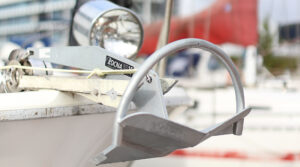
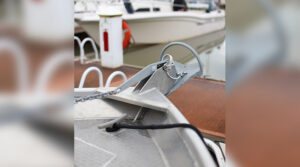
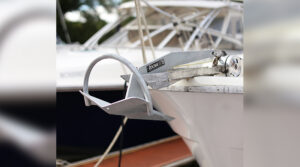
Modern anchor discussions today increasingly focus on how geometry, weight distribution, roll stability, and penetration angles affect performance underwater. Roll-bar assisted designs, concave flukes, chisel-style tips, and self-righting geometry have become common features among newer-generation anchors designed to improve consistent setting and reduce the likelihood of dragging.
Tracy and Kellogg explained that much of modern anchor development has centered around improving consistency during the moments when anchoring systems are tested the hardest.
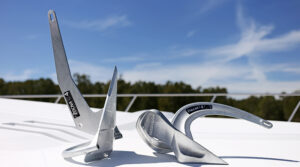
“Older plow and claw-style anchors were developed decades ago, and while they worked, they could be slow to set and sometimes inconsistent when conditions changed,” they explained. “Modern anchor design focuses more on setting quickly, burying deeply, and then being able to reset quickly if the wind or current changes direction. That difference becomes especially important during nighttime wind shifts or tide changes because that is when anchoring systems are truly tested.”
Rocna’s own design philosophy centers heavily on achieving fast penetration and reliable orientation on the seabed.
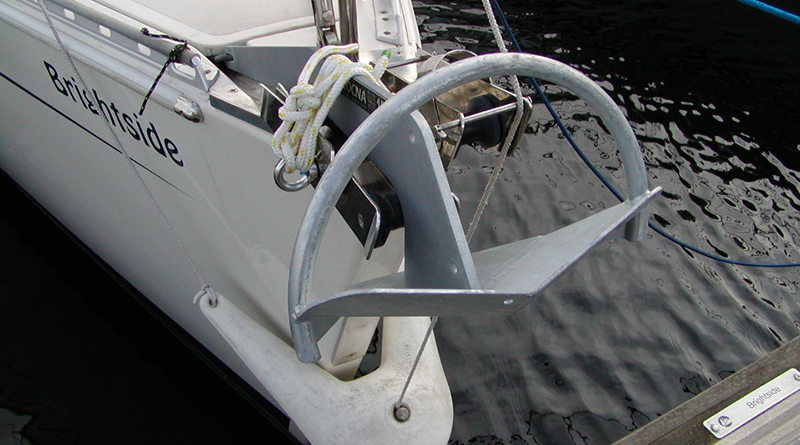
“The concave fluke is designed to dig deep and bury rather than skim along the surface,” Tracy and Kellogg explained. “The roll bar, or in the case of the Vulcan series the specifically designed shank geometry, helps the anchor orient itself correctly as it lands so the fluke consistently presents itself to the seabed instead of relying on luck.”
They added that penetration speed becomes especially important in harder bottom conditions or areas with kelp.
“The weighted toe is designed to penetrate quickly, which is extremely important in harder bottoms and kelp where slower anchors can struggle to get established,” they said. “The entire goal is to create an anchor that sets quickly and holds consistently across the kinds of bottoms cruisers actually encounter.”
At the same time, boaters continue facing practical questions about anchor selection that extend far beyond brand preference alone.
Anchor sizing, chain length, scope ratio, bow roller compatibility, and overall vessel weight all play major roles in anchoring performance. Improper setup, insufficient scope, or poorly matched anchor configurations can compromise even high-performing designs.
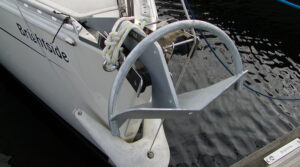
According to Tracy and Kellogg, one of the biggest mistakes boaters make is assuming anchor weight alone guarantees safety.
“The most common mistake is selecting an anchor strictly by weight,” they explained. “Heavier may feel safer psychologically, but holding power comes from design and from achieving a proper set, not simply from mass.”
They also noted that many boaters unintentionally rush through the anchoring process itself.
“People often drop the anchor, let out a little rode, and assume they are done,” they said. “But a proper set takes time. You need adequate scope, and then you need to slowly back down on the anchor to allow it to properly bury itself. We always recommend confirming the set by backing down with around a quarter throttle to make sure there is no slipping.”
Scope, they emphasized, continues to be one of the most important and misunderstood elements of anchoring.
“A good working range is generally around 5:1 to 7:1 scope, measured from the bow rather than the waterline,” Tracy and Kellogg explained. “Shortening scope changes the angle of pull and quietly reduces holding power. In crowded anchorages, boaters often shorten scope for swing room without fully realizing the tradeoff they are making.”
While shorter scope may work temporarily during daytime raft-ups or sandbar gatherings, they stressed that overnight anchoring requires a different mindset.
“That may work fine for a short daytime anchorage when people remain aboard and conditions stay calm,” they said. “But for overnight anchoring, you really want to size and set your system for the conditions you could experience later, not simply for the calm weather you have when you first arrive.”
Recognizing whether an anchor has actually set properly is another skill experienced boaters develop over time.
“The clearest sign of dragging is movement against fixed landmarks on shore,” Tracy and Kellogg explained. “If your position keeps changing relative to the shoreline, then you are moving. During the setting process, an anchor that bumps or shudders through the rode instead of coming to a firm stop usually has not fully dug in yet.”
They described the feeling of a properly set anchor as something experienced boaters quickly learn to recognize.
“When an anchor is fully set, there is usually a very solid and unmistakable stop,” they said. “Ideally, you should be able to hold your vessel’s position relative to a fixed point on shore while backing down at roughly 1,500 to 2,000 rpm. Once you shift into neutral, the boat will slowly move forward slightly as the weight of the chain settles lower into the water column.”
As larger center consoles, cruising boats, and offshore-capable vessels continue gaining popularity, anchoring systems increasingly are being designed to accommodate more complex bow layouts and modern vessel configurations.
That evolution led Rocna to later develop its Vulcan series, which was designed specifically for boats where traditional roll-bar anchors may not fit well.
“Customers loved the holding performance of the original Rocna, but not every bow configuration could accommodate the roll bar,” Tracy and Kellogg explained. “That led Peter Smith to develop the Vulcan, which self-rights using fluke geometry instead of relying on a roll bar.”
For many cruisers, however, the true value of an anchoring system only reveals itself during difficult conditions.
According to Tracy and Kellogg, the feedback that stands out most often comes after the kinds of nights boaters never forget.
“The stories that stay with people are almost always the bad nights,” they said. “The unexpected blow, the crowded anchorage where other boats began dragging while yours remained secure. We have heard stories from cruisers who ended up helping neighboring boats or even holding multiple vessels off the rocks because their anchor continued holding through the storm.”
At the same time, they noted that many of the most meaningful comments they hear are often quieter and simpler.
“We hear from people all the time who simply say they sleep better at anchor now,” they said. “At the end of the day, that peace of mind is really the whole point.”
As summer cruising activity continues increasing along the coast, understanding anchoring systems is becoming less about convenience and more about seamanship.
For boaters planning overnight stays this season, Tracy and Kellogg emphasized that confidence at anchor ultimately comes from combining good equipment with good habits.
“Set the anchor properly every single time,” they said. “Use enough scope, back down slowly, and confirm the set before you relax. Know what kind of bottom you are anchoring over, pay attention to changing conditions, and make sure the entire system — anchor, chain, rode, and connections — works together properly.”
They also stressed that boaters should think about anchoring systems as complete systems rather than focusing on any single component.
“One of the biggest misconceptions is that holding power comes down to weight alone,” they said. “It really comes down to the entire system working together properly, because the weakest link is ultimately what determines how the night goes.”
From overnight stays at Catalina Island to coastal cruising and offshore expeditions, experienced boaters often agree on one thing: confidence at anchor starts long before the hook ever touches the bottom.
For more information on Rocna, please visit https://rocna.com/.