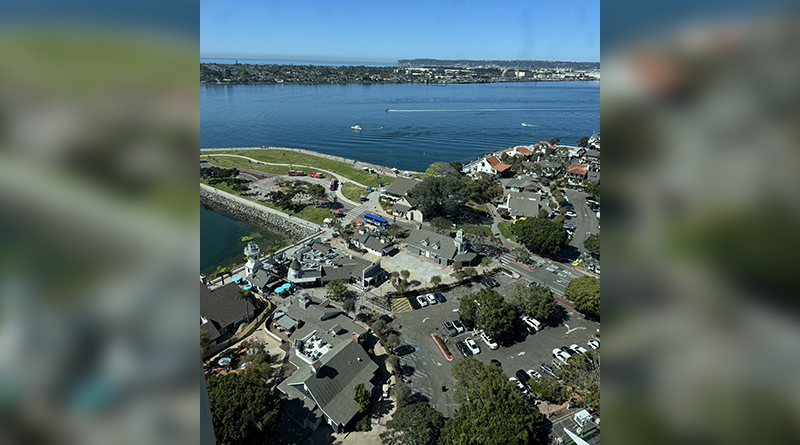
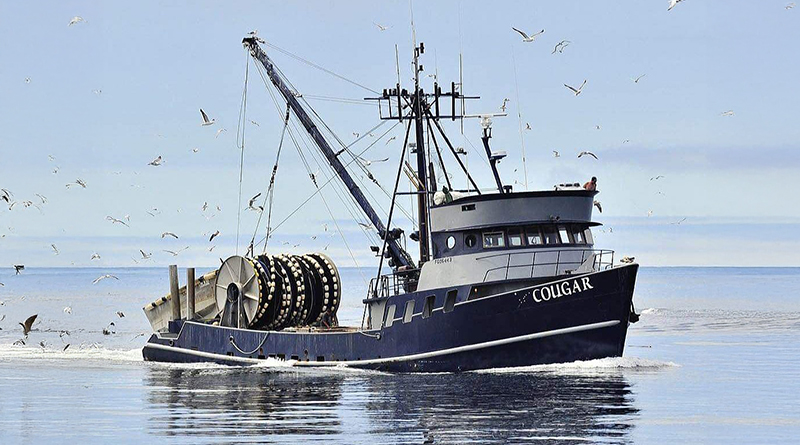
John Steinbeck’s legendary fishing boat, Western Flyer, is set to dock in San Diego this spring, offering visitors a rare opportunity to step aboard a vessel that played a key role in both literary and scientific history. On March 26, 2025, the Maritime Museum of San Diego will host the fully restored boat for one day, inviting guests to explore its past and discover how it continues to inspire marine research and conservation efforts today.
Credit: Western Flyer Foundation.
Built in 1937, the Western Flyer was originally a sardine seiner, a common workboat along the California coast. But in 1940, it became something far greater when Steinbeck and his close friend, marine biologist Ed Ricketts, chartered it for an expedition through the Gulf of California, known as the Sea of Cortez. At the time, Steinbeck was already an acclaimed author, known for The Grapes of Wrath and Of Mice and Men, yet he had another deep passion beyond storytelling — fishing and the sea. His fascination with the ocean was nurtured by Ricketts, a scientist whose research on marine ecosystems was groundbreaking. Their journey aboard the Western Flyer was as much an intellectual exploration as it was an adventure, blending marine biology, philosophical musings, and raw discovery.
Credit: Western Flyer Foundation.
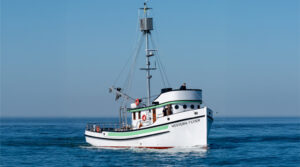
According to Western Flyer Foundation Chair Tom Keffer, “Ironically, the 50 years of neglect worked to the Flyer’s advantage: she may have been rotten, but she was original. Not much had been modified through the years. The easy approach would have been to demolish, then rebuild. However, because so much was original, the boat was taken apart piece-by-piece, each part measured, then put back in place. In the end, almost everything in the hull had to be replaced, but the boat ended up faithful to her original shape.”
The expedition resulted in Sea of Cortez: A Leisurely Journal of Travel and Research, a book that documented the marine species they encountered and the human communities they met along the way. More than just a scientific record, the book became one of the first public calls for conservation, emphasizing the importance of preserving ocean ecosystems long before environmental awareness became mainstream. Over the years, it has inspired generations of marine biologists, students, and nature lovers, cementing its place in both literary and ecological history.
While the book’s influence endured, the boat itself nearly vanished. After years of use as a commercial fishing vessel, the Western Flyer disappeared from public attention, passing through multiple owners and even sinking twice. At one point, it was destined to be cut into pieces and turned into a tourist attraction in Salinas, CA. But thanks to the dedication of the Western Flyer Foundation, the vessel was rescued and meticulously restored, returning it to its former glory. Now repurposed as a floating classroom, it continues its mission of exploration, engaging researchers, students, and conservationists in the study of marine environments.
The Maritime Museum of San Diego is one of the first stops on the Western Flyer’s commemorative voyage. During its visit, the boat will serve as an interactive experience for museumgoers, who will have the chance to tour its decks and learn about the journey that forever shaped Steinbeck’s writing and Ricketts’ scientific contributions. The Western Flyer Foundation plans to retrace key locations from the original expedition, revisiting intertidal research sites and collaborating with modern scientists to continue the study of ocean life along the Pacific coast.
The Maritime Museum of San Diego is dedicated to celebrating our region’s rich maritime heritage in the Pacific world and beyond. Dr. Connett Brophy, President and CEO of the Maritime Museum of San Diego adds “Western Flyer’s restoration is an exceptional example of the power of historic vessels to connect audiences with the sea through not only an amazing example of a Monterey sardine seiner, but also through the story of its service as platform to one of the most impactful expeditions of the 20th century. We believe visitors will be inspired to support ocean conservation and education when they visit the Western Flyer and reflect on the invaluable contributions Steinbeck and Ricketts made in bringing ocean science to a broad audience. We are honored to host Western Flyer and encourage everyone to take the opportunity to visit her at the Maritime Museum of San Diego!”
Maritime Museum of San Diego docent volunteers will be providing docent-led tours of the Western Flyer on Wednesday, March 26, 2025, from 10:00 a.m. to 4:00 p.m., to visitors purchasing general admission. This provides an opportunity for guests to learn more about Western Flyer and step aboard for a brief tour of the floating classroom dockside at the museum. General admission tickets provide freedom for guests to spend time before or after the visit to Western Flyer to enjoy a self-guided tour of the historic fleet of ships and fascinating below-deck exhibits representing 500 years of seafaring history found aboard Star of India, H.M.S. Surprise, the USS Dolphin submarine, Victorian-era steam ferryboat Berkeley, and more.
According to Dr. Keffer, “Western Flyer is equipped with several oceanographic tools that have been designed to be accessible to non-professionals.”
Specifically:
- A Remotely Operated Vehicle (ROV) with a simple controller that can be driven by a student.
- A flow-through system that continuously monitors temperature, salinity, oxygen, and pH, all displayed graphically.
- A CTD package that measures similar variables but can be deployed over the side. Displays are real-time.
- An echosounder that images subsurface aquatic life.
- An advanced meteorological package. This one requires a bit more skill to extract out data, but it offers very accurate measurements of wind speed, air temperature, radiation, humidity, and CO2.
For anyone interested in literature, marine science, or history, this is a unique opportunity to step aboard the very vessel that helped shape modern ecological thought and brought one of America’s greatest writers closer to the sea he loved.