By Katherine Clements, Reporting Live from the Bait Tank with Contributions from “Steve, the Anchovy.”
Somewhere beneath the calm waters off the Southern California coastline, an anchovy named Steve was having a pretty decent Tuesday.
The current was mellow. The school was tight. Life mostly consisted of swimming in circles, avoiding larger fish, and trying not to think too hard about the existential reality of being born approximately three inches long in the Pacific Ocean food chain.
Then came the net.
“It happened fast,” Steve recalled moments before being violently vacuumed into a bait receiver with 4,000 of his closest friends — not mention several cousins he didn’t particularly care for.
One minute they were free. The next, they were living shoulder-to-shoulder inside a floating bait barge while sea lions circled outside like unpaid security guards with anger issues.
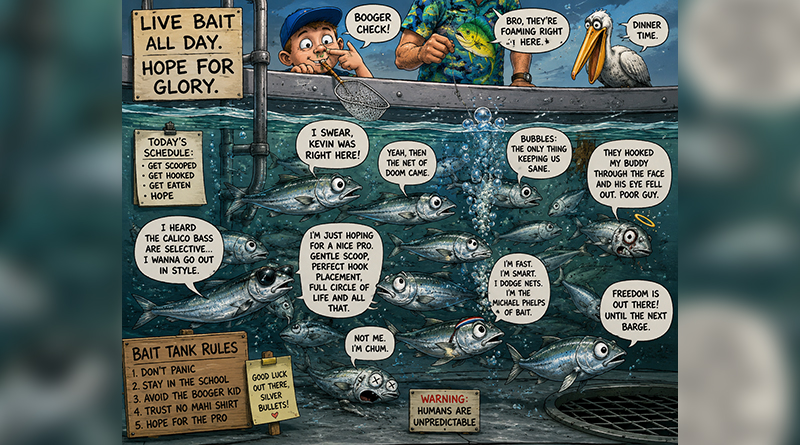
“It’s stressful in there,” said another anchovy, who asked to remain anonymous for fear of retaliation from the pelicans. “You’re packed into a tank with thousands of fish, everyone’s panicking. And every few hours, this giant shadow appears overhead and suddenly your buddy Kevin disappears into a scoop net.”
For many baitfish, the barge is merely a temporary holding facility before the next phase of their journey begins: sportboat selection.
The lucky ones get transferred into pristine, oxygenated bait tanks aboard professionally maintained sportfishing vessels. Others end up in what survivors describe only as “the froth chamber,” where overcrowding, hot water, and one guy washing sunscreen off his hands directly into the tank creates what marine biologists would likely classify as “a situation.”
But even then, hope remains alive inside the bait well.
Every anchovy knows the legends.
The stories of “Frankie, the Sardine,” who swam perfectly straight and got inhaled by a 42-pound yellowtail in front of cheering passengers. The tale of “Linda,” who earned respect after staying pinned on a hook through three casts, a sea lion attack, and an accidental backlash from a first-time conventional reel user.
“To die with purpose,” whispered one sardine dramatically from the corner of the tank. “That’s all any of us want.”
Unfortunately, not every baitfish gets a heroic ending.
Some are scooped up by children who immediately squeeze them with the grip strength of a hydraulic press while yelling, “DAD LOOK IT’S STILL MOVING.”
Others endure far darker fates.
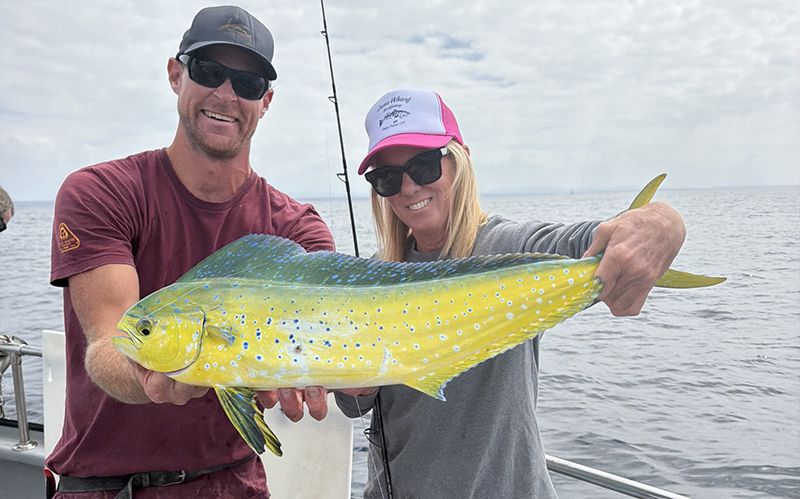
Perhaps nowhere is the threat more feared than from the man wearing the matching mahi-mahi print sunshirt and boardshort combo who says things like, “BRO THEY’RE FOAMING RIGHT HERE,” while repeatedly casting directly into the boat prop wash.
Baitfish know this man.
They fear this man.
“He hooked my buddy straight through the face and one of his eyes actually fell out,” said one horrified anchovy before quietly drifting into the corner of the tank. “After he launched him away from the boat…his face was so torn apart… he flew off the hook and floated on the surface before a bird got him. Who does that to someone?”
Improper hook placement remains one of the leading causes of premature bait burnout, or PBB, according to absolutely nobody. That’s because no one’s ever asked the baitfish.
Some are nose-hooked incorrectly. Some are collar-hooked with the delicacy of roofing equipment. Others are dropped onto scorching decks where they spend their final moments hearing someone yell, “Hey, does anybody want this dead one?”
Then there are the chum casualties.
No ceremony. No glory. Just a handful of anonymous bait launched into the ocean like wet rice at a wedding while anglers scream “GET THEM GOING! WAKE THEM UP!”
But among the chaos, a few elite athletes emerge.
The veteran baits.
The tank dodgers.
The silver bullets who evade the net all day through speed, awareness, and what experts can only assume is advanced tactical training.
These are the Michael Jordans of the receiver pen. The Tom Bradys of the bait scoop. The fish who instinctively know exactly where the corner of the tank net can’t quite reach.
“They’re special,” said one deckhand quietly while staring into the bait tank after his 19th failed scoop attempt. “Honestly, at this point, I kind of want him to make it.”
And sometimes, against all odds, they do.
At the end of the day, after the rods are rinsed and the passengers wander off debating whether calico bass count as “real bass,” the remaining survivors are released back into the ocean.
A sudden rush of water. One final swirl through the plumbing system. Then freedom.
The remaining bait explode back into the sea like tiny silver prison escapees, reunited with open water once again.
For a moment, they’re victorious.
Free.
Alive.
Untouchable.
And then approximately six days later they’re recaptured by another bait receiver and the entire cycle begins again.
NOTE: And perhaps that’s the real lesson hidden beneath the chaos of the bait scoop, the overcrowded hand wells, and the guy in the matching mahi-mahi outfit improperly nose-hooking sardines with the precision of a forklift operator. Healthy bait matters. From water circulation and tank design to handling practices and bait survival, a quality bait tank can make all the difference between lively, hard-swimming bait and complete aquatic disaster.