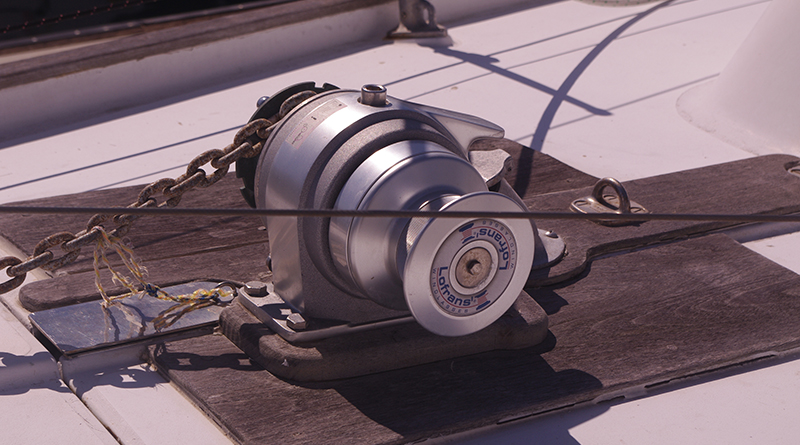
Every ocean-going vessel needs to have a dependable anchor windlass to take the hard work out of deploying and retrieving the anchor. We can choose between a traditional manual windlass or a modern electric model capable of handling extreme stresses in every type of anchoring situation.
Manual Windlasses
Despite what you may have heard about manual windlasses, operating one doesn’t require Herculean strength. Quite the contrary, a manual windlass is designed to make the job of raising the anchor easy, eliminating the strain you would otherwise endure by pulling up the hook and chain with your bare hands.
Horizontal manual windlasses are designed to reduce the job of weighing anchor to a straightforward, routine procedure without the aid of a hydraulic pump or an electric motor. Internal reduction gearing makes it possible for an adult with average strength to pull, depending on the model, up to several hundred pounds of ground tackle in a stiff breeze.
With rare exception, the manual windlass mounted on the bow of a cruising sailboat has a horizontal drive shaft with a wildcat and a rope capstan, each mounted on either side of the unit’s gear box. Virtually all of these units have the wildcat mounted on the starboard side directly abaft the bow roller, permitting the chain to make a solid connection with the teeth of the wildcat.
When Simpson Lawrence sold out to Lewmar in 2000, one of the most lamentable casualties of the transaction was the complete closure of the Simpson Lawrence line of manual windlasses. However, parts for the 510, 555 and Anchorman windlasses can be found on the Internet, and here and there you might even find a brand-new 510 or 555 still in the original box. Fortunately, there is a thriving cottage industry dedicated to producing replacement parts for the old Simpson Lawrence machines.
Several American and European manufacturers continue to produce manual windlasses along with their electric or hydraulic models. One of the most frequently mentioned in dockside conversation is the Lofrans Royal, built in Monza, Italy. Available in anodized aluminum or white enamel and very reasonably priced, this one-speed, double-action horizontal windlass uses a bevel gear drive system to pull up to 430 pounds and is recommended for vessels ranging from 26 to 39 feet LOA. The Royal weighs 22 pounds, slightly less than the SL 510, and its hot-forged bronze wildcat accepts 1/4”-, 5/16”- and 3/8”-proof coil, BBB and high-test chain.
A windlass appearing almost identical to the Lofrans Royal is the Ursus horizontal windlass, produced by Vetus of the UK. Built with roughly the same dimensions and mechanical operating system as the Lofrans Royal, the Ursus sells for roughly a grand and will probably last as long as the Lofrans. The wildcat accepts 5/16-proof coil and BBB chain.
R.C. Plath of Portland, Oregon, produces its Model 9A windlass, which is cast in high-tensile, marine-grade aluminum, yielding a strong yet light machine based on the heavier bronze Model 9B. The Model 9A weighs 28 pounds with combination capstan and wildcat, and the Model 9B, also available in chrome plate with the same configuration, weighs a hefty 45 pounds. Both the 9A and 9B are known to handle up to 800 pounds, and they have served well for many years on the decks of sailing vessels in excess of 35 feet LOA. The double-acting horizontal system is based on a gear drive similar to the SL 555 and therefore can last for decades with little servicing. Both the 9A and 9B accept 1/4”, 5/16” and 3/8” BBB chain and feature a cone clutch to hold the wildcat in place while retrieving the anchor.
Another fine device is the Muir Easyweigh 500 vertical windlass, which comes in several options. You can choose a pure chain wildcat set-up, a chain wildcat with rope capstan or either of the two with or without a rope hawser. Similar to the SL Anchorman, the Easyweigh 500 is operated with a standard winch handle, which means you can increase leverage simply by using a longer handle.
Electric Windlasses
A combination of factors continues to feed the growing popularity of electric windlasses on modern cruising boats. Bigger vessels, bigger battery banks and an aging boater population have conspired to make the electric windlass de rigueur on modern, high-tech cruising yachts measuring as little as 25 feet.
If you’re outfitting a large yacht between roughly 45 to 60 feet on deck, an electric windlass is probably the best choice. For very large passenger vessels, a hydraulic system, such as the series built by AI Crane, is the obvious choice but outside the range of a typical cruising vessel with only two to four crew members.
Just like manual windlasses, electric windlasses come in two species: vertical and horizontal. Vertical windlasses generally occupy less space than a wider horizontal windlass, but on a large yacht, the main difference essentially boils down to the owner’s preference.
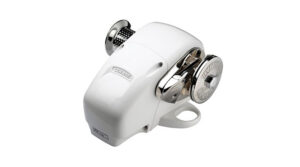
Many cruisers prefer the profile of a horizontal electric windlass, dividing the wildcat and rope capstan to either side of the motor housing. Ideal and Lofrans offer high-quality horizontal electric windlasses for mid-range cruising yachts, and both offer manual override. Very large yachts, measuring well over 70 feet, also use horizontal windlasses, such as those from Ideal Windlass.
Lewmar horizontal electric windlasses are generally designed for small to medium-sized boats and are intended for 1/4” to 5/16” chain with 1/2” nylon rode, the perfect package for weekend fishing trips to local coastal islands. However, these windlasses are not designed for total immersion in breaking head seas or for long exposure to the hot, humid conditions prevalent in tropical cruising.
Most of the electric windlasses being sold today are of the vertical type. They’re less complicated to manufacture, take up less deck space, and are easier to operate. A vertical combination of drum and wildcat, available on large models, allows you to move from nylon rode to chain more easily than by having to switch from one side of the windlass to the other.
Some of the most popular vertical windlasses in this class are Lewmar’s V and CPX series and Maxwell’s RC and VWC series vertical windlasses, not only because of their competitive prices but also their reputation for durability and ease of use. The profile of the Lewmar V series wildcat-only windlasses is so compact they look like small foredeck ornaments. Sleek and understated, the Lewmar V’s profile belies its pulling power, ranging from 1,000 pounds for the V1 wildcat to 3,190 pounds for the V5 wildcat/drum combination.
Maxwell offers several low-profile, capstan-only units in its VWC series. Known for their elegant, sculpted appearance, the VWC series windlasses feature a built-in hawse pipe and chain stripper. Both the RC and WVC models include a reversing solenoid, circuit breaker panel, and in case of power loss or mechanical failure, an emergency handle for manual override.
The windlass we choose for our vessel will have an outsized influence on the success of future voyages. Sailing across an ocean and dropping the hook off a tropical isle fills us with elation. We hope our choice of windlass enhances those feelings as we weigh anchor and move on to our next stop in paradise.