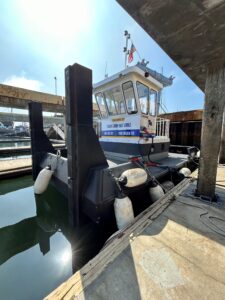
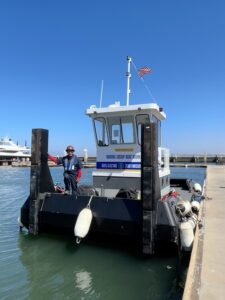
Marine Group Boat Works (MGBW), a family-owned shipyard based in Chula Vista, has taken a significant step toward sustainable maritime innovation with the successful electrification of its diesel-powered harbor tug, MARCO V. This milestone marks the first time a truckable tug has been retrofitted with a fully integrated electric propulsion system in San Diego.
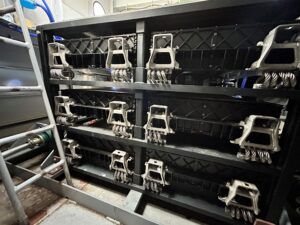
Used primarily for towing vessels to and from boat lift piers and for transporting crew members, MARCO V now operates on a zero-emission electric system that delivers horsepower and torque comparable to traditional diesel engines. The tug runs approximately 80 hours per month, and with its new system, each hour logged now avoids the environmental impact of diesel emissions. According to Todd Roberts, President of Marine Group Boat Works, the vessel is powered by two Torqeedo Deep Blue 100i direct drive motors paired with six Torqeedo Deep Blue 80 kWh batteries. These components were carefully selected through rigorous engineering evaluations to ensure the vessel could meet operational demands without compromise.
MARCO V relies on a total of 480 kWh of battery capacity, which connects directly to the boatyard’s standard shore power infrastructure. On a full charge, the tug can operate continuously for up to eight hours—more than enough to tackle a full day’s work around San Diego Bay. This efficiency allows the vessel to maintain its daily schedule while eliminating the need for fossil fuel refueling.
“Sustainability is truly at the forefront of our operations. We don’t just meet environmental regulations, we exceed them,” said Roberts. The complex conversion required more than 2,000 hours of labor by the shipyard’s skilled workforce, with close coordination between MGBW engineers, mechanics, and component manufacturers.
The shift to electric propulsion not only reduces emissions but also simplifies operations. “Torqeedo’s Deep Blue system is extremely user-friendly,” Roberts noted. “Its intuitive controls and the vessel’s maneuverability make it easy to run—even for entry-level operators.” Additionally, the system requires only basic routine maintenance, which can be performed without taking the vessel out of service, streamlining upkeep for crews and technicians alike.
Retrofitting an existing vessel rather than building new was not only cost-effective but also strategic. According to Roberts, the project serves as a real-life demonstration platform for an off-the-shelf electric system that could be readily adapted for use in other workboats, including passenger vessels and tugboats. Roberts added that MGBW conducted a thorough cost-benefit analysis before beginning the conversion and determined that repowering MARCO V was significantly more affordable than commissioning a new electric tug. “You’re essentially getting the same performance without the environmental impact,” he emphasized.
That financial strategy was further supported by environmental grants. MARCO V falls under the California Air Resources Board’s (CARB) Commercial Harbor Craft regulations and qualified for funding from the Volkswagen Mitigation Trust. The project received approximately $470,000 toward its cost, reinforcing California’s push for cleaner marine transportation and helping offset the investment needed to convert the tug.
MGBW now offers electrification repower services to outside clients and invites industry professionals to experience MARCO V firsthand. “We’ve shown that this kind of electrification can be done, and now we’re ready to help others do it, too,” said Roberts. Since the tug went into service, the maritime community has expressed growing interest in similar eco-friendly retrofits. Roberts noted that MGBW hopes to pursue additional grant opportunities with CARB and other partners as more vessel owners explore clean-energy alternatives.
This achievement places MGBW alongside other regional pioneers like Crowley Maritime and the Port of San Diego, who launched the nation’s first fully electric tug, eWolf, in 2024. Both efforts support CARB’s goal of transitioning all commercial harbor craft in California to zero-emission operations by 2035. Roberts stressed that MARCO V proves this transition isn’t just theoretical—it’s practical and already underway. “The biggest takeaway from this project is that electrification is possible. MARCO V is proof that cleaner operations in the maritime industry can be achieved.”
Electrification offers numerous advantages for both boaters and the environment. Reduced emissions contribute to cleaner air and water, especially in high-traffic ports. Electric systems also tend to produce less noise and vibration, which can enhance safety, crew comfort, and even marine life preservation. With maintenance costs generally lower than those of internal combustion engines, electric propulsion offers an appealing long-term value proposition for vessel owners.
MGBW has long been a leader in innovation and stewardship. More than 85% of its fleet of work vehicles and forklifts already runs on electricity. Later this year, the company is scheduled to install a 750-kilowatt solar power system to support vessel construction activities, making it the only solar-powered boatbuilder in the state of California. These advances reflect a broader modernization effort that keeps environmental sustainability central to the company’s operational philosophy.
The MARCO V’s name carries as much meaning as its mission. The tug was named in honor of Marco Vega, a dedicated MGBW employee who has overseen the shipyard’s painting operations for more than 34 years. His name now sails as a symbol of progress and loyalty, bridging the company’s legacy with its forward-looking ambitions. “Naming the tug after Marco was an easy decision,” said Roberts. “His dedication and impact on the company’s success made this a meaningful way to celebrate his legacy.”
Marine Group Boat Works operates two full-service waterfront facilities: its primary location in Chula Vista and a sister yard in San Jose del Cabo, Mexico. The Chula Vista facility spans over one million square feet, offering 2,000 feet of dockage, an 820-ton lift, and state-of-the-art workshops and cranes. The Los Cabos location includes over 300,000 square feet of land and water and multiple travel lifts up to 150 tons.
Between the two locations, MGBW employs more than 210 professionals, including ABS-certified welders, shipfitters, electricians, pipefitters, painters, and mechanics. Their combined expertise enables the company to serve a wide range of vessels, from commercial tugs and military craft to private yachts and megayachts.
Formerly known as South Bay Boat Yard, MGBW began in the 1980s and has since grown into San Diego’s largest boat yard. In 2006, it invested $6.5 million into redeveloping its facility and upgrading equipment to serve larger vessels. Today, MGBW is recognized for its technical skill, environmental responsibility, and commitment to supporting the maritime community.
As the marine industry looks toward cleaner, more efficient futures, companies like Marine Group Boat Works are proving that practical solutions are already within reach. Their electric tug project isn’t just a technological success—it’s a blueprint for how the industry can evolve with integrity, innovation, and purpose.
For more information about Marine Group Boat Works, visit marinegroupboatworks.com.