image 1 (1)

Multimeters for Electrical Maintenance

You and your family have prepared for a boat outing to Catalina Island for months. On the day of your intended departure, you turn on the battery selector switch, put the key in the ignition, turn the key and… nothing happens. You shake your head in wonder: the battery is still fairly new, and the battery cables are connected to both the engine starter and the house switch panel. So, with everything in sight appearing to be completely in order, what could possibly be the problem?

In another scenario, the engine starts, but some of the onboard electrical systems are not functioning. The running lights work, but the chartplotter is dead. Have you checked the wire connections at the chartplotter and the switch panel? If so, do you have a way to verify DC current is passing from the panel to the chartplotter? Perhaps surprisingly, these scenarios are played out daily at every marina on the planet. Batteries are drained of power, cables and wires leading to the switch panel rust and loosen, and so on.

Arriving safely at our next port or anchorage depends on a properly functioning engine, along with electronic navigation and communication systems ready at the flip of a switch. And maintaining those systems in tip-top condition requires dependable test equipment, most notably a high-quality multimeter.

Surprisingly, many cruising vessels carry no more than a current tester consisting of two wires and a sealed lightbulb to demonstrate the presence of current—how much is anyone’s guess. Some skippers on shoestring budgets rely on a small, inexpensive battery tester with color bands: green for full amperage or voltage, yellow for barely adequate current and red as an indicator to replace the battery.

Properly prepared skippers, on the other hand, equip their vessels with durable, drop-resistant, water-resistant, highly accurate multimeters suitable for the offshore sailing yacht. With this indispensable tool, you can measure precise battery voltage levels, alternator charging power, and current across circuitry within your electronic communications, deck and cabin lighting and navigation systems.

A high-quality multimeter is designed to measure amperage, voltage and resistance (ohms) precisely. Until recently, the Fluke series of electrical testing units, known for their yellow rubber jackets, were virtually the only choice for the offshore sailor. While the Fluke line of multitesters is still an industry leader, there are numerous other well-constructed multitesters that can stand up to the demands of ocean cruising, and most are well within the budget of the cost-conscious cruiser.

For budget-minded boaters, the Cen-Tech 9 Function Digital Multimeter, available at Harbor Freight for only $20, serves as a dependable digital tester with LED display for measuring amperage, voltage and resistance. Although the Cen-Tech lacks some of the features of pricier makes and models, this device will serve well for virtually all of the routine electrical tests you are likely to conduct on your vessel’s battery banks and both DC and AC circuitry.

The Ancor 8-Function Digital Multimeter, available at West Marine and other chandleries, is a well-built yet affordable tool with an LED screen and the standard two leads for electrical measurement. The Ancor 12-Function Wrap Around Meter with RMS (root mean square) measures electrical activity without the need of wire leads, and its backlit LED screen permits reading in poorly lit corners of your vessel, such as the engine and battery compartments.

The Sperry DM6650T True RMS Digital Multimeter is a rugged, professional electrical tester capable of reading current up to 10 amps AC/DC. The unit is water resistant and drop-proof to 10 feet. At roughly $200, the DM6650T is not exactly cheap but still quite reasonably priced for the quality it offers.

The Extech EX505 Heavy Duty, Autoranging Digital Multimeter is an industrial, waterproof, drop-resistant device capable of measuring AC/DC voltage (1000 volts), current (10 amps), resistance (40,000 ohms) and capacitance (100 microFarads). Additionally, this unit includes a Type K temperature probe which measures from 4 to 1,382 degrees F.

Along with the temperature probe and standard pair of test leads, the EX505 comes with a magnetic hanging strap, carrying case and 9-volt battery. Not a bad choice, especially when you consider a price tag of around $100.

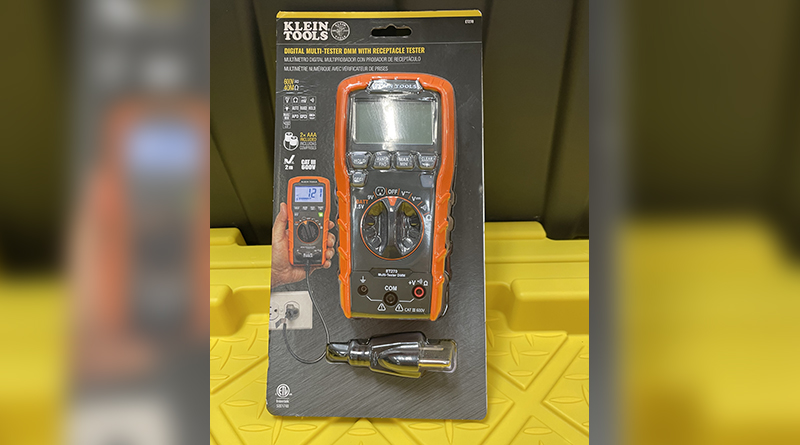
Another good value is the Klein ET270 AC/DC Voltage/Continuity Tester, which measures up to 600 volts AC and may be used to test the proper functioning of GFCI-protected circuits and electrical outlets. On my 1966 Cal 30 Saltaire, AC electrical outlets are GFCI-protected to protect both vessel and crew—I recommend you ensure the same for your floating palace.

An interesting feature of the ET250 is its test connections, which are inserted into the base of the unit rather than the face, permitting easier storage in a tightly packed toolbox. The ET250 is drop-proof to 9.8 feet and rated IP53 dust/water resistant. At roughly 50 bucks, this device offers a lot for a very low price.

And, of course, we can choose from the venerable line of Fluke multimeters, which are generally regarded among professional marine electricians as top of the line. The Fluke 28II is fully waterproof and impact resistant up to a 10-foot drop, ideally suited for the offshore yacht. It also floats when stored in its yellow rubber holster. The Fluke 28II measures up to 1,000 volts AC and DC, and up to 10 amps (20 amps for 30 seconds).

Running on three AA batteries, the Fluke 28II boasts “backlit keypad buttons, large display digits and two-level bright white display backlighting for easy visibility in low-lit areas.” The unit sells for about $600, which is significantly higher than other devices in its class but well worth the expense if you want the ultimate in dependability.

Adding a high-quality, water-resistant, dependable multimeter to your boat’s toolbox will equip you to test battery charge, wire connections and electronic equipment throughout your vessel, helping to ensure safe voyages. Find a multimeter that fits your needs and budget, and you will sail with greater confidence in the electrical soundness and safety of your vessel.