



For years you’ve dreamed of throwing off your boat’s dock lines and aiming for the horizon on a quest to cross oceans and discover the world on your own terms from the deck of your own floating castle. Many of us have lived that dream, sailing around the world, visiting different cultures, sampling exotic foods and forming lifelong friendships.
You too can enjoy this fascinating yet challenging way of life, but first you need a vessel capable of crossing oceans in virtually all kinds of weather, from a flat calm to an extended full gale with 20-foot breaking seas. While you peruse ocean charts and country websites, you also need to prepare your vessel for this challenging voyage.
Sails and Rigging
Like most offshore sailors, you’re probably electing to use a sailing vessel rather than a diesel-powered trawler. A sailboat uses very little fuel and can be rigged to steer itself for days on end with only minor adjustments to the steering.
Before setting sail, check the stainless steel rigging for signs of rust or broken wires. If you spot either, you’ll probably need to re-rig the entire vessel with new wire, ensuring it’s 316 stainless; 304 stainless is less expensive, but for an extended offshore voyage, you want the most rust-resistant rigging wire you can find. Dyneema carbon fiber cable is much lighter and stronger than stainless, and it’s not subject to corrosion. However, you should add the cost of new fittings for Dyneema before deciding to switch from stainless.
Also check for snags or wear in the double-braided, polyester sheath on running rigging, which includes halyards, jib sheets and the mainsail sheet. Serious wear obviously requires replacing the old line with new, high-quality cordage. New England Rope is popular among both coastal and offshore sailors, and you can find it in a wide range of colors and sizes at West Marine.
Communications
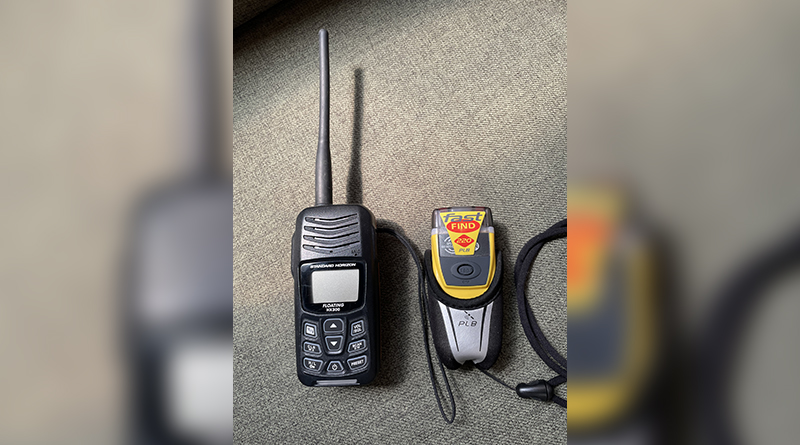
The range of electronic communication devices for inshore and offshore sailors can be a bit overwhelming, so let’s cut to the chase with the basic package: VHF/DSC/GPS/AIS permanent-mount radio, handheld VHF radio, personal locator beacon (PLB) and an emergency position-indicating radio beacon (EPIRB).
The full-service, permanent-mount VHF radio, such as the Standard Horizon GX2200 radio I carry on my Cal 30 sloop Saltaire, is able to send and receive VHF and DSC voice messages while providing GPS coordinates and receiving AIS warnings when AIS-equipped ships come within the range you select on the LED screen. While sailing east 20 miles south of San Miguel Island one night on my voyage back from Hawaii last spring, the AIS receiver woke me up with a loud scream three different times as cargo ships passed me on their voyage to Los Angeles Harbor. A brief call to each ship on Channel 16 allowed me to prevent a potentially life-threatening disaster.
A handheld VHF radio is also a must. While you’re out on deck or ashore away from your VHF base station, especially where cellular coverage is not available, a handheld VHF keeps you in touch with your crew and with other vessels in the anchorage.
For emergencies while underway, you should also have an EPIRB for the boat and a PLB attached to each personal flotation device (PFD) being worn outside the cabin. While sailing offshore, I carry a McMurdo GPS/PLB on my auto-inflate PFD whenever I step out to the cockpit.
I also highly recommend carrying a voice/text or text-only satellite phone, or “satphone,” which will not necessarily save lives but certainly offers some peace of mind while sailing hundreds of miles offshore. During the Hawaii trip, I communicated with my wife, Marilu, with my Garmin inReach Mini2 text-only satphone several times a day, boosting both of our spirits during the long passage.
Navigation
Today’s wide selection of electronic navigation equipment makes it easy even for sailors of humble means to cross oceans under sail. At the very least, you should have a GPS receiver and an adequate set of charts, along with parallel rules, dividers and a box of pencils to chart your course. Don’t laugh; these are still the tools of most offshore cruising sailors.
Inshore, it’s wise to have a chartplotter, which allows you to set a course and follow your progress, even at night, when the chart automatically lights up for easy reading. My Garmin 64cv chartplotter made it super easy to stay off the rocks while I was motoring around the northeast coast of Kauai at night last April. Garmin, Raymarine, Humminbird and Simrad are only a few of the makers of high-quality chartplotters on the market.
Spare Engine Parts
Carrying a set of essential spare parts for the engine is another obvious must. If you’re planning an extended cruise of six months or more, you should carry, at the very least, a plastic jug of oil and a filter for your next oil change. If you can’t find a proper oil disposal site onshore, store the old oil in a spare empty jug until you get back home to dispose of it at a designated oil collection site.
Also take along a new prefilter/water separator and secondary filter for the diesel fuel line. Diesel filters generally last a long time, but a sudden ingress of water or solids in the fuel line could necessitate a change of filters.
Food and Water
Selecting the right food items for the galley is always the most challenging yet most enjoyable part of preparing for an ocean voyage. And amazingly, you’ll be surprised to see how much time you spend devising new recipes, taking extra care to season and cook everything to perfection. While offshore, the most important and memorable part of each day is the evening meal.
If you catch a blue fin tuna or a mahi-mahi, you can grill it on the gas barbecue, prepare a delicious rice pilaf on the stove and pair it with a chilled sauvignon blanc or pinot grigio. On days when your lure fails to produce results, you can always rely on your store of canned and dry foods, such as the old standby, spaghetti with a can of sauce.
The basic rule for water and food on a cruising boat is to carry twice as much as you plan to use on each leg of your voyage. A lack of wind or a non-functioning engine, both of which are rather rare, can keep you adrift offshore much longer than you anticipate, so it’s essential to plan for the worst, as unlikely as it may seem.
Life Raft
Finally, we must always be prepared for the highly unlikely yet possible loss of our beloved cruising vessel while sailing offshore. Carrying a lifeboat, along with water, food rations and an EPIRB, will give the crew a strong chance of surviving and being rescued. There are numerous auto-inflate life rafts available for cruising vessels, and at least one, the Pudgy, also serves as both dinghy and life raft. You can choose one of two optional sail rigs for the solid-hull Pudgy, either a gaff rig or a square head rig.
The details involved in preparing vessel and crew for an ocean crossing are obviously far more extensive than the brief foregoing list. But by getting your vessel in proper order before casting off your dock lines, you will be rewarded with the greatest memories of your life. Fair winds!