To a sailor at sea, the fear of falling overboard is equaled only by the fear of being struck by a highly unlikely bolt of lightning at sea. Like a giant battery in the sky, the negative post on that wispy, amorphous blob of a cloud is always looking for the shortest path to ground, which in this case means the highly conductive saltwater on which you’re sailing — or the highest conductive point on your boat.
So there you are, sailing along, listening to Jimmy Buffett, blissfully unaware of the big cloud’s intentions as it aims its spear of lightning at the highest electrically charged point on your vessel, which we hope isn’t you or a fellow crew member. Fortunately, the odds of your being struck by lightning are slim, particularly on the West Coast.
However, farther down the coast of Mexico and Central America, lightning strikes are far more common in the tropical atmosphere. One night while I was sailing through the Bay of Panama many years ago, a bolt of lightning blew the VHF antenna off the masthead of my 1966 Cal 30 sloop, Saltaire. Amazingly, that was the only damage to my vessel.
As you may well imagine, the majority of boats hit by lightning are sailboats and for an obvious reason: an aluminum mast and its stainless steel wire rigging offer close points of contact from the cloud and a quick ground path through ocean water splashed on the deck and hull. If your deck shoes are soaked with saltwater while you’re ambling along a side deck, you could become a human light bulb for a tiny fraction of a second. Actually, in most cases where boats are hit by lightning, crew aren’t directly affected, and of those who are, roughly 90 percent survive.
Notwithstanding the low chance of being hit by lightning and the high survival rate of lightning attacks, it’s imperative that we as offshore sailors do everything possible to prevent damage in the event of a lightning strike. Fortunately, several manufacturers offer devices to protect our valuable onboard electronics, if not ourselves, from the ravages of lightning.
The first step in protecting your boat from lightning is bonding all thru-hulls with copper wire. This includes deck drains, standing rigging, windlass, bow roller, all bronze mushroom fittings for engine raw water intake and so on. The more dissipation surface you expose to a lightning strike, the less likely your vessel and electrical system are to incur serious damage.
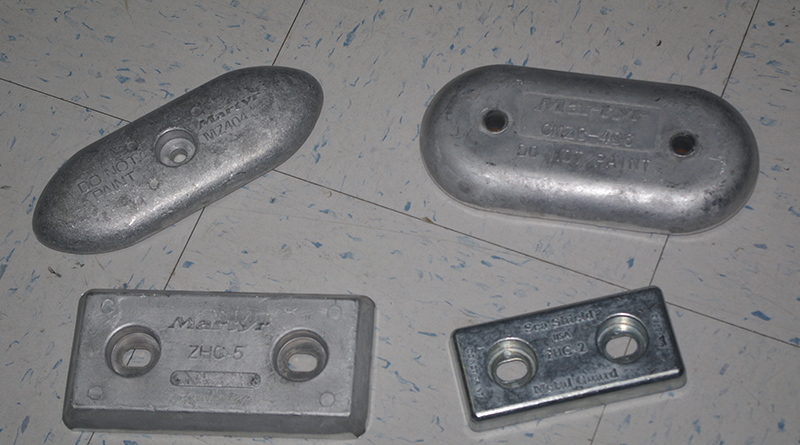
It’s also wise to install a grounding plate, or zinc anode, to the bottom of the hull and connect the heavy-gauge copper wire to a grounding plate bolt inside the vessel. Regardless of whatever other device you install to dissipate or absorb lightning energy, the traditional thru-hull grounding plate is still a necessary, inexpensive device designed to protect your vessel. Every time you haul out your vessel for bottom painting, be sure to exchange the worn-out chunk of zinc for a new one.
The traditional lightning protection device for boats is the old-fashioned lightning rod, which can still be found on the mastheads of many yachts. Forespar, L-Com and Rohn Products are some of the market leaders in this traditional form of lightning protection. Priced at under $100, even the humblest of sailors can enjoy a high degree of protection from lightning strikes on their vessels.
A more recent variation of the masthead rod is a lightning static dissipater, which looks like a metallic dust broom mounted upside down on a sailboat mast. As comical as they may look, those frizzy lightning dissipaters could save your onboard electronics and, if installed correctly, your life as well.
Mounted next to the masthead light, a dissipater acts first of all by being the highest point of contact for potential lightning. Because the thin wire strands are so thin and numerous, the surrounding air absorbs the electrical charge immediately, saving everything below that point.
You can find the Forespar Lightning Master for less than $200 online, and installation is fairly easy. Since the device is self-contained, it’s not connected to any cable leading down to a submerged lead or anywhere else. Installation involves little more than a small, stainless steel bracket on the masthead. The Lightning Master may also be mounted on the bridge of a large motorboat.
A more sophisticated device used to protect a boat’s electrical system and sensitive electronics is a microprocessor-controlled shunt, which immediately shorts out excess amperage, drawing the energy into itself and out to a large load where the electrical impulse dissipates when lightning strikes. By absorbing the huge surge of electricity in a fraction of a second, the shunt prevents current from reaching sensitive electrical and electronic equipment.
EMP Shield, named for “electromagnetic pulse,” is an industry leader in lightning control technology, manufacturing shunts for business, home and vehicle/vessel. The shunts are designed for specific applications and anticipated amperage levels, whether they are engine and generator power cables, radio and navigation systems, solar panels or other sensitive fixtures.
EMP Shield’s line of vehicle and vessel shunts include 12V/24V shunts to protect the majority of large systems on your vessel, while their inline VHF antenna shunts are small enough to be mounted anywhere along the antenna cable and tucked away neatly inside the mast or below decks.
For a device capable of protecting larger systems, consider one of EMP’s three-phase models designed to protect starter motors, generators and large battery banks. Incredibly, most of EMP Shield’s shunts are priced under $500, well within the budget of the humblest of offshore and coastal cruisers.
Protecting vessel, crew and sensitive onboard systems from lightning strikes will give you ease of mind while you are underway, particularly in tropical regions where lightning is common. Make sure your vessel’s thru-hulls and standing are bonded, and consider investing in a microprocessor-controlled shunt for added protection against lightning. Knowing your vessel is safe from lightning strike will give you ease of mind while underway or at anchor in lightning-prone areas.