Sailing has always been part of Long Beach’s identity, woven into the city’s waterfront culture as naturally as its tides. For generations, the harbor has been a starting point for new sailors, a training ground for competitors, and a haven for those simply looking to explore the coastline under canvas. Today, three major sailing programs — Santana Sailing, the United States Sailing Center of Long Beach, and the Leeway Sailing & Aquatics Center — continue to carry that tradition forward, each offering its own distinct pathway onto the water.
Santana Sailing, located on Shoreline Drive, has become a trusted option for adults seeking professional, accredited instruction. Its shoreline location gives students the advantage of real-world sailing conditions without venturing far from the harbor, which is ideal for both beginners learning the fundamentals and experienced sailors advancing into more technical skills. Chief Instructor Marc Hughston notes that many new sailors arrive with assumptions about how easy it is to learn from a friend, but he emphasizes that formal instruction makes a meaningful difference. As he puts it, “My friend has a boat, I can learn to sail by going out with them,” is one of the biggest misconceptions he hears. “Maybe. You’ll have a sailing experience that way, but it takes an expert sailor who is also an expert instructor to understand your learning style, your goals, and to break the complex skills down into understandable parts that you can practice, review, and practice again.”
Hughston also points out that students often believe private lessons will accelerate their learning, when the opposite can be true. “Small groups are actually a much better way to go because you learn more by watching other people,” he explains, adding that observing classmates attempt maneuvers helps students absorb more information and reduces the pressure of being the only one on the helm. At Santana Sailing, instructors even encourage peer teaching: “We ask you to tell the next person what it was you just learned.”
Another advantage Santana Sailing offers is its home harbor. Hughston has taught across Southern California and firmly believes Long Beach is unmatched as a training ground. He attributes that to several factors, noting that “It is windier in Long Beach,” which allows students to practice reefing, power management, and confident boat handling. He adds that the harbor is “less crowded in Long Beach,” giving beginners the freedom to focus without dodging heavy traffic. The ability to visit other harbors inside the breakwater during lessons also expands navigation training, and the proximity to Catalina, he says, makes longer training passages easier and more rewarding.
The school’s structured training approach blends online NauticEd coursework with extensive hands-on instruction. Students build confidence by learning theory at their own pace, then applying it on the water with licensed captains and experienced instructors. Certifications earned through Santana Sailing meet U.S. Coast Guard American National Standards and are recognized worldwide, giving graduates the skills and credentials to sail far beyond the local coastline.
Just across the water, the United States Sailing Center of Long Beach amplifies the city’s sailing legacy with a broader community footprint. Originally envisioned as a place for Olympic-level training, the center has evolved into a hub for sailors of all ages, abilities, and backgrounds. Todd Smith, Secretary of the U.S. Sailing Center, emphasized the scope of that impact, explaining that “We are proud to offer a wide variety of sailing programs to both the local Long Beach community and for college/high school racing programs throughout the US, as well as offering a high-performance training center for international Olympic sailors.”
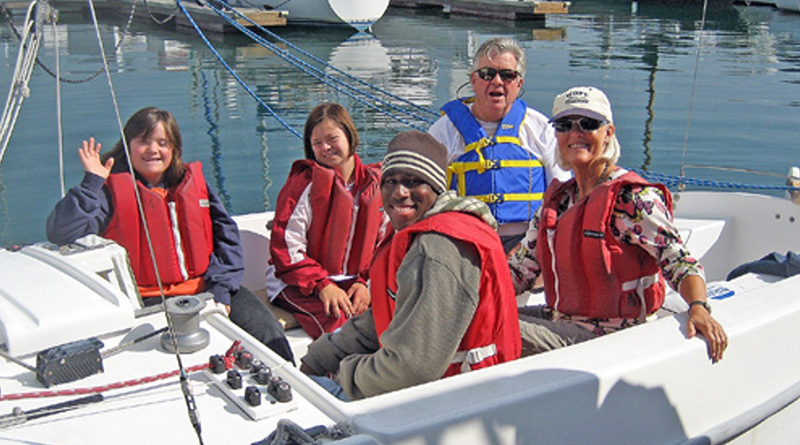
Smith noted the center’s long history of outreach remains one of its strongest contributions. He highlighted the work of longtime Executive Director Mike Segerblom, adding that “Our recently retired Executive Director, Mike Segerblom, built up our disabled and at-risk programs with local groups over the past three decades, and thousands of people have experienced sailing for the first time as a result.” That emphasis on accessibility has helped shape a diverse sailing community that spans beginners, youth racers, collegiate teams, and Olympic hopefuls.
With the 2028 Olympics approaching, the center continues to play a role in high-performance development. As Smith explained, “we have hosted several US Sailing high-performance training camps and are now seeing increasing participation from Olympic aspirants from countries outside the US.” He also noted that none of this growth would be possible without civic partnership, saying “none of this could have been possible without a long-time steady partner with the City of Long Beach, who continues to be incredibly supportive of our mission in serving the sailing community.”
A short distance away, the Leeway Sailing and Aquatics Center brings nearly a century of history to the waterfront. Founded in 1929 as a youth sailing program, Leeway has grown into one of the premier municipal instructional sailing facilities in the country. Known for its focus on safety, sportsmanship, and youth development, Leeway continues to introduce new generations to the water through sailing, kayaking, and canoeing classes.
Together, these three programs illustrate the versatility and depth of Long Beach’s sailing community. Students can begin in youth classes at Leeway, train competitively through the Sailing Center, or pursue advanced certifications and coastal cruising skills with Santana Sailing. Each program fills a unique role, yet all contribute to the same goal: keeping the city’s connection to the ocean thriving and accessible.
What unites them is the belief that sailing is more than a pastime. It’s a skillset, a confidence builder, a community, and a way of life. Whether someone is stepping aboard for the first time or preparing to charter a vessel abroad, Long Beach offers a complete ecosystem of instruction and opportunity — ensuring its sailing tradition endures for generations to come.