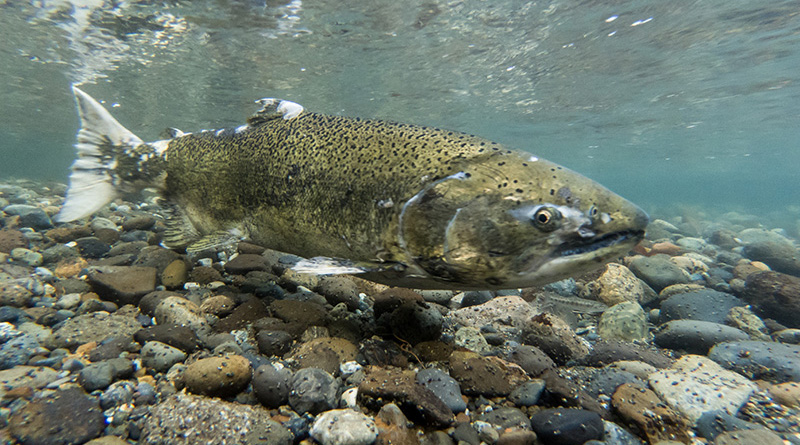
A little more than a year after four hydroelectric dams were removed from the Klamath River, California’s biologists are witnessing a transformation that few expected to unfold this quickly. In the months since the river was reconnected from its headwaters to the sea for the first time in more than a century, salmon are reoccupying habitat that had been blocked for generations.
The pace of the recovery has exceeded expectations across state and Tribal agencies working in the basin. Michael Harris, Environmental Program Manager for the California Department of Fish and Wildlife’s Klamath Watershed Program, described the moment as both rare and energizing for scientists who have waited years to see what might happen once the dams came down. “The speed at which salmon are repopulating every nook and cranny of suitable habitat upstream of the dams in the Klamath Basin is both remarkable and thrilling,” Harris said. “There are salmon everywhere on the landscape right now, and it’s invigorating our work.”
Although final counts for returning adults will not be available until January, early indicators show a stronger fall run of Chinook salmon compared with last year. The fish are not only returning in greater numbers but are dispersing widely into tributaries newly connected to the main stem. That trend has been reinforced by a series of observations from multiple agencies and Tribal organizations working along both the Oregon and California reaches of the river.
In Oregon, biologists with the Oregon Department of Fish and Wildlife and the Klamath Tribes have reported widespread salmon spawning in the upper basin, including tributaries above Klamath Lake where salmon have been absent for more than a century. Researchers in California are documenting similar signs of recovery within the former reservoir footprints. Fish counting stations on newly accessible tributaries have recorded 208 adult Chinook salmon in Jenny Creek and 260 adult Chinook salmon in Shovel Creek so far. These counts are part of an ongoing, coordinated effort among state and federal agencies, Tribes and conservation groups, though the California Department of Fish and Wildlife has placed special emphasis on monitoring the tributaries that opened after dam removal.
Field crews have been on the ground regularly, searching for active salmon nests and tracking adults as they move upstream. Snorkel teams working throughout the summer documented juvenile salmon and steelhead in nearly every newly accessible tributary within the former reservoir zones. Fall Creek was among the most striking examples. Roughly 65,000 wild juvenile Chinook salmon were counted there after flow was restored, providing early evidence that salmon are spawning, rearing and surviving in habitat that had been underwater for decades.
The resurgence is also visible at the Fall Creek Fish Hatchery, a state of the art CDFW facility now in its second year of operation. The hatchery began spawning returning fall run Chinook in mid-October and has already processed 416 females and collected roughly 1.27 million eggs. That total is four times the number of salmon spawned at the same point last year. More than 1,200 Chinook salmon have entered the hatchery to date, a sign that both hatchery and wild fish are responding strongly to the free flowing river.
As biologists track the movement of adult salmon, they’re also monitoring broader changes to the river system that followed dam removal. Temperature data from 2024 and 2025 show the return of natural seasonal fluctuations. The river is cooling sooner in the fall when adult salmon migrate upstream and warming earlier in the spring when juveniles rear and begin their journey to the ocean. These shifts are critical because they create conditions more in line with the seasonal cycles salmon evolved to depend on.
Another encouraging development is the reduction in harmful conditions that plagued juvenile salmon for years. Scientists are detecting lower levels of Ceratonova shasta, a parasite that caused extensive mortality prior to dam removal. Harmful algal blooms that once formed in the slow moving reservoir waters are now smaller and less frequent. With the river restored to a more natural flow, water quality is rebounding and improving survival prospects for young fish.
The long term goal of the project has always been more than simply opening the river. The objective is the reestablishment of viable, self-sustaining populations of salmon and other anadromous species that can support Tribal, commercial and recreational fisheries while restoring the ecological balance of the basin. To reach that goal, the California Department of Fish and Wildlife has invested more than $30 million in habitat restoration projects throughout the Klamath region.
These investments range from large scale watershed improvements to targeted access projects. Ten projects within the Scott and Shasta rivers received twenty million dollars in grants to improve fish passage and continue post McKinney Fire restoration work. Each project was developed in collaboration with local Tribes, ranchers, farmers and nonprofit conservation organizations dedicated to rebuilding salmon strongholds in the basin.
Additional funding has been directed to critical access improvements. A one hundred and thirty thousand dollar grant awarded to Trout Unlimited will remove a concrete barrier on Jenny Creek and reopen approximately one mile of spawning and rearing habitat for salmon and steelhead. A separate one point four million dollar grant to Trout Unlimited will install buffer fencing around the Iron Gate and Copco I reservoir footprints. The fencing will protect more than three thousand acres of riparian habitat, stabilize soil, support replanting efforts and reduce erosion that degrades water quality and affects fish survival.
Recreation is also part of the restoration vision. A five hundred eighty two thousand nine hundred fifteen dollar grant to the Klamath River Renewal Corporation will create new public access and a boating launch facility in the Copco Valley, the site of the former Copco Lake reservoir. These amenities will allow the public to reconnect with stretches of the river that have not been accessible for more than a hundred years.
The dam removal itself marked one of the most important actions in the state’s recent Salmon Strategy for a Hotter, Drier Future, a framework introduced in 2024 by Governor Gavin Newsom to guide decisions that support salmon recovery amid climate driven challenges. The early signs emerging across the Klamath Basin offer a rare moment of optimism in a region long marked by conflict and environmental decline.
Today, the river is once again behaving like a river. Salmon are pushing into tributaries that have not seen them since the early twentieth century. Juveniles are finding food, shelter and flow where they need it. Communities that relied on the Klamath for cultural, ecological and economic life are seeing tangible progress. The work continues, but the return of salmon to their ancestral waters has already become one of the most significant recovery stories in the West.
-30-