Seakeeper, long recognized as the global leader in marine motion control, is entering 2026 with a series of moves aimed at bringing stabilization technology into more boats — and into clearer focus for everyday boaters.
The company recently expanded its communications partnership with enthusiast agency Gunpowder, Inc., naming the firm its public relations agency of record. At the same time, Seakeeper Ride, the company’s underway stabilization system, announced a new partnership with Barletta Boats that brings the technology into the pontoon market for the first time.

Taken together, the developments signal a shift in how stabilization is being positioned within recreational boating: no longer as a specialty upgrade for large yachts, but as an increasingly common feature across a wide range of vessels, from center consoles and cruisers to pontoons.
For boaters, the changes are less about business announcements and more about what they feel on the water.
Seakeeper’s gyroscopic stabilizers, introduced to the market in 2008 after five years of research and development, are designed to reduce up to 95 percent of boat roll at rest and at low speeds. In 2022, the company introduced Seakeeper Ride, a Vessel Attitude Control System (VACS) that automatically adjusts a boat’s running attitude to improve stability while underway, reducing pitch, roll and yaw by as much as 70 percent.
Together, the systems address the two most common discomforts in boating: roll while drifting or anchored, and instability while running in chop.
That growing awareness among boaters is something Seakeeper President and CEO Andrew Semprevivo has seen change dramatically over the past decade.
“Seakeeper launched its first product, our gyrostabilizer, in 2008,” said Semprevivo in an interview with The Log. “Since then, the awareness and accessibility to stabilization has grown exponentially, paving the way for the rapid uptake of Seakeeper Ride when it launched in 2022. In our core markets, stabilization has become the minimum expectation for boaters who now expect comfort onboard to be standard. Across both Seakeeper and Seakeeper Ride, we are working with hundreds of builders to give that new standard to their customers, both at rest and underway.”
“Seakeeper has built a category-defining brand around solving real problems for boaters through engineering and innovation,” stated Ryan Chuckel, Founder and CEO of Gunpowder in a news release. “Our work with Seakeeper Ride over the past year has been a great collaboration, and expanding that partnership to support the broader Seakeeper brand was a natural next step.”
Gunpowder’s expanded role will focus on helping boaters, marine media and industry partners better understand how the technology works and how it directly improves comfort, safety and performance on the water.
That education becomes even more relevant as Seakeeper Ride moves into new segments of the market — including pontoons.
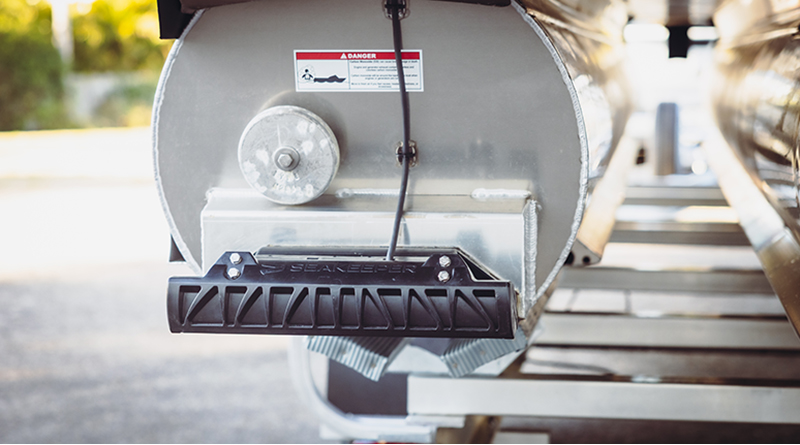
In January, Seakeeper Ride and Barletta Boats announced a partnership that will bring underway stabilization technology to pontoon boats for the first time. With new pontoon-specific software and subtle changes to the boat’s aft running surface, Seakeeper Ride will now be offered on Barletta’s 23 Lusso and 25 Lusso models, with plans to expand to additional models in the future.
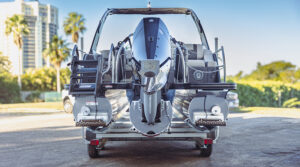
Semprevivo explained that adapting the system for pontoon hulls required more than simply transferring existing technology.
“Our software engineers did the heavy lifting to bring Seakeeper Ride to the pontoon market,” said Semprevivo. “The software that was being used on fiberglass and aluminum hulls already provided impressive pitch, roll, and yaw elimination on pontoons, but that wasn’t good enough. For the new application, we wanted to address a pontoon’s unique challenges, so we engineered the adaptation that Seakeeper Ride can also induce bank into a turn for a pontoon where they traditionally turn very flat, giving it a much more natural, comfortable feeling.
“It was Barletta that engineered the solution for installation on their Lusso models, incorporating subtle updates to the aft running surface and adding a dedicated mounting system — ensuring the technology performs at its best on every equipped model.”
“Seakeeper Ride is rapidly becoming the minimum expectation on boats in our current segments, and the pontoon industry has been massively underserved from a stabilization standpoint,” Semprevivo said in a January press release. “We’ve always had the goal of transforming the boating experience for all boaters, so entering the pontoon market was a natural next step for us.”
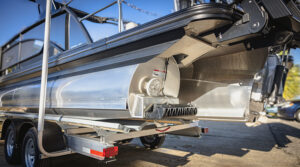
Jeff Haradine, President of Barletta Boats, said the partnership aligns with the company’s focus on improving the on-water experience in ways customers can immediately feel.
“Partnering with Seakeeper Ride allows us to bring breakthrough stabilization technology to our pontoons for the first time, making the industry’s smoothest ride even smoother, the handling more natural, and the entire experience more comfortable for everyone onboard,” Haradine said in the news release.
As more manufacturers begin integrating Seakeeper Ride at the factory level, Semprevivo sees the technology influencing the way boats are designed altogether.
“Our goal has always been to stabilize every boat out there, and we’re pushing further towards that goal every day,” said Semprevivo. “We already see manufacturers, take Sportsman Boats for example, making hull modifications to factor in stabilization and changing the shape of their recessed pockets to accommodate Seakeeper Ride’s controllers where they used to accommodate trim tabs. What was once considered a smooth ride, is now subpar compared with boat models from manufacturers incorporating Seakeeper Ride, and consumers have taken notice.”
The Seakeeper Ride-equipped Barletta 25 Lusso debuted at the Minneapolis Boat Show in January and will be available for demonstration rides at the Miami International Boat Show in February.
For recreational boaters, particularly those in Southern California who regularly encounter afternoon wind chop and mixed swell conditions, the practical benefits are easy to recognize. Stabilization can reduce crew fatigue on long runs, make it easier for passengers to move safely around the deck, and improve overall confidence when operating in rougher conditions.
For boaters who have never experienced stabilization firsthand, Semprevivo describes the difference in unmistakable terms.
“For someone who’s never experienced stabilization, the change is immediate and unmistakable — like switching from horseback to an automobile, or from a dirt road to an interstate,” said Semprevivo. “The noise, the pounding, the constant corrections — you don’t even realize how much effort and fatigue they create until they’re suddenly gone. With Seakeeper Ride, the boat stops slamming, stops rocking, and stops reacting to every wave or person moving onboard. You don’t brace yourself. You don’t fight the wheel. You don’t anticipate the next slam. Instead, the boat feels planted, predictable. You’re confident and comfortable. It fundamentally changes what boating feels like. And once you experience it, there’s no going back.”
Seakeeper products are now available for boats as small as 23 feet, and the technology is increasingly being offered as factory-installed equipment or retrofit upgrades.
Kelsey Barrett, Seakeeper’s Director of Brand & Creative, said the company’s growing communications effort is focused on helping boaters understand that stabilization is no longer reserved for large offshore yachts.
“Their work with Seakeeper Ride demonstrated a clear ability to translate complex engineering into compelling storytelling,” Barrett said of Gunpowder. “We’re looking forward to expanding that collaboration as we continue to grow the Seakeeper brand globally.”
Founded in 2003, Seakeeper has continued to invest in motion control technology that addresses both at-rest and underway conditions. As the systems expand into more boat types — including pontoons — the company is working to make sure boaters understand how stabilization can directly improve their time on the water.
Because for many boaters, the difference is immediate: a boat that feels steadier, more predictable and more comfortable, no matter the conditions.
For more information, visit seakeeper.com/.