After many years of pondering the idea of sailing singlehanded to Kauai, Hawaii, to visit my cousin “Mac,” whom I hadn’t seen since we were kids in the 1960s, I finally mapped out a round-trip course to Hanalei Bay and directly back to Los Angeles Harbor.
Tall seas in the North Pacific produce a wild ride for cruising vessels. (Credit: Bill Morris)
I had circumnavigated the world on my 1966 Cal 30 Saltaire 20 years before, but I was in my prime, much stronger and quicker than I am now. Could I handle the sleepless nights, reefing sails in pure darkness with huge waves pounding against the hull? I dared myself to face those challenges, come what may.
Jimmy Cornell, in his well-known book, “World Cruising Routes,” recommends sailing from Hawaii to San Francisco and then anchorage-hopping down the coast back to Southern California. I was determined to bypass the Bay Area and aim directly for L.A., even though this route would put me on a somewhat tighter journey around the Northeast Pacific High (aka the “Garbage Patch”), making for an even more difficult passage.
I left the marina April 3 [of 2025], spent a night anchored in White’s Cove, Catalina Island, and then sailed hard to weather, passing San Clemente Island to starboard. Over the next few hundred miles, I sailed southwest and then gradually more westerly, following the curve of the high. I used my Garmin inReach Mini2 satellite text device to stay in contact with my wife, Marilu, and my sailing buddy, Joao Nicolau, who provided me with weather information.
Everything from squalls to calms crossed my path during the outward leg, and after 23 days at sea, I had covered the 2,400 NM to Hanalei Bay on the north side of the island. I arrived in the wee hours of the morning, using my Garmin 64cv chartplotter to avoid the rocks lying along the northeast portion of the island.
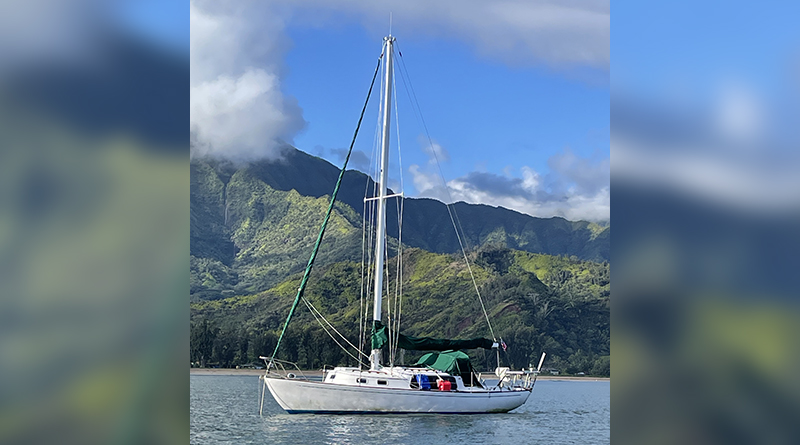
I dropped anchor in what has to be the most beautiful bay I have ever seen. Long waterfalls streamed down through lush, green jungle on the mountains lying to the west, and the Hanalei River wandered lazily through overhanging palms and out into the east side of the bay.
After a long, desperately needed sleep, I dropped the inflatable dinghy in the water, hooked up the Torqeedo electric outboard and motored across the bay and a short distance up the Hanalei River, where I found a palm tree to tie off the dinghy before sauntering into town.
Only a mile-long walk from the river, the enchanting little town of Hanalei is a great place to enjoy fine restaurants, along with craft pizza and exotic cocktails. Of course, you will also find tourist shops with tee shirts, seashell jewelry and other sundries.
My reunion with Mac had been long awaited, so we spent some quality time on Saltaire and at his home in Kekaha, where he made a fantastic dinner of enchiladas — once a Californian, always a Californian!
The 10 days I spent in Kauai were one of the most memorable times of my life, but as all good things must come to an end, I spent my last couple of days filling diesel and water jerry cans and stocking up on fresh food that could last several weeks without refrigeration. Cabbage, onions, potatoes, apples and eggs will survive rather long periods at sea if stored in a cool, well-ventilated corner of the vessel. Each egg got a thin coat of mineral oil to ensure freshness along the 3,400-mile trek back to L.A. Harbor.
At 1000 (military time) on Wednesday, May 7, after a brief phone chat with Marilu, I raised the anchor and headed north by northwest, following the current outside Hanalei Bay. At 0830 the following morning, I was awakened by the sound of water sloshing inside the cabin. I slid across the cabin sole to sample the water from the tank at the galley sink — dry as a bone. So, after cleaning up the mess, I was relegated to pouring water from jerry cans during the remaining voyage back to L.A.
The following morning, during a raging gale, the boat felt horribly off course, though I had carefully set the windvane self-steering only a few hours earlier. A peak out the companionway revealed the problem: the thin plywood vane had sheared right off its base! I quickly scrambled out on deck to install a storm vane, putting the boat back on course in little time.
The first few days of sailing hard to windward through a series of squalls already had me a bit depressed. “What next?” I moaned to myself as I lay on the settee trying to sleep. The sound of sloshing water inside the cabin again woke me. This time, the water in the cabin was deeper, but where the heck could it come in? It occurred to me that water breaking over the bow was probably rushing down through the foredeck where the anchor rode passes to the chain locker.
Apparently, the automatic bilge pump had given up the ghost. I crawled out across the forward deck and stuffed a thick piece of foam rubber in the hawser hole to stem the water ingress — it worked! A couple of hours of sweating over the built-in manual bilge pump and mopping the cabin sole restored some normalcy to the cabin atmosphere.
As if this mayhem weren’t enough, when I tried to light the stove, there was no propane, even though I had topped off the tank before leaving Hanalei. The malfunction turned out to be a worn-out solenoid valve at the tank mounted near the transom. After drilling a hole through the brass valve stem inside the valve housing, I had the stove working again. At least now I could cook and eat with some semblance of normalcy.
A strong gale several days later ripped two water jerry cans and a diesel can from the side decks, even though I had taken great care to secure these items properly. Despite the loss, this still left me with enough water and fuel to reach home.
Sailing from latitude 37, due west of Santa Cruz, southeast around the Northeast Pacific High had me aiming for a point roughly 40 miles south of Point Conception, which I passed with a deep sense of joy and relief. It was now just a matter of passing Catalina to starboard and sailing through a refreshing breeze back to L.A. Harbor on June 2.
If you are contemplating a round-trip sail from Southern California to Hawaii, by all means, do it. Make sure both vessel and crew are solidly prepared for the voyage, and be prepared for sudden changes in the weather. Aloha!