Sometimes the hardest part of catching fish isn’t finding them — it’s figuring out what to do when the bait barge is loaded with giant sardines.
In honor of National Fishing Day, which was celebrated June 18, I thought I’d share a few things I’ve learned recently out on the water. Some lessons came from successful trips, some came from getting outfished, and a few came from doing things the hard way — so hopefully, you don’t have to.
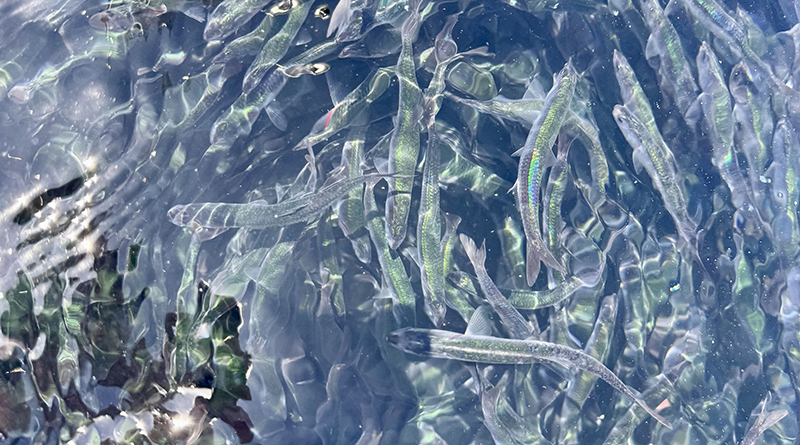
There are few things better, after all, than pulling up to the bait receiver and seeing healthy, lively sardines. Unless, of course, they’re the size of hot dogs. Everybody take a bait fish home so you can say you caught something!
Lately, Southern California anglers have been dealing with an unusual challenge: massive sardines. While those bigger baits can be a dream for tuna fishermen, they’re not always ideal when you’re targeting calico bass, sand bass, spotted bay bass, or other inshore species.
Trying to get a trophy-sized sardine to behave naturally on a light bass setup can be frustrating. Many of those fish simply aren’t interested in chasing a bait that looks like it should be swimming around the 181 or Cortez Bank instead of a local kelp line. When the bait is oversized, anglers often find themselves having to adjust their approach or head offshore to deeper water where bigger baits make more sense.
One option is embracing the deep-water bite.
If you’re making the run to spots such as the 14 Mile Bank, where anglers are commonly fishing in anywhere from 400 to 700 feet of water, jigs can be incredibly effective. Over the past several trips, I’ve had excellent success fishing Streaker jigs in deeper water, particularly the 300-gram model in what the manufacturer calls Blue Sardine. Around the rail, however, I’ve always heard that color referred to as “Katy Perry.”
Whatever you call it, the fish seem to like it.
I’ve also had success with the Mint-colored Streaker, carrying both a 120-gram and a 300-gram version depending on depth and current conditions. What has really surprised me is how often fish will eat the jig before I even start working it. There’ve been plenty of drops where the lure barely reaches depth before getting hammered. I’m not talking about carefully working a slow-pitch presentation or spending several minutes jigging. In some cases, the fish seem so keyed in on this particular jig that they’re eating it almost as soon as it gets into the zone. More often than not, the fish are pinned perfectly in the lip rather than snagged in the eye because I bonked them on the head, a good indication they’re actively feeding on the jig.
I’ve also made a little modification that’s been helpful: replacing the standard assist hooks with a treble hook setup. Traditional assist hooks, commonly used in vertical jigging and slow-pitch applications, hang from a short cord attached to the lure. While they’re highly effective and widely used throughout the industry, I’ve personally had good results fishing the Streakers with a treble.
The Streaker’s design makes it particularly effective for deep-water rockfish. Its fast sink rate helps it get down quickly in heavy current, while its sharp darting action and rapid drop often trigger reaction bites from fish holding near the bottom.
And if your jig is scoping way out from the boat, don’t be stubborn — try going heavier. I’d rather fish a heavier jig that’s getting bit than spend half the drift waiting for a lighter one to reach the bottom. When we’re fishing 500 or 600 feet and there’s current running, the fish don’t care that you’re trying to be delicate. They care that the jig actually made it down to them. For the days where I have been stubborn, I reel the jig back in and instead of casting it away from the boat I just drop it straight down. That has worked for me in forgiving current conditions.
Of course, jigs aren’t the only solution when the bait is oversized. Traditional cut squid continues to produce for deep-water rockfish, and stripped baits remain one of the most reliable methods for anglers fishing structure.
Closer to shore, artificial lures become an even more valuable tool.
When the sardines are simply too large for local bass fishing, soft plastics can save the day. Hookup Baits, flukes, and swimbaits all allow anglers to match a smaller forage profile while maintaining excellent action.
My personal favorites in the Hookup Bait lineup are Chovy and Shad White. I will admit that I once bought the Red Crab color because it looked fantastic in the package. Unfortunately, the bass didn’t seem nearly as impressed as I was.
Stripped mackerel fished on a leadhead near the bottom also remains one of the most productive ways to target calico bass and sand bass. While live bait often gets most of the attention, a properly presented strip bait can be deadly around structure, particularly when fish are feeding close to the bottom.
Also, I’ve probably told this story before, but last summer I absolutely crushed the bass on frozen anchovies. I was on a boat recently and one of the passengers actually recognized me from that trip. He said he went home and told his family about the girl who outfished everyone on the boat. So, if anyone tries to tell you frozen chovies don’t work, I’d respectfully disagree.
But what I’m trying to tell you is the lesson is simple: don’t let giant bait dictate your entire fishing plan.
While oversized sardines may not always be the best choice for every species, they can be a reminder to explore other techniques that many anglers overlook. Sometimes the answer isn’t finding a smaller bait. It’s putting down the bait rod altogether and picking up a jig, swimbait, or strip bait instead. Let’s be honest — fish are supposed to eat live bait. That’s why we buy it. But there’s something incredibly satisfying about getting bit on a lure or jig. Sometimes I think it takes a little more creativity and a little more skill to convince a fish to eat something artificial. If the live bait is too big or the bite is slow, don’t be afraid to experiment. At worst, you’ll learn something. At best, you might discover a new favorite way to fish.
You may discover the fish were willing to bite all along.
P.S. A heartfelt thank-you to frozen anchovies for providing one glorious day when everything went right and I outfished the rest of the boat. I’m still chasing that feeling.