By: Katherine Clements, Still Staring at the Horizon
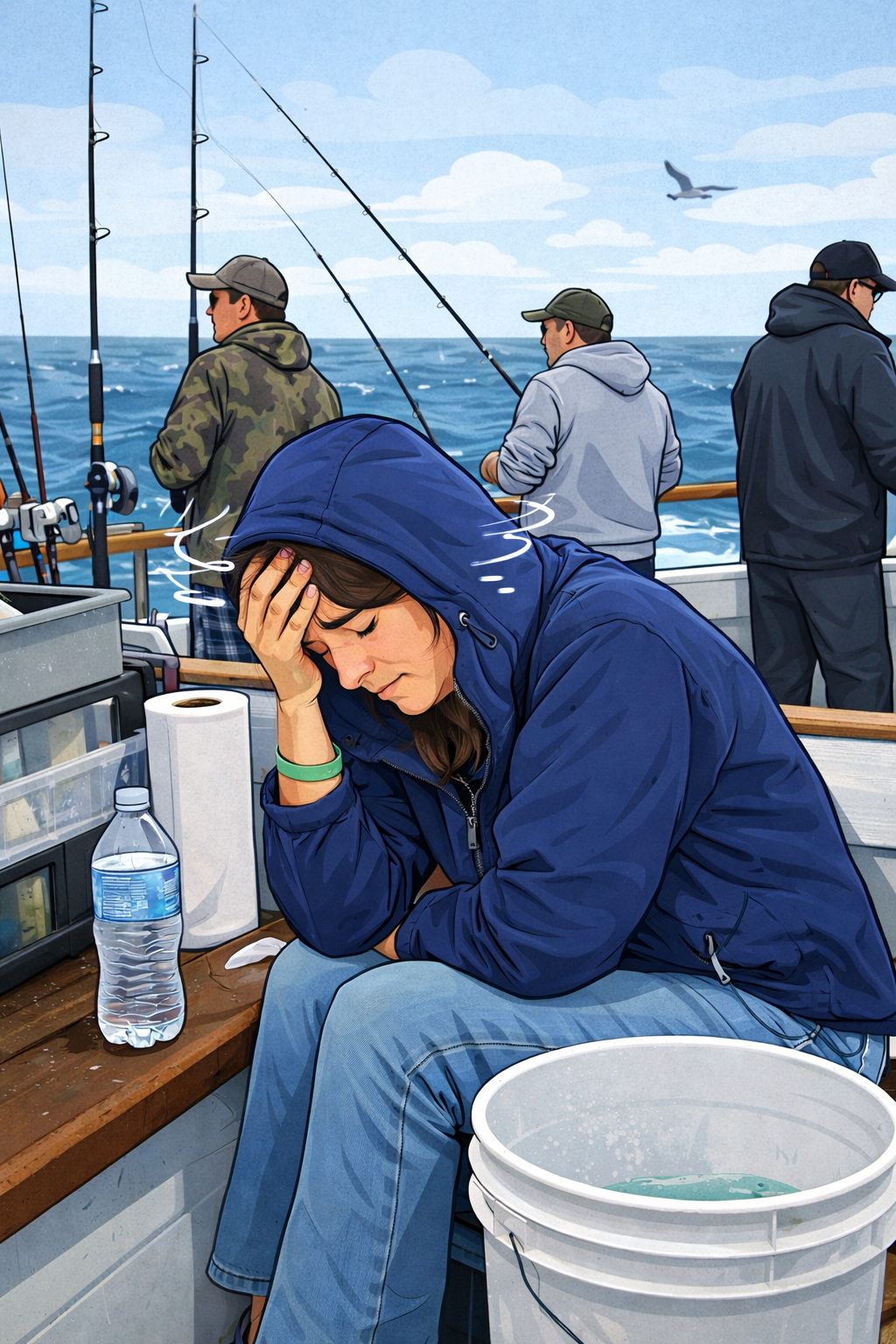
Somewhere between the harbor mouth and the first stop on a ¾-day fishing trip, it happens. The engines settle into a rhythm, the horizon starts doing slow gymnastics, and you realize, with absolute certainty, that you’re the only person on board whose inner ear has decided to mutiny.
Panic not. In the strange social ecosystem of a sportfishing boat, being the lone seasick angler is not a tragedy. It is, in fact, a quiet victory.
First, let’s talk about space. While everyone else is shoulder-to-shoulder at the rail, jockeying for position and arguing over whose sardine is swimming better, you’re given what can only be described as a luxury suite. The stern opens up. The galley bench becomes yours. No one questions why you’re lying down like a Victorian child with “the vapors.” You are waved past with sympathy and respect.
Now, about the crew. Publicly, deckhands maintain professionalism. Privately, behind the bait tank, near the anchor locker, or somewhere within earshot but just out of sight, you have absolutely become a nickname. This is not personal. This is tradition. Every boat has one seasick person, and every crew has a running commentary that will never, ever make it into the safety briefing.
The upside? You’re no longer expected to perform. No one is waiting on you to hot-rail a stop, gaff a fish, or enthusiastically re-bait at lightning speed. Your only responsibility is to not fall overboard. If you catch something, it’s legendary. If you don’t, you were “really battling it today,” which sounds heroic and weather-related when explained later.
There’s also a morale advantage. When half the boat is sick, the trip feels cursed. Buckets everywhere. Silence at the rail. Regret hanging in the air thicker than diesel exhaust. But when it’s just you, the rest of the passengers bond over their collective stability and quietly root for your survival like spectators at a slow-motion sporting event.
And then comes the comeback. You stand up. You sip water. You maybe even drop a line. This moment carries weight. No one claps, but everyone notices. You didn’t just fish. You rejoined society.
By the time the boat turns toward home, sunburned anglers are comparing fish counts while someone says, “Honestly, at least you tried,” which in boating culture is high praise. Somewhere forward, a deckhand is still laughing about it, but that’s fine. You’ll be back. And next time, it’ll be someone else. You’ll have done your research by then, armed with ginger chews, prescription ear patches, wrist bands, motion sickness glasses, and a level of preparedness that suggests both experience and unresolved trust issues. You may still feel a little green, but at least you’ll be medically, emotionally, and technologically ready, which is more than can be said for the next unsuspecting passenger.
Because on a ¾-day fishing trip, being the only seasick person doesn’t make you weak.
It makes you the storyline.