It’s not often we dive beneath the surface — literally — in The Log, but there’s a growing tribe of ocean lovers in Southern California who are doing just that. Spearfishing, while not a regular topic in our pages, is certainly no secret along our coast. From the kelp forests of La Jolla to the offshore reefs near Catalina, adventurous watermen and women are trading rods and reels for wetsuits and spearguns, pursuing their catch one breath at a time.
But what exactly is spearfishing? At its core, it’s the oldest form of fishing — using a spear or speargun to hunt fish while free diving or scuba diving. It’s as much about skill, patience, and breath control as it is about knowing your target species and mastering your environment. Unlike traditional fishing, spearfishing is completely visual and requires the hunter to get up close — there’s no waiting on bait here. It also requires some essential gear: a proper wetsuit, fins, mask, weight belt, and of course, a speargun or pole spear. But more than the equipment, it requires respect — for the ocean, for regulations, and for the fish themselves. Spearfishers are selective by nature, often harvesting just what they need, which makes the practice one of the most sustainable ways to fish.
To help us navigate this exhilarating and under-the-radar sport, The Log turned to a local expert who knows the ins and outs of the dive. Chris Cheezem, owner of Just Get Wet, a San Diego-based freediving and spearfishing shop, has introduced countless divers to the sport and emphasizes that safety and respect must come before all else. He’ll be sharing his insight and tips throughout this article, starting with the most important rule in spearfishing: “Don’t go alone,” Cheezem says. “By far the biggest safety rule with freediving and spearfishing. And overall, please approach this sport with respect. It can be — and is — done safely by thousands of people, but it can be very dangerous if you haven’t eased your way into it and asked a lot of questions.”
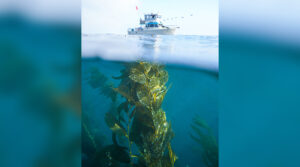
From understanding the ocean and reading conditions to mastering your breath and movement in the water, Cheezem walks us through what every new spearfisher needs to know to dive in safely, successfully, and sustainably.
Now let’s talk about gear. When it comes to gearing up for spearfishing in Southern California, Cheezem emphasized that having the right equipment isn’t just about performance — it’s about safety, warmth, and staying in the water longer. “A 5mm two-piece spearfishing wetsuit is essential in Southern California,” Cheezem advised. “Fin socks and gloves are highly recommended — gloves will also make it easier to handle fish and load your speargun.” Unlike surfing or open water swimming, freediving doesn’t generate the same body heat, so insulation becomes critical. Once the cold sets in, your breath-hold capability drops significantly. Long fins, he said, are another must-have: “They let you travel further in the water with less effort, which extends your breath hold and gives you additional power if you need it.”
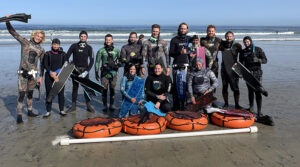
For vision and breathing, a basic low-volume mask and a reliable snorkel do the trick, but Cheezem stresses that “price doesn’t matter nearly as much as the fit and seal — just try a few masks and make sure one fits your face well.” A rubber weight belt is also important because it won’t ride up your torso when you’re diving head-down, and a quality dive knife is key for dispatching fish or freeing yourself from tangles. Once a diver feels confident in their diving abilities and is familiar with local species, Cheezem recommends starting with a speargun around 90cm in length. “It’s a great gun to start with and grow into,” he said. As for safety and visibility, “you’ll want some sort of tether — either a reel mounted on the gun and connected to your spear, or a float line clipped to a float at the tail end — which also makes you more visible to boaters.” With these essentials, beginners can enter the water with confidence, stay warm, and start building their skills responsibly.
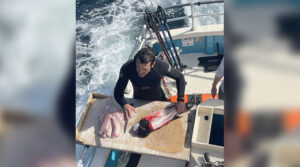
Grab your mask and take a seat — school’s in session, (and the classroom is underwater). Cheezem told The Log that formal instruction is one of the smartest ways to start — or improve — your spearfishing journey. “We offer both freediving and spearfishing classes, and have found both to be very effective,” Cheezem said. While many beginners turn to courses to build foundational knowledge, he’s also seen seasoned divers benefit just as much. “We’ve had a number of people who’ve spearfished for decades and grudgingly took the freediving class because family or friends pressured them into learning the safety aspects in a formal course. At the end of the class, ALL of these people have said something along the lines of, ‘I can’t believe I didn’t kill myself.’”
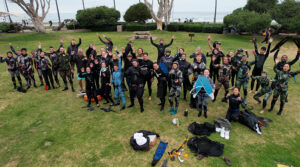
Whether you’re new or experienced, the courses offer valuable insight, especially when it comes to safety and breath-hold diving.
The freediving course focuses on technique, safety, and efficiency in the water, while the spearfishing course dives deeper into species-specific knowledge, hunting tactics, target practice, and hands-on experience. Cheezem is quick to clarify that no class will make you a master overnight. “With both freediving and spearfishing there are a lot of things you will have to learn and develop on your own, and none of these courses will make you a master at either sport,” he said. “They will, however, provide a great foundation, dramatically shorten your learning curve, and teach you how to dive safely.” After completing the freediving course, students are invited to weekly group training sessions capped off with a beachside cookout — a fun and casual way to hone skills and connect with the local dive community.
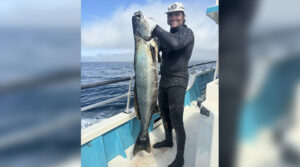
Cheezem brings a lifetime of experience and passion to the world of freediving and spearfishing. Growing up in Florida, he was introduced to the sport at a young age, often trailing behind his dad on spearfishing adventures. But what truly pulled him in was the intensity and contrast of the underwater experience. “Being immersed in water, under pressure, with only the air in your lungs sends so many powerful messages of ‘you don’t belong here,’” he said. “But with some time and training, you can feel completely at home in this alien world.”
For Cheezem, spearfishing is more than just a sport — it’s a deeply personal connection to the environment and the fish he targets. It takes time to become an effective freediver, he explained, and even more time to fine-tune your gear, learn the terrain, and understand fish behavior. “When you do land the fish you’ve been looking for, it’s really powerful,” he said. He’s quick to note that in the underwater world, you’re not at the top of the food chain, adding a sense of respect and humility to the experience.
And while Cheezem speaks thoughtfully about the beauty and challenge of the sport, he’s not shy about the adrenaline rush either. “The feeling of spearing a big fish, wrestling around with it underwater, and coming back to the boat — or better yet, walking out of the water and up the beach — with a slug of a fish in your hands is just the coolest,” he said with a grin. “I’d be lying if I said that had nothing to do with it.”
As the story comes full circle, it’s clear that Chris Cheezem’s path to founding Just Get Wet was shaped by a lifelong bond with the water. “I’ve always been a water rat,” he said, recalling his early days in Florida paddling canoes and spending time on boats. That passion led him to study oceanography and serve as a Deep Sea Diving Officer in the Navy — experiences that deepened his connection to the ocean and laid the groundwork for what would become his life’s work.
In 2018, Cheezem started Just Get Wet as a casual meetup group, bringing divers together to share their love for freediving and spearfishing. It wasn’t long before he earned his freediving instructor certification through FII, later going on to teach under the Molchanovs system. “I’ve gotten to learn from some of the best instructors in the world, have taught over 1,000 students, and have personally trained our group of instructors here in San Diego who are legitimately world class,” he said.
Cheezem’s own love for the sport shines brightest when he talks about hunting white seabass — a notoriously elusive target that hides in the kelp beds off Southern California. “They’re some of the most sensitive fish around,” he explained. “A splash, a bubble, a jerky movement will send them bolting, so your entire dive has to be in slow-motion stealth mode.” For Cheezem, it’s this slow-down, this sharpened mental focus, that makes the experience so rewarding. “You get locked into such a cool mental zone,” he said. “I don’t love the cold, murky water these fish are so fond of, but it does make them that much more rewarding.”
Chris Cheezem’s journey is a testament to what happens when passion meets purpose — and it all starts with a breath, a dive, and a deep respect for the water. Whether you’re just starting out or ready to take your skills to the next level, there’s no better time to dive in. So grab your speargun, trust your training, and just go get wet.
Summarized Regulations Provided by The California Department of Fish and Wildlife:
Summary of Spearfishing Regulations in California (2025) Spearfishing in California is a unique and regulated method of fishing that involves the use of a spear or hand to take fish while in the water. According to California Code of Regulations Title 14 (CCR §1.76), individuals may engage in spearfishing using underwater goggles, face plates, breathing tubes, SCUBA, or other artificial underwater breathing devices.
Under California law, spearfishing gear may be used to take a wide variety of finfish, with several notable exceptions. It is unlawful to use spearfishing gear to take or possess the following species: giant (black) sea bass, garibaldi, gulf grouper, broomtail grouper, trout, salmon, and broadbill swordfish (CCR §28.90). Additionally, spearfishing is not allowed within 100 yards of the mouth of any stream in ocean waters north of Ventura County.
For federal groundfish species and greenlings, if a spearfisher is targeting or in possession of these species in areas or during seasons where they are otherwise closed to take, no other fishing gear besides spearfishing gear is allowed onboard the vessel or watercraft (CCR §28.90(b)).
Spearfishing is permitted for specific species in designated Marine Conservation Areas (MCAs). For example, white seabass and pelagic finfish may be legally taken by spearfishing in areas such as Naples State Marine Conservation Area, Farnsworth Onshore State Marine Conservation Area (Catalina Island), and Point Dume State Marine Conservation Area, among others. However, it’s essential to note that regulations vary significantly by location and anglers must refer to local area rules to ensure compliance.
Marine Protected Areas (MPAs) play a significant role in the regulation of spearfishing. In some MPAs, spearfishing is allowed for certain species, while in others, it’s completely prohibited. Therefore, spearfishers should consult the official California Department of Fish and Wildlife (CDFW) website or specific MPA regulations for up-to-date guidance before entering the water.
The 2025 California Ocean Sport Fishing Regulations also outline bag and size limits for commonly targeted species. In general, there’s a 20-finfish daily bag limit across all species, with no more than 10 of any single species unless stated otherwise (CCR §27.60).
Relevant Bag Limits for Common Spearfishing Targets Include:
California Halibut: 5 fish south of Point Sur; 2 fish north of Point Sur
Lingcod: 2 fish
Rockfish (RCG Complex): 10 fish combined, excluding prohibited species such as cowcod, yelloweye rockfish, and bronzespotted rockfish
California Sheephead: 2 fish, with an open season year-round for spearfishers
Surfperch (Redtail): 10 fish (restrictions apply in San Francisco and San Pablo Bays)
Yellowtail: 10 fish, with no more than 5 fish under 24 inches fork length
Prohibited Species for Spearfishing and Possession Include:
Giant (Black) Sea Bass
Garibaldi
Yelloweye Rockfish
Cowcod
Bronzespotted Rockfish
Coho Salmon
Steelhead (in ocean waters)
White Shark
Gulf and Broomtail Grouper
Green Sturgeon
All Abalone
When spearfishing for California sheephead during its closed season (January 1 through the last day of February), only spearfishing gear may be aboard the vessel or used to take and possess the species. Angling and other gear types are restricted during this time (CCR §28.26).
Additionally, divers may take crustaceans using hands only while diving. Hooked devices are prohibited when diving, although divers may carry spearfishing equipment if it is otherwise lawful and not used to take crustaceans.
All anglers and divers are strongly encouraged to stay informed on the latest regulations and updates by visiting wildlife.ca.gov or consulting the 2025 Ocean Sport Fishing Regulations Handbook. Compliance with regulations supports sustainable fishery management and the long-term health of California’s marine ecosystems.
For more information, reference the 2025 Ocean Sportfishing Regulations as provided by the CDFW by visiting chrome-extension://efaidnbmnnnibpcajpcglclefindmkaj/https://nrm.dfg.ca.gov/FileHandler.ashx?DocumentID=220187&inline, or contact a CDFW information officer with any questions.