You have probably heard someone describe a rare event as being as unlikely as getting struck by lightning. On land, the odds are indeed low. According to the National Weather Service, a person has about a one in 1.2 million chance of being struck in any given year. Once you step aboard a boat, however, the math changes. BoatU.S. insurance data shows that roughly 1.5 out of every 1,000 powerboats are struck annually, along with even more sailboats. The question becomes simple. If your boat is hit, are you prepared for what comes next?
For many boat owners, the answer is no. A lightning strike can cause catastrophic damage that goes far beyond a scorched antenna or a fried VHF radio. You may feel more vulnerable than you realize, especially if your boat is equipped with the sophisticated electronics that modern mariners rely on for navigation, propulsion, steering, and communication.
One real-world example illustrates the problem clearly. A 60-foot sportfishing boat took a mild lightning strike while sitting at the dock. The hit traveled through an outrigger and into the aluminum structure above the helm before finding its way into the hardtop bonding wire. Although the boat had a clear path to ground, the journey was destructive. Every fixed electronic device was rendered inoperable. Engines ran, but only at low and uneven rpm. The bow thruster locked itself on. Shore power failed. Generators went down. Even LED running lights were knocked out.
This level of damage surprises many boaters. It often surprises seasoned professionals too. The reason has to do with the nature of lightning itself. As electrical engineer James Cote explains, lightning spans all electrical frequencies, which means it can transfer from one wire to another even without physical contact. When a lightning charge flows through a bonding wire, the energy can induce currents in nearby power or data cables. Anything attached to those cables, from chartplotters to engine sensors, can fail instantly. On the sportfishing boat, the engines were bonded correctly, but the lightning wiped out sensors related to turbo boost and fuel injection, causing the engines to run poorly even though the electronic control modules survived.
Despite how common these failures are, many recreational boats are fundamentally unprepared for a lightning event. Andrew Bucchin of EMP Shield Inc. says the most widespread weakness he sees is simply the absence of true lightning protection. “The biggest issue by far is that most recreational boats have no dedicated lightning protection at all. Many owners assume they are covered because they have circuit breakers, fuses, or a basic power strip surge protector. None of those are designed to handle the 100,000+ volts and millions of amps in a lightning strike.”
That false sense of security is compounded by installation shortcuts and unsuitable equipment. Bucchin notes that “another frequent mistake is poor or nonexistent grounding and bonding, fragmented electrical systems that allow surges to jump from one circuit to another, and the use of generic big box surge protectors that corrode quickly in the marine environment and react far too slowly.” According to him, correcting those vulnerabilities does not require guesswork. “The fix is straightforward: install true lightning rated surge protection at the power entry points of every electrical system on the boat (shore power inlet, battery banks, generator, inverter, solar charger, etc.).”
You may assume that a factory-installed bonding system and a reputable tower installation protect you against this type of event. In reality, many boats leave the factory with only a basic level of lightning protection. The system may prevent structural damage and reduce the chance of injury, but it may not protect sensitive electronics or prevent a strike from causing a cascade of failures. According to Cote, simple improvements such as providing a dedicated heavy conductor from high-risk strike points, like outriggers or towers, to proper grounding strips can significantly reduce damage.
If a bonding system does not provide a clear, low-resistance path to the water, lightning creates its own. It will jump unpredictably between metal objects, water tanks, appliances, engine blocks, and people. These leaps, known as side flashes, cause some of the worst types of hull and equipment damage. Marine lightning expert Dr. Ewen Thomson has seen this firsthand. After examining a boat with an ungrounded outrigger that took a direct hit, he counted forty large holes and hundreds of smaller ones where lightning arced through the hull on its way to the water.
To protect yourself, you need to understand what lightning really seeks. Contrary to popular belief, lightning isn’t looking for a path into deep water. It’s seeking the water’s surface, where opposite charges accumulate during a storm. Any tall, conductive structure between the cloud and the surface is a natural target. Your mast, antenna, tower, or rigging shortens that distance, making your boat more vulnerable.
A well-designed lightning protection system gives the strike a controlled path from the highest point on your boat to the water. Air terminals should be placed on top of masts or towers, above navigation equipment and antennas. Heavy conductors should lead straight down to a grounding plate below the waterline. That plate must be large enough and shaped effectively enough to dissipate the strike without forcing the energy to arc through other parts of the boat. Thomson recommends distributing these grounding paths toward the outer edges of the hull to create a protective cage that keeps people and electronics at equal voltage, reducing the likelihood of side flashes.
While those fundamentals address the strike itself, modern boats face an additional layer of risk from voltage surges that propagate through electrical systems. Bucchin says lightning protection has evolved significantly over the past decade as electronics have become both more powerful and more fragile. “Over the past ten years, the biggest leaps have been in response speed, surge capacity, and whole vessel protection philosophy. Older marine surge devices typically reacted in microseconds and could only handle relatively small surges. Today’s best units respond in picoseconds and can divert hundreds of thousands of amps repeatedly without degrading.”
This shift has changed how professionals approach protection. “The single most effective modern practice is ‘zone protection’: placing high performance surge protective devices (SPDs) at every power source entry point so the entire downstream system (engines, chartplotters, radios, autopilots, refrigeration, lighting) falls inside a protected zone,” Bucchin explains. He adds that “hybrid circuitry combining silicon avalanche diodes, high energy gas discharge tubes, and advanced MOVs now provides multi stage filtering that stops both the initial lightning impulse and the follow on current that used to destroy electronics even when the first spike was caught.”
These technologies are no longer theoretical. “EMP Shield has pushed these advancements further than most, building devices that meet or exceed military EMP and lightning standards (MIL STD 188 125, MIL STD 461G, etc.) while remaining compact and easy to install on boats,” Bucchin says. “The result is real world protection of over $8 billion in assets worldwide and thousands of documented lightning events with zero customer losses when properly installed.”
For boat owners looking to take meaningful action, Bucchin emphasizes that protection works best when approached as a system rather than a single upgrade. “If a boat owner wants to dramatically cut the chances of a single lightning strike wiping out every electronic system on board, the key is to stop thinking in terms of ‘protecting one gadget’ and start treating the entire vessel as one electrical ecosystem.” He cautions that “lightning does not care whether it enters through the shore power cord, the solar panels, the generator, or the starter battery. It will take every available path and destroy anything in its way.”
He outlines three priorities that consistently deliver results. The first is understanding the boat’s electrical layout. “Map every electrical system on the boat. Identify all power sources: 12V or 24V DC battery banks, 120V or 240V shore power or generator, inverter output, solar or wind charge controllers, and any backup batteries. Surges enter through any of these paths.”
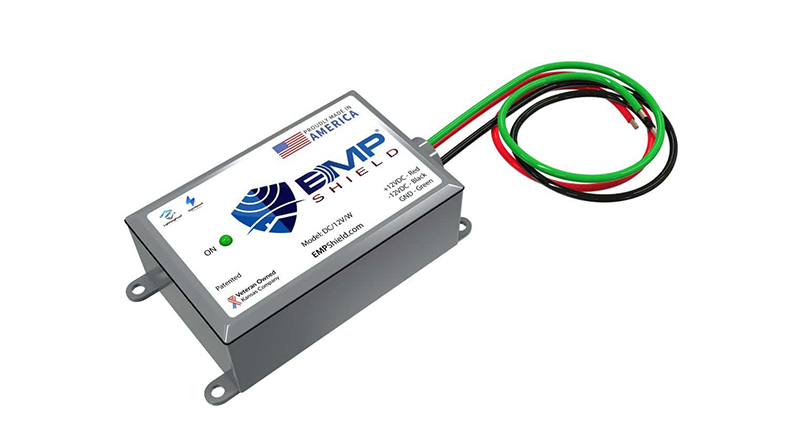
The second step is installing protection at each of those entry points. “Install voltage matched, marine rated lightning surge protection at each power entry point,” he says, citing examples such as EMP Shield units on battery banks, shore power inlets, generator outputs, inverters, and solar charge controllers. “These devices clamp in less than 1 nanosecond, are 100% weatherproof, and each carries the $25,000 connected equipment guarantee.”
Finally, grounding ties everything together. “Verify and improve the vessel’s grounding and bonding system,” Bucchin advises. “Ensure the shore power ground, all DC negatives, engine block, through hulls, and the surge protective device ground terminals are tied together with low impedance paths.” Without that foundation, even the best surge protector cannot function properly. “A solid ground is what allows the surge protector to divert energy harmlessly overboard instead of through your electronics.”
Even the best technology cannot protect your boat if it is not installed correctly. An air terminal must sit higher than antennas or radar arrays. The conductor from the terminal must lead directly to the grounding plate rather than through the bonding system. No conductor should run alongside electrical wiring where induction can occur. The grounding plate itself must be positioned where it can shed the charge efficiently. Mistakes in any of these areas can undermine the entire system.
The goal is simple. You want lightning to view your protection system as the best available path to the surface of the water. You cannot prevent a strike, but you can guide it away from critical systems and away from the people on board.
As a boater, you live in a world where technology is rapidly changing and where lightning protection hasn’t always kept pace. Your engines and electronics may depend on your understanding of these principles. The good news is that proven solutions exist, and resources are available to help you evaluate and improve your system.
Lightning remains a complex force of nature, but you can reduce its potential for harm. By updating your knowledge, examining your boat’s current protection system, and addressing weaknesses before a storm appears on the horizon, you give yourself the best chance to withstand a strike with minimal damage. Safe boating requires preparation and awareness, and lightning protection is no exception.