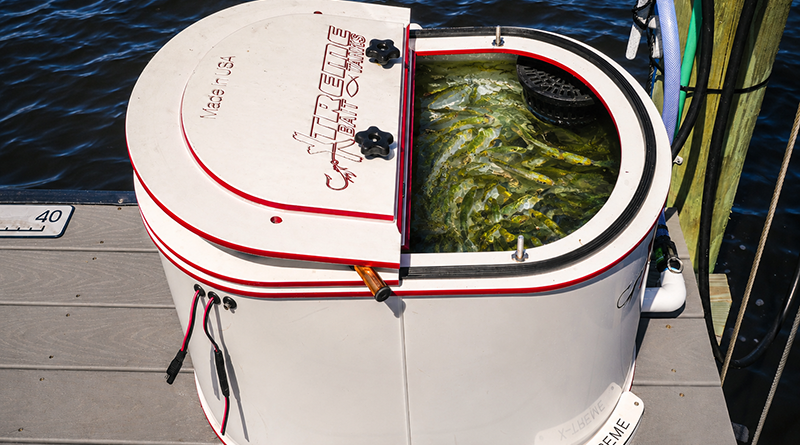
Professional fishing guides share their advice for keeping bait healthy and bait tanks performing at their best.
For boaters who fish live bait, a clean and well-maintained bait tank is one of the most important pieces of equipment on the boat. Even the best bait can quickly become weak, stressed or die if the tank environment is not properly maintained.
According to Damon Melcho, owner of X-Treme Bait Tanks, successful bait care comes down to a handful of fundamentals that apply regardless of the type of system an angler uses.
“Whether it’s a five-gallon homemade tank, a factory livewell or a professionally built bait system, the fundamentals are the same: clean water, adequate oxygen, proper circulation, stable temperatures and consistent maintenance,” Melcho said.
Over the years, Melcho has designed, built and troubleshot bait systems used by anglers across the country targeting everything from shrimp and pilchards to threadfin shad, blueback herring, trout and other freshwater and saltwater bait species. That experience has given him a broad perspective on what makes virtually any bait tank successful.
Rather than relying solely on his own experience, Melcho also encouraged several members of the X-Treme Bait Tanks Pro Staff to share the maintenance practices they use every day on the water.
“These anglers have decades of hands-on experience with many different styles of bait systems,” Melcho said. “While each of us has our own methods, it’s interesting how often we arrive at the same conclusions.”
Those professionals—including charter captains, fishing guides and longtime live-bait specialists from across the country—shared many of the same recommendations: keep the system clean, maintain consistent water circulation, monitor oxygen levels, inspect equipment regularly and address small problems before they become major ones.
Capt. Joshua Taylor, owner of Salty Scales Fishing Charters in Tampa Bay, knows firsthand how critical bait health can be. As a full-time fishing guide who targets species ranging from snook and redfish to tarpon and offshore gamefish, he depends on healthy bait every day.
“Healthy bait catches more fish, plain and simple,” Taylor said. “Whether I’m targeting snook, tarpon, trout, redfish or offshore species, the quality of my bait directly impacts my success on the water.”
According to Taylor, one of the most important aspects of bait tank maintenance is ensuring proper water flow and circulation.
“The most important thing is ensuring your bait tank maintains proper water flow and circulation,” Taylor explained. “Healthy bait depends on clean, oxygen-rich water constantly moving throughout the tank.”
Water quality is often the first thing to suffer when maintenance is neglected. As baitfish consume oxygen and produce waste, scales, slime and debris accumulate inside the tank and filtration system, creating conditions that stress bait and reduce survival rates.
Tommy Richardson, owner of Striper Redemption Guide Service and Bait Sales in South Carolina, also relies on healthy bait every day and uses an X-Treme Bait Tanks system aboard his guide boat. He said the foundation of every successful bait tank is cleanliness and dependable circulation.
“Healthy bait starts with clean, oxygen-rich water and reliable water circulation,” Richardson said.
He recommends routinely inspecting pumps to ensure proper water flow and aeration, cleaning or replacing filter media as needed, checking hoses, fittings and valves for leaks or blockages, monitoring water quality, temperature and oxygen levels, and making sure battery connections remain clean so pumps receive proper voltage.
Jason Spence, owner and operator of Two-Fisted Fishing Adventures in North Carolina, has spent nearly five decades catching and keeping virtually every type of live bait imaginable, including threadfin shad, blueback herring, alewives, crawfish, spring lizards and nightcrawlers. According to Spence, successful bait care starts with understanding how every component of a bait tank functions.
“Bait tanks come in many shapes and sizes, from coolers with aerators to professionally manufactured units,” Spence said. “All bait tanks should filter, aerate and circulate the water. It is critical that the components performing these tasks are working properly.”
He encourages anglers to become familiar with their individual systems, including how pumps, filters, hoses and aeration devices work together to provide the clean, oxygen-rich environment baitfish require.
To stay ahead of problems, Taylor regularly inspects pumps, intake screens, plumbing, spray heads and fittings.
“It only takes a few minutes, but catching a problem early can save an entire day’s worth of bait,” he said.
Taylor also recommends removing debris before it becomes a larger issue.
“Over time, scales, slime and debris can accumulate on the surface of the water,” he said. “Removing this buildup helps maintain water quality and keeps the system operating efficiently.”
Michael L. Eller, a longtime X-Treme Bait Tanks pro staff member and owner of a live bait business that has supplied blueback herring to anglers for more than 30 years, said cleanliness remains one of the most overlooked aspects of bait tank care.
“My thoughts are that the most important thing about a bait system is cleanliness, which needs to be done after use,” Eller said. “Maintain battery power at the highest speed to get the most out of your pumps.”
Contrary to what some anglers may think, Taylor doesn’t believe every bait tank requires a complete deep cleaning after every trip.
“As a guide who fishes frequently, I typically perform a thorough cleaning every few days, depending on how heavily the system is being used,” he said.
His routine includes emptying the tank, rinsing it thoroughly, inspecting plumbing, cleaning intake screens, checking filtration systems and ensuring spray heads are delivering proper water flow.
“The key is consistency,” Taylor said. “Small amounts of maintenance performed regularly are far more effective than waiting until a problem develops.”
Richardson follows a similar philosophy but recommends every angler perform at least a light cleaning after each outing.
“A bait tank should receive a light cleaning after every trip and a more thorough cleaning every few weeks during heavy use,” Richardson said.
After each trip, he recommends draining the tank completely, removing dead bait, scales and debris, rinsing the tank with clean water and flushing pumps and plumbing with fresh water. During more thorough cleanings, Richardson advises removing and cleaning filters and screens, inspecting pump impellers for debris or wear, cleaning plumbing lines if buildup is present, checking fittings and electrical connections, and sanitizing the tank with a bait-safe cleaner.
“Avoid harsh chemicals or soaps that may leave residue harmful to bait,” he added.
Spence agrees that cleaning should extend beyond simply rinsing the tank.
“The basics are to wash the filters and remove trapped scales, slime and other debris before putting them back into service,” he said. “It’s also important to remove old water, rinse the tank thoroughly and flush the plumbing with fresh water to eliminate waste and contaminants.”
According to Spence, how often filters require cleaning depends on the amount and species of bait being carried, as well as the style of filtration system being used.
One of the most common mistakes Taylor sees is anglers waiting until bait starts dying before investigating their system.
“Most bait tank issues don’t happen overnight,” he said. “Water flow slowly decreases, intake screens become restricted, pumps lose efficiency and water quality gradually declines. By the time bait starts showing signs of stress, the problem has often been developing for a while.”
Another frequent issue is overcrowding.
“Even a high-performance bait tank has its limits,” Taylor said. “Too many pilchards, threadfins, greenbacks or herring in one tank creates stress, increases waste and reduces oxygen availability.”
Richardson said several other common maintenance mistakes can also quickly compromise bait health.
“Not cleaning the tank after each trip, ignoring filters and pump screens, overcrowding the tank, running worn-out pumps and allowing water temperatures to get too warm are some of the biggest mistakes I see,” Richardson said. “The result is stressed bait, increased mortality and poor fishing performance.”
He also cautioned anglers against using untreated water from poor-quality sources because it can introduce contaminants, parasites or algae into the bait system.
Summer heat can make those problems even worse. As water temperatures rise, dissolved oxygen levels decline, leaving less room for error.
“As water temperatures approach the 90-degree mark, oxygen levels decrease and overcrowding can quickly stress or kill your bait,” Taylor explained. “Keeping fewer baits in the tank helps maintain water quality, improves oxygen availability and keeps your bait healthier throughout the day.”
Richardson agrees that water temperature is often overlooked.
“Many anglers focus heavily on pumps and filtration but overlook water temperature, which is often the biggest factor in bait survival,” he said. “Even the best bait tank on the market cannot overcome excessively warm water.”
He also recommends avoiding sudden temperature changes when transferring bait, matching the tank design to the species being carried and learning proper stocking rates for different baitfish.
Taylor also encourages anglers not to overlook their electrical systems.
“A perfectly designed bait tank can’t perform if the pump isn’t receiving proper voltage,” he said.
Spence recommends making electrical and mechanical inspections part of every pre-trip routine. He advises checking electrical connections for corrosion or looseness, inspecting hoses for cracks or leaks, replacing damaged filters, listening for unusual pump noises and making sure pumps are producing adequate water flow.
“Pumps should hum, not grind or squeal,” Spence said. “Always carry a spare pump because they can quit without warning, and without one you’ll have dead bait.”
He also recommends keeping electrical butt connectors, wire strippers and electrical tape aboard for emergency repairs.
Fortunately, baitfish often provide early warning signs when something is wrong.
“If bait begins gathering at the surface, swimming erratically, flashing excessively, losing scales or appearing lethargic, it’s time to start checking your system,” Taylor said.
Other signs include reduced water flow, weak spray patterns, unusual pump noise, vibration, cloudy water or slower tank turnover.
Richardson said anglers should also pay attention to warning signs from the equipment itself.
“Reduced water flow from spray bars, uneven water circulation, excessive pump noise or vibration, water discoloration, foul odors or bait gathering near water inlets seeking oxygen are all signs that something may not be operating properly,” he said. “If baitfish begin showing signs of stress before anglers notice equipment problems, the system may already be underperforming.”
Spence said simply observing the bait tank can reveal many developing problems before they become serious.
“Is the water moving? Can you see air bubbles? Is the water clear?” he said. “Those observations will quickly tell you whether the tank is operating properly.”
According to Spence, poor circulation often indicates a failing pump or obstructed plumbing, while a lack of bubbles suggests the aeration system is no longer supplying enough dissolved oxygen. Red noses, lethargic bait or unexplained bait mortality are all signs that immediate attention is needed.
Neglecting maintenance can have consequences beyond losing bait. Restricted water flow forces pumps to work harder, increasing wear and shortening the lifespan of pumps, plumbing and filtration systems.
Richardson said poor maintenance affects both bait survival and the equipment itself.
“Lower oxygen levels, increased ammonia buildup, greater disease risk, higher stress levels and significant bait loss are common results of poor maintenance,” he said. “At the same time, neglected systems experience shortened pump life, clogged plumbing and filters, electrical issues, premature wear on fittings and components, and more costly repairs.”
Taylor said those problems ultimately lead to what every angler hopes to avoid.
“Poor maintenance often results in stressed bait, reduced survival rates and ultimately fewer fish caught,” he said. “Nobody wants to spend time catching bait or spending money on premium bait only to watch it struggle and ultimately die.”
For charter captains, tournament anglers and serious fishermen, the stakes can be even higher.
“A bait tank failure can ruin an entire trip,” Taylor said.
Spence said preventive maintenance is almost always easier than trying to diagnose problems after the tank is already full of bait.
“Time spent on maintenance before bait is introduced to the tank is much better than troubleshooting when a problem arises,” he said.
He believes every angler should understand the three primary functions of a bait tank: circulation, aeration and filtration.
“The key to successfully keeping lively bait is understanding the operations the tank performs,” Spence said. “How the pumps, filters and hoses work together provides the specific environment your bait needs. There are many different bait species and many styles of tanks, but a solid maintenance plan is vital for reliable performance.”
Eller noted that one often-overlooked component can create serious problems even when the rest of the system appears to be functioning properly.
“I would think the most commonly overlooked part of a bait system is the air intake,” Eller said. “It accumulates algae and dirt. If it’s not providing good airflow to aerate the bait, it will kill them. The pump will run and sound fine, but you don’t hear the sucking of air.”
His comments highlight an important lesson for anglers: a bait system may appear to be functioning normally while still failing to provide the oxygen exchange needed to keep bait healthy.
If Taylor could offer anglers only one piece of advice, it would be simple: stay proactive.
“Don’t wait for a problem to appear,” he said. “The anglers who consistently have the healthiest bait are usually the same anglers who consistently inspect and maintain their systems.”
Richardson offered similar advice, comparing bait tank maintenance to routine engine maintenance.
“Treat your bait tank like you treat your boat’s engine—don’t wait until something fails to maintain it,” Richardson said. “Preventive maintenance is far less expensive than replacing pumps, losing bait during a tournament or dealing with system failures on the water. A few minutes of cleaning and inspection after each trip can dramatically improve both bait survival and equipment longevity.”
Spence agreed, emphasizing that successful bait care requires more than simply purchasing a quality tank.
“There are many different baits and many styles of tanks,” he said. “Each has specific needs, but reliable performance comes from understanding your system and maintaining it properly.”
Ultimately, all four professionals agree that successful bait care begins with quality equipment, routine maintenance and attention to detail.
“Not all bait tanks are created equal,” Taylor said. “The shape of the tank, water circulation, filtration efficiency and overall system engineering all play a major role in bait survival.”
Richardson echoed that sentiment.
“At the end of the day, the best bait tank isn’t just the one with the most features,” he said. “It’s the one that’s properly maintained and provides consistent circulation, filtration and oxygen for healthy bait every trip.”
For anglers hoping to maximize bait survival and spend more time fishing and less time troubleshooting, a few minutes of preventative maintenance may be one of the best investments they can make. Whether it’s inspecting pumps, cleaning filters, checking electrical connections or simply paying attention to how bait behaves throughout the day, routine maintenance helps ensure a bait tank performs the way it was designed.
Melcho said one of the biggest mistakes anglers make is waiting until something goes wrong before paying attention to their bait system.
“If you fish with live bait, your bait tank is the most important piece of equipment on your boat,” he said. “Take care of it, and it’ll take care of your bait.”
A clean tank, proper water flow, dependable aeration and consistent preventative maintenance can mean the difference between a tank full of lively bait and a tank full of missed opportunities. And as Taylor put it, “Healthy bait catches more fish.”
For more information on X-Treme Bait Tanks, please visit xtremebaittanks.com.