No matter what type or size of boat you own, safety on the water largely comes down to the quality of cordage, or “line,” employed on your decks. Though this is obviously of primary concern to those of us who own sailboats, motorboats also use line for fenders, personal flotation devices (PFDs), anchor line and other various types of gear requiring secure tie-downs.
Before running off to buy a roll of line, you first need to know what type of materials, construction and size of line are best suited for the application you have in mind. Different types of polymers are suited for specific purposes, so we want to ensure the line we choose is destined only for the job intended.
Boat line can be broken down into four categories, each of which offers a range of options, depending on boat size and personal preference: running rigging; docking; anchoring; and small craft, which includes dinghies, jet skis and PFDs.
Running Rigging
Running rigging refers to all the lines used to manage a sailboat, including halyards for hoisting sails, sheets for managing sail trim, topping lifts, preventers, boom vangs and various other applications. The line we use for these needs to be low-stretch, abrasion-resistant and brutally strong in order to keep our sails trimmed for maximum performance.
Polyester line with a braided filament core and a bright, colorful, braided shell is what you’ll see on modern yachts plying the waters of Southern California and throughout the yachting world. If you’re planning to buy new running rigging for your sailboat, check out the selections offered by New England Ropes, Samson, CBKnot and other manufacturers.
The style of weave and color selections will vary among these three rope manufacturers, but they all offer highly dependable line designed to keep your vessel safely underway in all types of weather, if properly employed.
For applications requiring extra strength and durability, consider Sta-Set X double-braided line from New England Ropes. Sta-Set X has a layer of polyester cloth between the inner and outer braids to ensure greater strength and lower stretch, making it ideally suited to halyards and spinnaker sheets. I personally have used Sta-Set X for many years as the mainsheet on my 1966 Cal 30 Saltaire, and though it is a bit stiff for the job, it’s lasted for more than 20 years and 40,000-plus miles of offshore and coastal sailing.
Docking
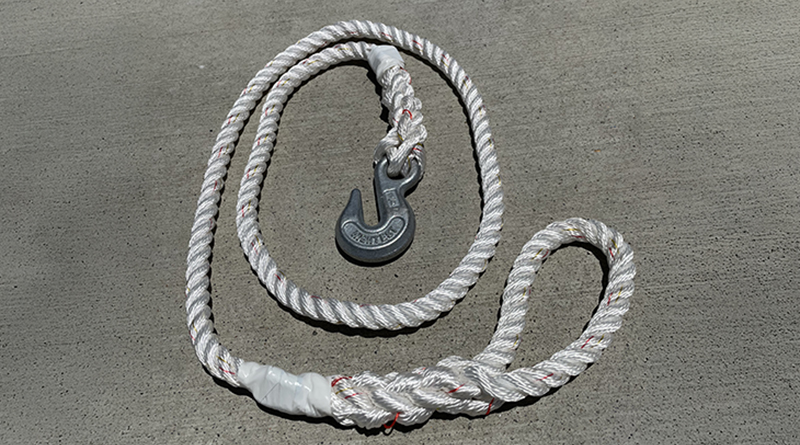
When tying off your vessel to a dock, you want the line to have a combination of qualities, including high strength to ensure the safety of the vessel, moderate stretch to protect deck cleats, and softness for easy coiling and flaking. The traditional line with which most of us are familiar is white, three-strand nylon, which is easy to cleat off on the dock and has adequate stretch, ensuring the deck cleat doesn’t fly right off the dock when a jet ski throws a fast, tall wake.
Another really great attribute of three-strand line is its ability to be woven into eye splices for easy docking and line splices for combining two or more lengths of line into a much greater length. For this job, you’ll need a fid to aid you in weaving loose strands through woven line.
Owners of larger yachts often choose double-braided nylon line or New England Ropes’ Premium 8 Plait woven nylon dock line to ensure added strength. Samson Harbormaster Yacht Line, with its distinctive bronze and white braid, is another high-quality nylon dock line preferred by many owners of larger yachts.
If you choose double-braided line for docking or any other purpose, you can make eye splices with a rope splicing tool kit, which includes several fids to accommodate different sizes of rope core. Sending rope core back down through a double-braided shell to form a solid eye splice is not an enviable job, but if done properly, the result will last for many years.
Anchoring
As with docking, the line you choose for anchoring will be either three-strand or double-braided nylon. However, don’t even toy with the idea of attaching nylon line directly to the anchor. To ensure a safe amount of weight behind it, you’ll need a bare minimum of one full boat length of chain, which in turn you’ll attach to the nylon rode with a chain-to-rope splice. Similar to an eye splice or line splice, a chain-to-rope splice simply entails weaving the strands back up the line several inches to ensure a strong, permanent connection.
In the case of double-braided nylon line, again, use a fid to pass the core back under the shell, providing enough length (a foot or more, depending on line diameter and potential load) to ensure proper strength for the size and weight of the vessel.
When anchoring with all chain, you will still need to have a separate snubber line made of nylon rode to act as a shock absorber for the chain. Large waves can destroy your windlass, bow cleat, bow roller or deck structure unless you protect your vessel with a big “rubber band,” which also acts as a sound absorber.
As a side note, my boat, the Saltaire carries 150 feet of 5/16-inch BBB chain and 250 feet of 5/8-inch three-strand nylon road. In the Channel Islands, the deepest anchoring I’ve done has been in roughly 60 feet, which has required all 150 feet of chain plus roughly 50 feet of nylon rode, allowing just over a three-to-one length-to-depth ratio, the minimum we need for safe anchoring.
Small Craft
For dinghies, jet skis and other recreational flotation devices, the safest choice is polypropylene line, be it three-strand or double-braided. Polypropylene line floats and is brightly colored, usually yellow, making it easy to spot on the water.
Polypropylene doesn’t have nearly the same tensile strength or lifespan as polyester or nylon, but on small craft, the keys to safety are visibility and buoyancy. If in a moment of desperation you throw a lifeline to a potential drowning victim, you want to know it is not the jib sheet but brightly colored, always floating polypropylene.
Do your due diligence in studying the various attributes of types of marine line, and pass by your local chandlery to study their collection of cordage. By choosing yacht line carefully, you’ll add greatly to the performance of your vessel and to the safety of crew and passengers.