

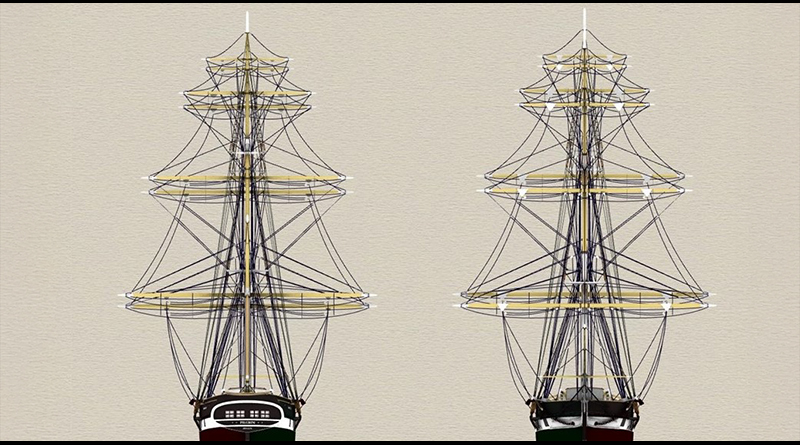
Nearly two centuries after the brig Pilgrim first sailed into Alta California — and later into literary fame through Richard Henry Dana Jr.’s classic Two Years Before the Mast — a new effort is underway to re-create the ship as a fully functional, Coast Guard inspected sailing vessel. The ambitious project, known as PILGRIM III, is being guided by the newly formed PILGRIM III Foundation, which has set out to design, engineer, and build a historically faithful re-creation of the 1825 brig while adapting it to modern safety standards.
Behind the timing of the project is both loss and a renewed sense of purpose, according to Doug Sharp, who described the origins of the effort in personal and historical terms. “The decision to recreate the Brig PILGRIM now was inspired by two events – the irretrievable loss of the PILGRIM II in Dana Point several years ago and the Benefactor’s vision to provide an historically accurate ship to the California maritime community that could be used for educational and ocean adventures purposes. The ship is intended to tell the story of early California, trade between the wild pre-State California and the more established eastern seaboard of the young United States and provide authentic early 19th century seafaring experiences once it is put into commission.”
The goal is as historic as it is educational: to return a vessel of immense cultural significance to California’s waterfront and, in doing so, create a living classroom for maritime history, traditional craftsmanship, and youth sailing programs. The foundation envisions a ship that will not only honor the original Pilgrim but also serve as a platform for teaching, exploration, and public engagement.
A Vessel Rooted in History
The original Pilgrim was launched in 1825 from Medford, Massachusetts, built by Sprague and James. It became widely known thanks to Dana’s firsthand account of life at sea, chronicling the hide trade off the coast of California and offering an unparalleled look into the region during its pre-statehood years. For generations, the ship has been a symbol of early American enterprise, maritime trade, and the formative years of the West Coast.
The builders of PILGRIM III intend to honor that legacy while embracing the realities of 21st-century vessel construction. The replica will follow the brig-rigged silhouette and traditional details of the 1825 design, but modern naval architecture, updated engineering, and advanced construction methods will ensure that the ship meets today’s U.S. Coast Guard requirements for inspected Sailing School Vessels. As Sharp noted, regulatory requirements are only one part of a much larger undertaking: “The project depends on six significant categories of need, each of which presents it’s own challenges: 1) The historical record of the original ship and how to incorporate into a modern accurate recreation, 2) wrapping a doable design around the need to create the working ship to the vision of the benefactor and supporting Foundation, 3) finding and arranging an appropriate place on which to build and launch the ship, 4) gathering the myriad materials (modern, traditional and capable of approval in modern context) necessary to construct and outfit the ship, 5) gathering an experienced and technically capable crew of shipwrights and builders that also have a feeling for the context of the project and how to interpret the historic shipbuilding practices into the modern project as well as an ability to work with volunteers and students to impart their knowledge and understanding of the traditional and modern practices of shipbuilding and 6) arranging the financial support necessary to accomplish the first 5 items. In terms of the overall, working within the constraints of the requirements for Certification as a Sailing School Vessel is just one, albeit a very important one, of the significant challenges in the project to bring the Brig PILGRIM III to life and one in which we are working closely in partnership with the local sector Coast Guard office of Marine Inspections.”
The result will be a historically accurate but functional ship capable of sailing, educating, and engaging the public for decades to come.
A Community-Built Ship
Central to the foundation’s vision is the belief that the construction of PILGRIM III should be as meaningful as the vessel itself. Rather than building behind closed doors, the organization hopes to create a shipyard that welcomes community involvement and cultivates maritime skills. Sharp emphasized that participation is part of the long arc of the project, even as the work remains focused on the primary mission. “We welcome the community to participate and will be working with the various groups the accrue to the project in developing the skillsets they desire to gain from their participation. Understand that the mission of this project is to build the ship. Collateral benefits to the community in terms of educational opportunities will develop as we progress and will most likely evolve into many different directions – all with a firm grounding in historical aspects of shipbuilding, maritime trade, naval architecture, seafaring and, as in the book in which the original Brig PILGRIM was featured, a realization of the life of the common American mariners in the early 19th century shipping aboard US trade vessels.”
Building a traditional ship requires an expansive, open site with room for shaping large timbers, assembling components, storing materials, and ultimately launching the completed hull. The creation of such a shipyard will become a significant undertaking on its own — one that the foundation describes as a chance for the community to witness shipbuilding “from raw materials to completed ship.”
The human element is equally vital. Constructing a historically accurate brig demands specialized knowledge in woodworking, rigging, vessel design, and traditional craftsmanship. Though the old shipwright wisdom of the early 1800s is long gone, the foundation notes that the curiosity and passion behind such work remain ingrained in those drawn to the sea. The project aims to gather skilled shipbuilders, students, volunteers, and enthusiasts, offering participation at multiple levels, from expert to apprentice, to ensure the knowledge continues forward.
Crafting a Ship from the Right Materials
The new brig will be built from a carefully selected collection of hardwoods sourced throughout the Western Hemisphere. Each species has been chosen for its strength, weight, flexibility, or resistance to rot, depending on its placement within the ship.
Materials will include Purpleheart, Wana, Sapele, Southern Live Oak, Douglas Fir, Western Cedar, Hackmatack, and Black Locust. Handling such massive timbers, each destined for a frame, plank, keel, or deck beam, requires precision and experience, and the process of shaping and installing them is described by the foundation as “an art form in itself.”
For visitors and volunteers, watching these materials take shape will provide a rare window into how ships of the 19th century were constructed.
Funding a Modern Maritime Vision
While the original Pilgrim came to life through Yankee enterprise and the booming maritime trade of the early 19th century, PILGRIM III is taking a decidedly contemporary approach to financing. The PILGRIM III Foundation was established as a not-for-profit entity dedicated exclusively to designing, building, and eventually operating the vessel. In a modern twist, the foundation intends to utilize Bitcoin as its primary medium of exchange.
Supporters say the Bitcoin ecosystem offers unique opportunities for funding innovation, attracting global contributors, and streamlining the purchase of materials and construction services. The foundation sees the financial model itself as an experiment in pairing historic craftsmanship with emerging digital economies.
A Future Educational Icon
Once complete, PILGRIM III will serve as an active participant in California’s maritime landscape. The foundation anticipates a robust schedule of youth sailing programs, hands-on educational opportunities, public sails, community events, and dockside interpretation highlighting the formative era of California’s coastal history.
The ship is expected to join the small but significant fleet of historic vessels in the state, giving students and visitors a chance to step back into a chapter of maritime life that shaped early commerce and cultural development along the Pacific Coast.
For those who join the project now, be it as donors, volunteers, students, or maritime enthusiasts, the venture represents a rare chance to witness and contribute to the construction of a true, working brig. It’s a once-in-a-generation opportunity to rebuild a piece of history, plank by plank, and bring one of America’s most storied vessels back to the water.
As the PILGRIM III Foundation moves forward, the call remains open: learn the history, study the craft, join the build team, or simply follow along as the project transforms raw timber, human skill, and bold vision into a ship worthy of its name. For more details, visit piiiconstruction.com/.


2 Responses
where will the shipyard be proposed? how can we get on a list for volunteers?
Joe, it is being built at Driscoll Mission Bay they are setup and work has started it will be at least a 3 year project