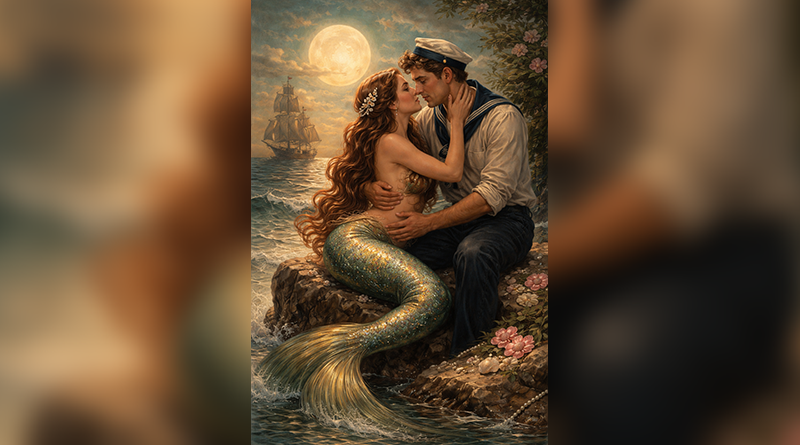
Long before charts were accurate and coastlines well known, sailors filled the blank spaces on maps with stories. Some warned of monsters and whirlpools. Others told of love. Among the most enduring of these tales are stories of mermaids and sailors — romances that exist somewhere between longing and loss, desire and danger, beauty and the unknowable power of the sea itself.
Across cultures and centuries, mermaids have appeared in maritime folklore as enchanting, elusive figures who blur the line between human and ocean. They’re often described as stunningly beautiful, with voices capable of drawing sailors from their ships and into the water. But these stories are rarely simple fairy tales. Instead, they reflect the emotional realities of life at sea: isolation, temptation, homesickness, and the powerful pull of something just out of reach.
In many early European legends, mermaids weren’t always benevolent. To sailors navigating long voyages far from home, the sea could feel both nurturing and cruel, and mermaids embodied that contradiction. A sailor might glimpse a mermaid at dusk, singing from the rocks or floating just beneath the surface. She promised comfort, intimacy, and escape from the harshness of shipboard life. Yet following her often led to shipwreck, loss, or disappearance. Love, in these stories, came with consequences.
In Scandinavian and Celtic folklore, similar figures appeared as selkies or sea women — beings who could move between land and sea. One common tale tells of a fisherman who finds a selkie’s sealskin hidden on shore. Without it, she cannot return to the ocean, and she becomes his wife. They live together, sometimes happily, sometimes uneasily, until one day she finds her skin and returns to the sea, leaving behind children and a husband who loved her but could never truly keep her. These stories are not about betrayal so much as inevitability. The sea always calls its own back.
For sailors, these myths mirrored real life. Relationships formed on land were often shaped by long absences, uncertainty, and the constant awareness that the ocean could take someone away without warning. Mermaids represented both the comfort sailors missed and the dangers they faced. They were the embodiment of longing itself, made visible in moonlight and foam.
In Mediterranean traditions, sirens filled a similar role. Unlike later romanticized versions, early sirens were not gentle figures but powerful, dangerous ones. Their songs were irresistible, pulling sailors toward rocky shores. In these stories, love was not safe or domestic. It was overwhelming, consuming, and capable of destroying even the most disciplined mariner. The lesson was clear: the sea offers beauty, but surrendering to it entirely can be fatal.
As maritime culture evolved, so did mermaid stories. By the 18th and 19th centuries, mermaids began appearing in sailors’ journals, tattoos, and figureheads, often depicted less as monsters and more as symbols of hope and companionship. For men who spent months or years away from home, mermaids became a stand-in for women left behind, imagined companions during lonely watches, and reminders of why they endured the hardship of life afloat.
Mermaid figureheads on ships were particularly telling. Carved into the bow, they faced forward, leading vessels into unknown waters. Sailors believed they offered protection, good luck, and guidance. Love, in this context, was no longer something that lured sailors to destruction, but something that watched over them as they crossed vast, unpredictable seas.
Some maritime love stories placed mermaids not as temptresses, but as tragic figures. In certain legends, mermaids fell genuinely in love with human sailors, longing for souls, legs, or a life on land. These tales often ended in sorrow. The mermaid might sacrifice her voice, her immortality, or her home, only to find she could never fully belong among humans. These stories flipped the narrative. Now it was the sea creature who suffered for love, echoing the sacrifices made by those who waited ashore for sailors who might never return.
Even today, these myths resonate with modern mariners. Anyone who has stood watch alone at night, staring into dark water under a full moon, understands how imagination and emotion can blend at sea. The ocean amplifies feelings. Loneliness feels deeper. Attraction feels stronger. Longing stretches out like the horizon itself.
Mermaid stories endure because they speak to something universal in maritime life: the idea that loving the sea means accepting a certain kind of distance. Sailors often love people they cannot always be with, just as mermaids love worlds they cannot fully inhabit. These romances exist in the space between departures and arrivals, between what is desired and what is possible.
In coastal communities, mermaid folklore became part of local identity. Ports told their own versions of sightings and encounters. Fishermen claimed to have seen figures in the water at dawn. Children grew up hearing stories passed down through generations, half-believed and half-dismissed, but always cherished. These tales gave personality to the sea and made it feel alive, watching, and aware.
Valentine’s Day, often associated with roses and candlelit dinners, may seem far removed from storms and salt spray. Yet maritime love stories remind us that romance has never been confined to safe or predictable spaces. Love at sea has always involved risk, patience, and faith. Whether through mythical mermaids or real-world relationships shaped by tides and seasons, maritime romance is defined by longing as much as by connection.
Perhaps that’s why mermaids remain such powerful symbols. They’re not simply creatures of fantasy. Mermaids are reflections of the emotional landscape sailors navigate every time they leave shore. They represent the beauty that draws people to the sea and the sacrifices required to live with it.
In the end, mermaid tales are not warnings against love, nor are they invitations to chase fantasy. They’re reminders that the sea, like love, is vast, unpredictable, and impossible to fully possess. To love either one is to accept that some part of it will always remain just beyond reach, shimmering on the horizon, calling softly, and never entirely yours.
And maybe that is exactly what makes maritime love stories endure.