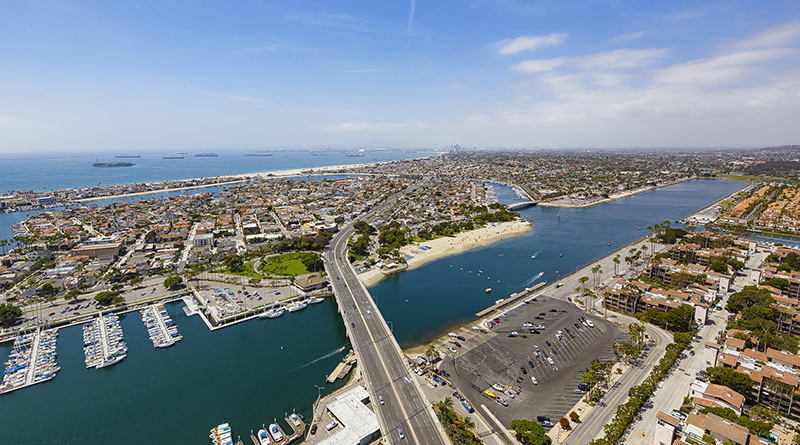
For more than six decades, the Second Street Bridge — officially named the John H. Davies Bridge — has quietly carried the daily rhythm of Long Beach across Alamitos Bay. It’s the route residents take to work, the path visitors follow toward Belmont Shore and Naples, and the link boaters, cyclists and pedestrians use to move between waterfront neighborhoods and Pacific Coast Highway. Since opening in 1959, the bridge has been less a landmark than a lifeline.
That lifeline is now preparing for a significant transformation.
Following years of inspections, testing and engineering review, the City of Long Beach is preparing to launch a full replacement of the bridge’s concrete deck, along with major safety and mobility upgrades that will change how the structure looks and functions for decades to come. Construction is targeted to begin in fall 2026 and continue through winter 2027, roughly one year of work that is expected to affect traffic patterns and daily commutes for thousands of people who rely on the bridge each day.
The project stems from findings that date back nearly a decade. As Assistant City Engineer, Joseph Khilla, P.E., T.E., explains, “In 2017, LA County’s Bridge Inspection Report (BIR) rated the 2nd Street Bridge ‘Structurally Deficient’ due to the condition of the bridge’s deck. Material testing of its concrete in 2019 supported those findings.”
While the terminology can sound alarming, the rating reflects long-term infrastructure planning rather than an immediate safety threat. Khilla clarifies how these classifications are determined, noting, “Under federal inspection criteria, a bridge is classified as ‘structurally deficient’ when one or more key structural components, such as the deck, superstructure, or substructure, are in poor condition and require rehabilitation or replacement. The 2nd Street Bridge deck, constructed in 1956, is made up of reinforced concrete which shows signs of aging due to moisture and traffic loading over many decades. Moisture can be from standing water, drainage issues, advanced weather, etc., similar to the roof on a house. While the bridge remains open and safe for travel, the City is proactively advancing this project to improve the Bridge structure and keep it in service for generation to come.”
In fact, inspection ratings are intended to guide maintenance priorities and extend the useful life of infrastructure before problems become critical. Khilla adds important context to how these ratings are used nationwide: “Bridges are generally inspected every two- to four- years to assess their condition and identify needs. Depending on where the bridge is located, the County or the State is contracted to provide these inspections for Local Agencies (like the City of Long Beach) so that there is uniformity with inspection standards, following Federal Highway Administration (FHWA) National Bridge Inspection Program (NBIP).
The findings from these inspections and rating reflect the condition and remaining service life of a bridge so that the asset/bridge owner can address these conditions to preserve infrastructure, extend lifespan, and avoid costly repairs. In the beginning of 2018, the FHWA eliminated the term ‘Structurally Deficient’ from use in their NBIP and instead use the rating ‘Poor’. Poor condition suggests major reconstruction investment is needed. Of course, should there be a concern to public safety, immediate measures will be taken; but the rating findings are not a direct proportional measure to public safety. To put a national scale perspective on Bridge conditions, the American Society of Civil Engineers publishes a nation infrastructure report card. More than half of the nation’s bridges are assessed to be in ‘fair’ (49.1%) or ‘poor’ (6.8%) condition, giving our nation a ‘C’ rating. Our nation needs to invest more in our infrastructure and prepare the future generation which will be looking after it.”
The marine environment around Alamitos Bay plays a role as well. As Khilla explains, “Most damage to most bridges is caused by water/moisture/weather/corrosion, loading/wear over time, and earth movement (earthquakes), whether metal or concrete, whether over land or water.”
Because the deterioration is widespread rather than isolated, patchwork repairs are not enough. Khilla describes why a full deck replacement is the most effective solution: “The current bridge deck is built with two symmetrical, monolithic, reinforced concrete slabs which join at the center of the existing median. They were cast-in-place concrete, meaning the reinforcement metal and concrete was formed and poured to fit this specific design and location. The type of wear observed is not localized (not in specific spots) and therefore a full deck replacement is necessary, in alignment with the inspection report.”
She also notes that the redesign goes beyond structure and must comply with modern transportation laws. “The City works with consultants and subject matter experts in making decisions for and designing major structural replacements such as this 2nd Street Bridge Deck project. We have to not just design the physical material of the bridge but think about how it fits into our built environment and comply with other requirements set by laws such as Assembly Bill 1358 (Complete Streets Act of 2008) and Senate Bill 1216 (Class III bikeways: prohibition).
These laws require Cities to meet the needs for all roadway users (drivers, transit users, cyclist, and pedestrians alike) as well as reconsider the existing bike facility through this section of 2nd Street. The final product will be better, both structurally and operationally, improving long-term durability while enhancing navigability and safety for all roadway users. It will create a more welcoming gateway into the City and a comfortable space to enjoy a view of the bay and marina.”
This isn’t the first modernization effort for the bridge. In 1998, it underwent a seismic retrofit. The upcoming project addresses the aging deck and reimagines how the space functions for today’s mix of drivers, cyclists and pedestrians.
Funding for the project reflects its priority status. Khilla explains how projects like this rise to the top for federal support: “The Federal Highway Bridge Program (HBP) is funded by the Federal Highway Administration and administered in California through the California Department of Transportation.
Under this program, local agencies apply for funding to support bridge repairs, replacement, rehabilitation, retrofitting, preservation, protection, and other improvements.” She outlines the prioritization system and adds, “This project is funded through the Bridge Highway Local System (BHLS) program, a component of HBP that specifically focuses on locally owned bridges and roadways. BHLS prioritizes projects that address aging or structurally deficient bridges, extending service life and preventing further deterioration. HBP funds can only be used to directly address the bridge needs and the directly adjacent infrastructure.”
When complete, the payoff will be long-term. As Khilla notes, “We hope to get another 50 to 75 years out of the bridge deck and we will continue to look after the other parts of the bridge and keep them maintained and serviceable for the people who live, play, and work in Long Beach. It’s worth noting that the City completed seismic retrofits to this bridge in 1998.”
For residents, boaters and waterfront visitors, the improvements will be visible. The entire deck will be replaced. Traffic lanes will be reconfigured. Protected bike lanes and upgraded pedestrian barriers will be added. Lighting and railings will be modernized. The bridge will look familiar, but it’ll function better for the way people actually use it.
During construction, some access will remain, but drivers should expect detours, lane reductions and delays. A virtual community meeting took place on February 5, 2026, to help residents understand what to expect and to ask questions.
For the boating and coastal community, this bridge is more than pavement and concrete. It frames Alamitos Bay, connects neighborhoods to marinas and waterfront dining, and serves as one of the most recognizable crossings in Long Beach. The upgrades acknowledge that this is not just a traffic corridor, but part of the coastal lifestyle.
When the project wraps in winter 2027, the Second Street Bridge will be ready for its next half-century of service, carrying Long Beach safely across the bay once again.