Most boats that sink in marinas don’t go down because of storms, collisions or dramatic accidents. Instead, they’re often lost quietly at the dock when a hose slips off, a clamp fails or an aging plastic through-hull fitting snaps without warning. In those moments, seawater begins entering the hull through an opening below the waterline, and the situation can escalate faster than many boaters realize.
That’s when one of the smallest and least expensive pieces of safety equipment on board suddenly becomes the most important. Emergency boat plugs — often called bungs — are simple, tapered cones made of soft wood or pliable plastic that are designed to be driven into a leaking hole if a through-hull fitting fails. They,re inexpensive, easy to store and frequently overlooked until they’re desperately needed.
Nearly every boat has multiple through-hull fittings beneath the waterline. These include engine raw-water intakes, head intake and discharge lines, sink drains, livewell pickups, air conditioning intakes, scuppers and cockpit drains. Each of these connections relies on hoses, clamps and fittings that age over time. If one of them breaks or comes loose, the result is an open hole in the bottom of the boat allowing water to rush in at an alarming rate. In that moment, the solution is not complicated, but it must be immediate. A properly sized plug, hammered into the opening, can stop or drastically slow the flow of water long enough to stabilize the situation and get back to the dock for repairs.
For decades, wooden plugs have been a staple aboard boats for this very reason. Typically made from soft pine, these plugs compress as they are driven into place and then swell slightly when wet, creating a tight, reliable seal. They also conform well to irregular openings, such as those caused by cracked plastic fittings, and can even be trimmed with a knife if needed to fit an unusual shape. That adaptability is why wooden bungs remain so effective in real-world emergencies.
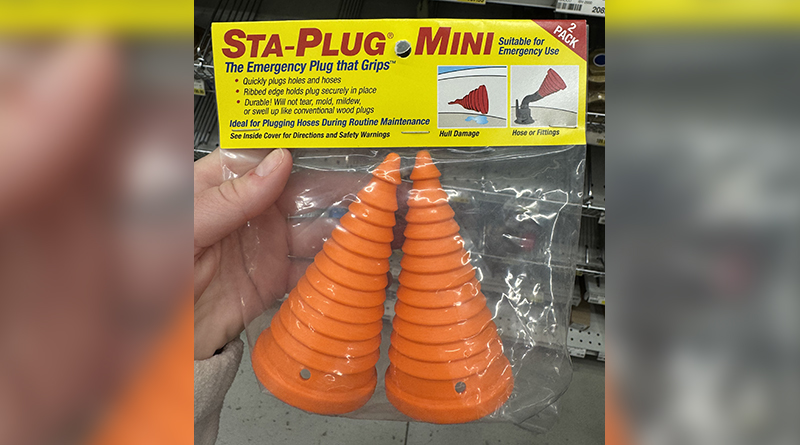
At the same time, modern plastic plugs have gained popularity for their durability and versatility. Unlike wood, they won’t rot, mold or swell in a damp bilge, and their flexible cone shape allows them to conform to irregular holes. Many feature ridges that help them grip when forced into place. Plastic plugs also serve a practical purpose during routine maintenance, allowing boaters to temporarily plug hoses to prevent messy drips while working on onboard systems. For this reason, many experienced boaters carry both types.
Beyond simply owning a set, there’s a best practice that marine surveyors consistently recommend. Rather than storing plugs in a toolbox or drawer, a plug should be tied with a short length of cord directly to every seacock or through-hull fitting. In a flooding situation, no one remembers where they put the bag of emergency gear. Boaters instinctively go straight to the source of the leak, and having the plug already within reach can make all the difference.
This matters more than many realize because through-hull failures are one of the most common reasons boats sink at the dock. The scenario is often surprisingly routine. A plastic fitting that’s been exposed to years of sun and saltwater becomes brittle and cracks. A hose clamp corrodes and fails. A hose works itself loose. Water enters quietly and steadily until the bilge pump can no longer keep up. What could have been a manageable emergency turns into a costly loss.
Part of being prepared also means having the correct sizes on hand. Through-hull fittings vary widely in diameter, often ranging from half an inch to an inch and a half or more. Emergency plugs are sold in sets for this reason, and each plug should be slightly larger than the hole it’s intended to fill so that it wedges tightly when driven in, creating a secure seal.
The concept itself is simple to understand. An emergency boat plug is essentially a cork for your hull when something below the waterline breaks. It’s one of the least expensive pieces of safety equipment aboard any vessel, yet it has the potential to prevent one of the most expensive and devastating outcomes a boat owner can face.