If you’ve spent much time hanging around with some of the “old salts” in our local marinas, you no doubt have heard the old saying, “The most important piece of equipment on your boat is the anchor.” It’s just like brakes being the most important feature of an automobile. And, as we ocean cruisers know, we actually spend most of our “cruising” time at anchor.
Having not just one, but at least two anchors onboard our vessels (I carry four) is essential for all inshore and particularly offshore vessels. If anchored in a gale, you’ll need to put out two bow anchors, along with plenty of chain, to ensure a firm hold. If you are forced to anchor in a side wind, you’ll need both a bow and stern anchor to avoid whatever obstruction, such as rocks or a beach, you are trying to avoid.
And, of course, an anchor is useless unless it’s firmly attached to a length of high-quality chain and, for most cruising yachts, three-strand nylon rode. So let’s take a look at some typical anchors and the best choices of chain to deploy them.
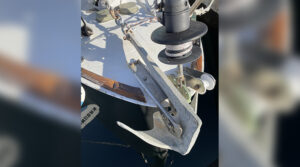
Anchors
As small children, all of us knew, or thought we knew, an anchor has a big, long stock and a broad curve attached to it. You remember, the kind we learned about while watching Popeye the Sailor. Those devices, called “kedge” anchors, are still used by some ships, particularly in the developing world, but you’ll almost certainly never see this type of device aboard a modern cruising vessel.
Today’s sailors have several types of anchors from which to choose, but most of us rely on a Danforth-style folding anchor or a fixed anchor, which can be either welded or cast. Anchor choice isn’t simply a matter of personal choice but of the specific needs of the vessel. For boats roughly 30 feet or less, the choice of most skippers is a folding anchor, which is relatively light and easy to stow in limited space. A folding anchor has long, sharp flukes that slide into grass and gravel snugly, keeping the boat safe for short stays in mild weather.
If there’s one common problem with folding anchors, it’s the tendency to bend when under stress. If the wind picks up and shifts 45 degrees, the folding anchor’s stock can bend, and good luck trying to bend it straight again. Such an attempt would no doubt weaken the granular structure of the steel and, in extreme cases, perhaps even break the stock, rendering it completely useless. This is why many sailors refer to a folding anchor as a “day” or “lunch” anchor.
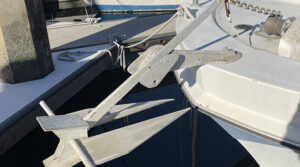
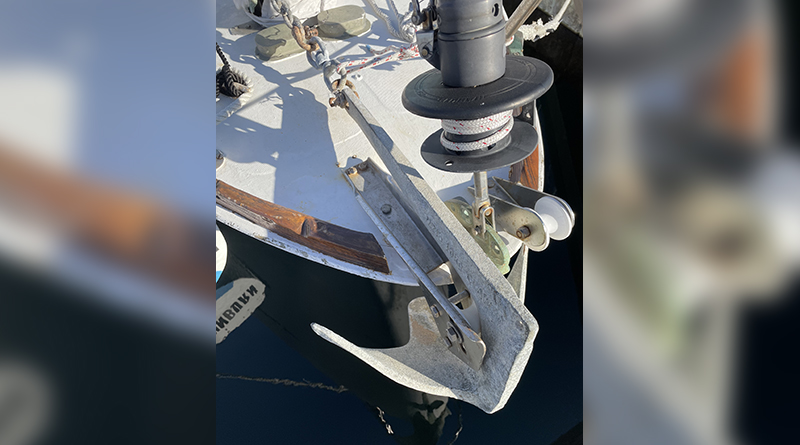
The most common and popular anchor to be seen hanging from the bow rollers of midsize to larger yachts, especially cruising yachts, is a plow anchor made popular by Bruce Anchors, which you’ll find at Captain’s Locker in Long Beach and West Marine. When you first see the blunt, rounded edge of a plow anchor, you may wonder how in heck that thick, wide edge can actually slide easily into virtually any kind of bottom structure and hold a boat securely through a full gale without fail.
But if you study a plow anchor closely, starting right from the tip, you’ll see the scoop is shaped like the tip of a spoon, like the one you use to dig into cold, hard ice cream. That’s the magic of a plow anchor, and that’s why the vast majority of us cruisers swear by them.
A recent adaptation of the plow anchor is the “scoop” anchor, which has a pointed tip and is welded rather than poured into a mold in the manner of a plow anchor. I have no doubt the scoop anchor holds well in most conditions. What worries me is the possibility of the relatively thin metal bending or even severing along a weld line in a prolonged gale.
Make sure you buy the correct size anchor for your boat. For boats from roughly 25 to 35 feet, a 22-pound anchor should be sufficient. From 35 feet to 42 feet, 33 pounds is the appropriate size of anchor.
Chain
The chain you select, particularly for the main bow anchor, should be of galvanized, marine-grade steel. If you are anchoring a small boat in shallow water near home in mild conditions, you can get by with a boat length of proof coil chain, along with sufficient nylon rode, which is an inexpensive set-up with enough weight and strength to hold your vessel securely in light winds.
However, if you’re planning a cruise among the Channel Islands or beyond, your vessel requires a higher grade of chain, rated either BBB or high test. Most coastal and offshore cruisers choose hot-dipped galvanized BBB chain, available from Acco, Trident Marine, Peerless Hardware and a few other manufacturers. You’ll recognize BBB chain by the “BBB” stamp on the side of each link and the lack of a weld line.
An even better grade of chain, rated “high test,” is lighter than BBB but has a much greater strength-to-weight ratio than proof coil or BBB, requiring a specially designed wildcat to grip the chain at the windlass. Many offshore cruisers enjoy being able to carry more chain while not bogging their bows down with excess weight.
Boat chain is available in various sizes, starting from ¼ inch for smaller vessels to 3/8 inch for most recreational vessels above 25 feet in length. The prudent offshore sailor carries at least three boat lengths of chain, but many of us carry much more — just to be on the safe side. My 1966 Cal 30 Saltaire, on which I circumnavigated the planet from 2000 to 2005, carries 100 feet of 3/8 BBB chain, plus 300 feet of three-strand nylon rode attached to the end of the chain, a total of 400 feet of anchor rode, or 13 1/3 times the length overall.
Before investing in anchor gear, do your due diligence by discussing anchor size, anchor chain and rode, and types of windlasses with experienced sailors. Once you toss off the dock lines and sail off to Shangri-La, you need to know your ground tackle will hold your vessel in all kinds of weather.