How modern fish mounts are helping Southern California anglers relive their best days on the water without sacrificing the resource.
For generations, landing a trophy fish has been one of the defining moments in an angler’s life. Whether it’s a hard-fought bluefin tuna offshore, a bright dorado under kelp paddies, or a local halibut brought over the rail after a long drift, the instinct to preserve that moment has always followed close behind. Traditionally, that meant bringing the fish home, not just for the table, but for the wall. Today, however, that tradition is evolving in a way that reflects both advances in technology and a changing mindset among anglers.
Fish mounting, once synonymous with traditional taxidermy, has taken on a new identity. While the goal remains the same — to preserve and display a memorable catch as a lifelike piece — the method has shifted. In modern practice, fish mounting is less about preserving the actual fish and more about preserving the experience itself. This shift is especially noticeable in Southern California, where a strong sportfishing culture is increasingly paired with conservation-minded practices.
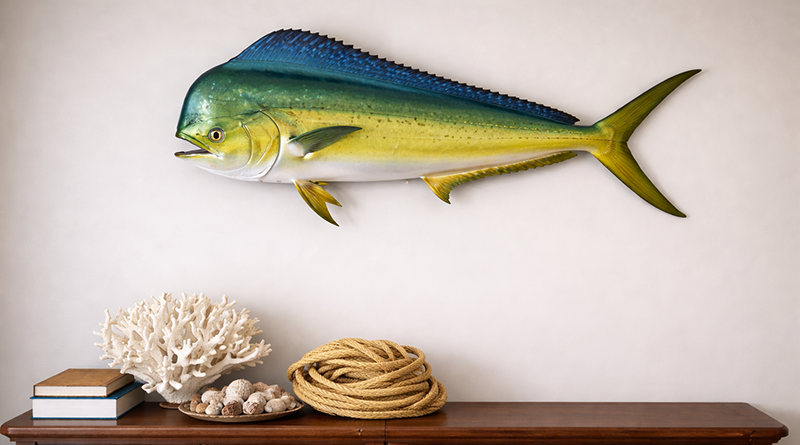
At its most basic level, fish mounting is the process of creating a realistic display of a fish, typically one that represents a significant catch. For many anglers, that might mean a personal best, a first offshore species, or a fish tied to a memorable trip. While this process is closely related to taxidermy, the two are no longer identical. Traditional taxidermy relies on using the actual fish skin, carefully preserved and stretched over a form. Modern fish mounting, by contrast, often relies on replica techniques that use fiberglass or composite materials to recreate the fish in precise detail.
This distinction marks one of the most important developments in the craft. In earlier years, skin mounts were the standard. The process required careful preparation, beginning with measuring and photographing the fish, followed by removing the skin, cleaning out all remaining flesh and fat, and preserving it with chemical treatments. The preserved skin would then be stretched over a foam or fiberglass form, with fins positioned and dried before the entire piece was repainted to restore the fish’s natural appearance.
While effective, this method comes with limitations. Fish skin is delicate and does not hold up over time as well as other materials. Exposure to light, temperature changes, and humidity can cause mounts to shrink, crack, or lose color. In addition, the process requires the fish to be kept, which does not align with the growing emphasis on catch-and-release practices.
As a result, the industry has steadily shifted toward replica mounts, which have become the preferred option for most anglers and professionals alike. Rather than using the fish itself, this method relies on detailed measurements and photographs taken at the time of the catch. Using that information, a mold is selected or created to match the fish’s exact size and proportions. The replica is then cast, shaped, and hand-painted to replicate the original fish as accurately as possible.
This process introduces a level of artistic detail that has helped redefine what a fish mount can be. Skilled artists layer colors, patterns, and finishes to recreate the iridescence and subtle variations found in live fish. In many cases, the final product captures the fish as it appeared in the water more accurately than a traditional mount, which must rely on repainting faded skin.
For Southern California anglers, this advancement has particular relevance. The region’s offshore fisheries are known for species that are not only prized for their size and fight, but also for their vibrant coloration. Dorado, for example, display bright greens, yellows, and blues that fade almost immediately after being brought aboard. Tuna lose their metallic sheen, and other species quickly shift in appearance as well. By relying on photographs taken at the moment of capture, replica mounts preserve those colors in a way that traditional methods often cannot.
At the same time, the shift toward replicas supports the broader conservation ethic that has become part of the Southern California fishing community. Many anglers now choose to release large or breeding fish, particularly species like bluefin tuna and marlin. Replica mounts remove the need to choose between preserving the memory and protecting the resource, allowing anglers to do both.
This evolution also reflects the realities of fishing in the region. Southern California boaters often travel long distances to reach productive fishing grounds, whether heading offshore to the tuna grounds or making crossings to Catalina Island. These trips require planning, time, and investment, and the fish caught on them often carry significant personal meaning. Being able to preserve that experience without compromising sustainability adds value to the entire outing.
In addition to benefiting anglers, fish mounting has created opportunities across the broader marine industry. Professional mount makers, who combine technical skill with artistic ability, are at the center of the process. Their work requires not only an understanding of fish anatomy and proportions, but also the ability to recreate lifelike color and movement.
Charter operators and sportfishing crews also play a role, often encouraging anglers to take proper measurements and photographs so they can create mounts later. In some cases, these operators partner with mount makers, providing referrals or working together to streamline the process for customers. Meanwhile, marine retailers and gear manufacturers have found ways to connect with this space, offering tools and accessories that support documentation and display.
The process itself begins on the water, where accuracy is key. Anglers are encouraged to measure the fish carefully, noting both length and girth, and to take clear photographs from multiple angles. Capturing details such as fin shape, coloration, and unique markings can make a significant difference in the final result. Once that information is collected, it’s passed along to the mount maker, who uses it to create a replica that reflects the fish as it was caught.
From there, the project becomes a collaboration between the angler and the artist. Decisions about pose, finish, and display allow for customization, turning the mount into a personal representation of the catch. While the process can take several months, the end result is a durable, long-lasting piece that can be displayed for years without the maintenance concerns associated with traditional mounts.
Ultimately, fish mounting today is less about preservation in the traditional sense and more about storytelling. It captures not just the fish, but the moment — the conditions, the location, and the experience of being on the water. For Southern California boaters, where fishing is often tied to both lifestyle and identity, that distinction matters.
As the practice continues to evolve, it reflects a broader shift within the boating and fishing community. Anglers are no longer defined solely by what they keep, but by how they engage with the resource. Modern fish mounts support that shift by offering a way to honor the catch while still prioritizing sustainability.
In that sense, preserving the catch no longer requires sacrificing it. Instead, it allows anglers to relive their best moments on the water, long after the lines are reeled in and the boat returns to the dock.