Editor’s Note: The following excerpt is from the book, “USCG Cutter Eagle: The Legacy of the Coast Guard’s Flagship,” by Will Sofrin. This first chapter was contributed by the author and published with his permission.
From CHAPTER 1, “Bremerhaven”
Sharp, icy winds swept in from the nearby North Sea, carrying the faint smell of saltwater mixed with engine exhaust and the remnants of soot and ash from bombed-out buildings. Commander Gordon McGowan surveyed the shattered landscape of Bremerhaven, a former stronghold of the Kriegsmarine, the naval branch of Nazi Germany’s military and a vital hub for Hitler’s Atlantic Wall. The once-vibrant city felt hollow, with vast stretches of rubble and ruins where homes, docks, and warehouses had stood. Wooden boards creaked underfoot as he navigated the temporary pathways. There was an occasional cry of a child or the reedy bark of a stray dog. The voices of those walking around were subdued, speaking in hushed tones, their words heavy with the weight of hardship. He heard the scraping of bricks and the pounding of metal, signaling the beginning of reconstruction.
During World War II, Bremerhaven’s geographic location had made it a prime logistical hub, allowing Germany to project naval power into the North Atlantic, the English Channel, and Arctic territories, supporting operations in Norway and other occupied regions. It had played a critical role in shipbuilding and repair, its shipyards producing U-boats and other naval warships essential to the Nazi agenda. Its strategic importance, however, made it a frequent target of Allied bombing campaigns, which caused significant destruction to the city’s infrastructure contributing to its devastation and shaping its postwar recovery.
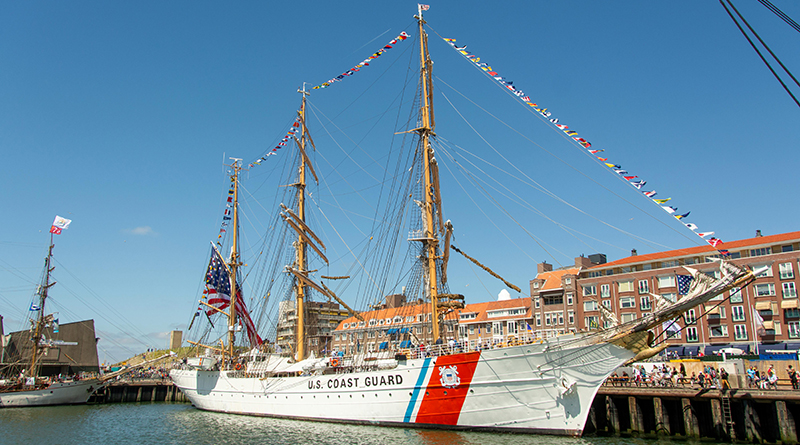
Standing atop a mound of rubble, McGowan gazed across the Weser River, eyes falling on his new command for the first time. Tied to a makeshift dock, he saw what looked like a forgotten vessel from another era resting on her keel in the low water, slightly listing to starboard. The 295-foot (89.9-meter), three-masted training barque, built to endure the harsh forces of the sea, evoked the grace of a nineteenth-century sailing vessel, blending the traditions of old-world sailing with modern maritime engineering. Towering 148 feet (45.1 meters) above the buff-colored deck structures and expansive teak deck, the masts stood naked, their bare yards crisscrossed with an intricate web of wires and lines stretching in every direction like a complex puzzle. The ship’s long, sleek steel hull showed the marks of time and neglect, with rust and grime streaking the blistering gray topsides into the water.
Intended to embody the strength and determination of the Third Reich, the Horst Wessel had been the second of five Gorch Fock–class training vessels designed to prepare future naval officers and instill the discipline and ideals of the Nazi state. These five vessels — Gorch Fock (1933), Horst Wessel (1936), Albert Leo Schlageter (1937), Mircea (1938), and Herbert Norkus (which was never completed due to the outbreak of World War II) — later became known collectively as the “Five Sisters.” The second barque was named after Horst Wessel, a member of the Nazi SA (Sturmabteilung) who had written “Horst Wessel Lied,” the anthem of the Nazi Party. After Wessel’s murder in 1930, Joseph Goebbels, head of Nazi propaganda, had elevated his status to that of a martyr, turning him into an enduring symbol of the Nazi cause.
Near the end of April 1945, the Nazi regime ordered the Horst Wessel to make her final voyage under its flag, moving westward to an undisclosed destination with her forty-member crew, ten Croatian sailors, and an unknown number of refugees, including women and children. Hitler’s death was announced on May 1. The next day, the barque anchored in Glücksburg, near the city of Flensburg, and was officially taken on May 3 by the British Royal Marines under the command of Norman Ricketts, who was involved with divvying up the German fleet among the United States, Britain, and Russia. Among the captured German vessels were the Horst Wessel, Albert Leo Schlageter, and Prinz Eugen. The Horst Wessel was ordered first to Kiel and then to Wilhelmshaven, where the barque remained until she was directed to Bremerhaven in early December of that year.
In December 1945, representatives from the three Allied navies convened in Berlin to negotiate the distribution of captured German ships. Neither the US Navy nor the Royal Navy was interested in acquiring the sailing ships. However, the US Coast Guard made its interest known regarding the Horst Wessel, leaving the final decision to the American inspection team. The Albert Leo Schlageter went to England, in addition to the unfinished hull of Herbert Norkus, which was filled with ammo and scuttled. A coin was tossed for the Prinz Eugen. The United States won the toss, and she was delivered to America, where she met her end during atomic bomb testing. The Horst Wessel and the Albert Leo Schlageter were towed to Bremerhaven, marking the beginning of their postwar roles under Allied direction.
According to a secondhand account published by Captain Harold B. Robert in the US Coast Guard Academy Alumni Association Bulletin, Commander Robert Canby Sr., US Naval Reserve, was sent to Berlin as part of the Tripartite Commission for the division of the German fleet. Commander Canby was a member of the subcommittee handling the sail-training ships Horst Wessel and Albert Leo Schlageter and two merchant vessels. The ships were divided into three lots: lot 1 was the Horst Wessel, 2 was Albert Leo Schlageter, and 3 was the two merchant training ships. Canby drew 3, the Russian commander drew 1, and the British commander drew 2. Canby immediately pitched the two merchant vessels to the Russian commander instead. He convinced the Russian — and with that, the Horst Wessel became America’s prize.
Preparing the former German barque would be an arduous task with many challenges, the two most significant being the sourcing of materials/parts and the lack of experience.
Stepping on board for the first time, Commander McGowan received a crisp hand salute and full military honors. Awaiting him was the former German captain, Kapitänleutnant Barthold Schnibbe, a tall, thin, thirty-five-year-old officer with a deep voice and a strong command of English. His crew respectfully called him “Herr Ka-Leut,” a shortened form of “Kapitänleutnant.” McGowan’s gaze swept forward and then aft, taking in the barren teak deck. The wooden planks were worn and splintered, etched with scars where countless sailors had once trod.
Once gleaming with care, the rails and brass fittings were mottled with the coarse texture of corrosion. Amidships, jagged stumps of broken bolts and splintered wood marked the former positions of two quad antiaircraft guns, silent witnesses to the barque’s wartime role and the passage of years. The rigging was sparse, with a few strands of frayed wire swaying like forgotten cobwebs in the wind. Blocks hung idle, their metal fittings pitted from salt and neglect. Stripped of its glory, the barque was a shadow of its former self, its grandeur replaced with quiet, somber dignity.
With the formalities complete and Ka-Leut serving as his guide, McGowan started with a top-to-bottom inspection to determine what needed to be done to make the barque seaworthy for the passage to America. The interior was spartan, divided into three decks comprising living spaces, various storerooms, tanks, and a small engine room.
McGowan descended a ladder worn from heavy use to the main deck, moving aft through the spartan quarters of the seamen and cadets. The space was open and bare, save for rows of hammock hooks along opposing bulkheads.
The galley was surprisingly small, given the task of preparing meals for more than two hundred men three times a day. Continuing toward the stern, he noticed that the appointments improved in scale and quality as he passed the chief petty officers’ staterooms and the Wardroom, where officers gathered to eat, socialize, and hold off-duty meetings. McGowan and Ka-Leut descended deeper, exploring the various storerooms and tanks. The air grew heavier in the small engine room with the residual smell of fuel and grease. The massive, now-silent machinery loomed, its surfaces slick with oil residue and dust.
The barque was powered by a Maschinenfabrik Augsburg-Nürnberg AG (MAN) diesel engine, renowned for its use in German U-boats, tanks, and other wartime equipment. There were two diesel generators, two compressors, an evaporator, a condenser operated by a small donkey boiler, and assorted pumps. Moving on, the men encountered the boatswain’s locker, which smelled of oakum and tar but was nearly bare, save for a few coils of rope, some worn marlin spikes, and random tools. The sail locker wasn’t much better.
The sight of the old sails, tattered and patched, was all McGowan could bear.
The main engine was determined to be a total loss. A spider crack ran through nearly every cylinder wall, and only the bolts fastening the cylinder head assembly held the engine together. McGowan learned the factory that had produced the engine was in Augsburg, now in the British zone, roughly a five-hundred-mile drive, depending on the exact route. With this information, he visited Royal Navy headquarters to meet with the commodore, who immediately recognized the Coast Guard shield on McGowan’s sleeve. The Coast Guard held a special place in the commodore’s heart because of his personal experience with help from them on D-Day. He told McGowan he could have anything he needed, directing his staff to take care of McGowan.
Returning to the Horst Wessel, McGowan gathered his officers to share the good news. He ordered all the rigging replaced and the ship’s stores filled with extra gear.
The weather improved as the barque’s interior neared completion, and McGowan shifted his focus to the exterior. The final stage of work involved cleaning and painting the hull and deck structures. The spring weather energized the crew, and the sight of new lines in the rigging symbolized the barque’s rebirth. Preparing the rigging also provided a valuable training opportunity. McGowan assigned the American crew to tentative sail stations, strategically intermixing the German crew in key positions to share their knowledge and experience. Under Ka-Leut’s direction, the German sailors worked closely with the Americans, offering hands-on guidance and detailed demonstrations to ensure that the rigging was prepared correctly.
With the heavy work nearly finished, the barque was ready to be hauled into dry dock, giving McGowan his first opportunity to admire the elegant contours of her underbody. The yard crew cleaned and scraped the hull, finding it in excellent condition aside from minor repairs needed on the rudder. Prepared for a complete rebuild of the steering gear if necessary, the crew was relieved to complete the repair with a straightforward realignment of the rudder post, which took only a few hours. With the structural work behind them, the team turned to the final touch — a fresh coat of paint to restore the barque’s appearance. Following Coast Guard tradition, McGowan chose a classic white finish, bringing the barque closer to readiness and marking a symbolic step in her transformation.
Despite all the progress, his crew shortage issue weighed on McGowan. Six weeks after his arrival, a new wave of crew members had arrived—including a newly assigned executive officer, an electrical engineer, and apprentice seamen fresh out of boot camp—most of whom had never set foot on a large oceangoing vessel. This addition brought McGowan’s crew to fifty, far short of the manpower needed to operate the barque.
Over morning coffee early in the refit, McGowan was taken aback when Ka-Leut expressed his satisfaction with the progress and mentioned how glad he was to be sailing with them to America. This revelation surprised McGowan. The captured German heavy cruiser Prinz Eugen had previously been delivered to America by a mostly German crew under American leadership. On her arrival in Philadelphia, a celebratory party was held and American relatives of the Germans were allowed aboard, triggering public outrage. Mindful of the controversy, McGowan decided not to address the topic directly and kept his options open with Ka-Leut. He was relying heavily on the German crew’s willingness and hard work to prepare the barque for the voyage. He didn’t yet realize how much more he might need to depend on them.
One day, while sitting in the naval officers’ lounge, McGowan confided his dilemma to a British officer, Anthony, explaining his desperate need for manpower to operate the barque. He had only fifty willing hands. He should have had at least two hundred but would settle for fifty more. Anthony, who was overseeing mine-sweeping operations with more than a thousand German workers under his command, offered a solution, proposing to lend McGowan fifty ex-navy German volunteers from his crew and to keep them on his payroll for the voyage. Once in America, McGowan could leave them at a POW camp, and from there they would eventually return to Germany. Anthony suggested McGowan start supplementing the crew by recruiting the Germans who were already working on the barque.
During the refit, the American crew had been commuting to the barque from the Navy barracks, unable to move aboard until the ship was officially commissioned, as it remained a foreign asset under Allied control and lacked the legal status, command structure, and operational authority required for US military personnel to take responsibility. Considering the time required to load stores, set up the galley, and prepare the sleeping quarters, McGowan determined that May 15 would be commissioning day. An American name for a new American ship.
For her commissioning, the commodore from the US naval command attended the ceremony. A general muster formed just forward of the mainmast. The American crew lined up to starboard, facing inboard, while the German crew stood to port. Across the deck, athwartship, the officers took their positions, with the Americans in front and the Germans behind. McGowan, the chaplain, and the commodore stood at the head of the formation, just forward of the mainmast. The commodore began by reading his orders, officially directing McGowan to place the barque into commission. McGowan then read his orders, formally assuming command. Following tradition, they turned to face aft and rendered a hand salute as the American flag was hoisted to the mizzen gaff, accompanied by the sound of pipes playing in the background. With this ceremonial act, the Horst Wessel officially became the USCGC Eagle.
Preparing the barque for sea had revealed McGowan’s honed ability to lead through influence, not force. But would that be enough when an American crew had to sail alongside a German crew on a former Nazi vessel so soon after the war’s end? The Americans, inexperienced and unfamiliar with the barque, would be forced to rely on the Germans, whose knowledge and expertise were essential to her operation. The Prinz Eugen had proved such a feat was possible, but could this crew do the same? Tensions had been subdued during the refit, in which both sides could find common ground. But the stakes would be far higher out on the open sea with its merciless unpredictability. Trust would be tested. Fault lines would emerge. And the question loomed: Would this fragile alliance hold, or would it fracture when survival hung in the balance?