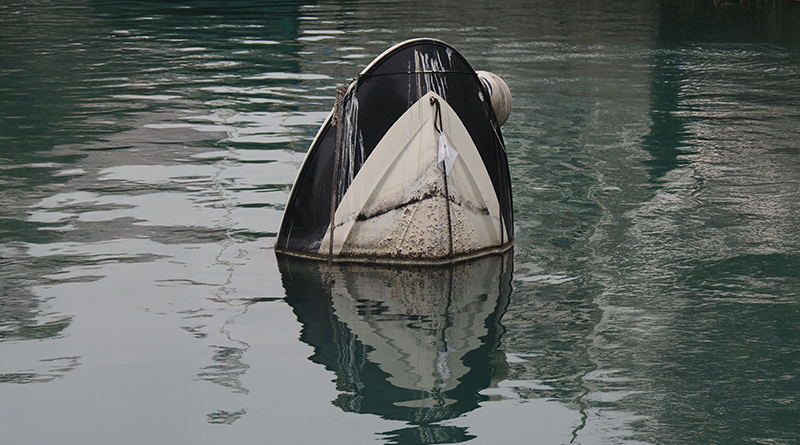
Every marina has a story. Someone shows up one morning, coffee in hand, and stops short because something looks … off. Their slip is quieter than usual. Too quiet. Then it hits them: the boat isn’t floating the way it should be.
According to the BoatUS Foundation, for every boat that sinks offshore, four sink right at the dock. Not during storms at sea. Not during dramatic emergencies. Just sitting there, tied up, minding its own business.
And almost every time, the first question out of the owner’s mouth is the same: “What happened to the bilge pump?”
That’s usually the wrong question.
Bilge pumps don’t cause boats to sink; they often hide the real problem. A working bilge pump can quietly keep water at bay for days or weeks, emptying the bilge just enough that no one notices what’s actually leaking. Eventually, the pump clogs, the battery dies, or the water comes in faster than the pump can keep up. When that happens, the boat sinks — and the pump takes the blame.
The real issue usually starts much earlier, and much lower.
Underwater fittings and hoses are involved in about half of all dockside sinkings, with stuffing boxes leading the list. That’s why a boat can’t just be left to “take care of itself.” At least a couple times a season—spring and mid-season are good benchmarks—every through-hull, hose, and fitting below the waterline deserves a close look. If it moves when it shouldn’t, drips when it shouldn’t, or looks tired, it’s already trying to tell you something.
Weather plays a bigger role than most people think, too. Rain, snow, and sleet account for nearly a third of dockside sinkings. As water accumulates on deck, the boat sits lower in the water. That reduced freeboard makes even a small leak or minor boarding wave a much bigger problem. Combine that with clogged cockpit drains or a lazy scupper, and you’ve got a slow-motion sinking.
Docking setup matters as well. Poor line arrangements can let a boat ride up under a dock or get pinned against a piling. Over time, that kind of movement can damage hulls, rub rails, or fittings just enough to let water in. A proper mix of bow, stern, and spring lines keeps the boat centered in the slip and reduces unnecessary stress on the hull.
Rubber components are another quiet culprit. Outdrive boots, hoses, and seals don’t fail all at once; they dry out, crack, and weaken over time. Checking them a few times a year and replacing anything suspect is far cheaper than dealing with what happens after they let go. If your boat has an outdrive, storing it in the down position can help extend the life of those boots. Seacocks and gate valves should also be inspected for corrosion; on bronze fittings, pink discoloration is a red flag you don’t want to ignore.
Through-hulls deserve special attention. Transducers and raw water intakes are easy to forget because they’re out of sight, but hoses connected to them should always be double-clamped with stainless steel clamps and made of reinforced marine-grade hose — not PVC, which can crack or rupture without much warning.
Freshwater systems cause their own share of dockside disasters. City water pressure is far higher than what a boat’s plumbing is designed for. If you’re connected to dockside water, turn it off at the dock whenever you’re away for more than a few hours. Use a pressure reducer and a reinforced hose. If your hose is clear PVC, look for the crisscross reinforcement pattern. If it’s not there, it doesn’t belong on a boat.
One of the simplest preventative measures is also the most overlooked: visit your boat. Boats that sit unattended are the ones that sink quietly. A submerged boat typically costs about 40 percent of its value to repair, assuming it’s even salvageable. If you can’t check in regularly, consider a buddy system with another boater on the dock or take advantage of marina inspection services if they’re available.
Boats don’t usually sink because of one big failure. They sink because of a series of small things no one noticed in time. The good news is that most of those things are preventable with regular attention, a little curiosity, and the willingness to crawl into awkward spaces once in a while.
It’s not glamorous work. But it does beat showing up to the marina and realizing your boat has decided to go snorkeling without you.