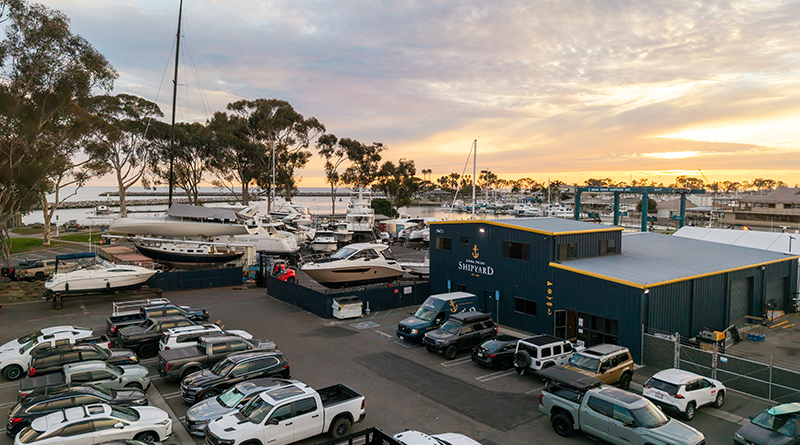
From routine haul-outs and bottom coatings to major repowers, fiberglass repairs and custom installations, the family-owned Dana Point Shipyard has served recreational and commercial boaters since 1967.
DANA POINT — Amid the uncertainty surrounding the Dana Point Harbor revitalization, where construction timelines continue to evolve and conversations often center on which businesses are leaving, relocating or remaining open, one longstanding operation continues working largely behind the scenes for the region’s boating community: Dana Point Shipyard.
And for boaters wondering whether construction will change that, owner Steve Morris has a straightforward answer.
“Yes, we will be open with no impact to our services,” Morris said.
For boaters in Dana Point and neighboring Southern California harbors, the shipyard provides many of the services necessary to keep vessels safe, operational and on the water. In fact, nearly every maintenance topic The Log has explored through its Tech Tip series, from bottom coatings and mechanical repairs to electrical work, fiberglass repair, repowers, stabilizers and custom installations, represents work that can be performed within the shipyard.
While much of the attention surrounding Dana Point Harbor’s transformation has understandably focused on the waterfront businesses and amenities visitors encounter from shore, a working harbor also depends on the infrastructure that supports the vessels themselves.
Dana Point Shipyard has filled that role for decades, but its history actually began before the business arrived in Dana Point.
According to Morris, his grandfather and his grandfather’s high school friend, C.B., started their first boat repair company in Newport Beach’s Back Bay in 1967 with $50 and their hand tools. Four years later, an opportunity emerged to bid on the lease for the Dana Point property the shipyard occupies today.
Getting there required a considerable gamble.
“They mortgaged everything they had,” Morris said.

At the time, three partners needed to come up with $30,000 for the property. When one partner backed out because he couldn’t produce his $10,000 share, Morris said his grandfather and C.B. found a way to cover the difference and secure the lease.
What they acquired was essentially a dirt lot.
They brought with them a 40-ton dry dock Morris’ grandfather had built in Newport Beach, towed it south to Dana Point and began hauling boats. The yard later added a 30-ton crane, a piece of equipment Morris himself learned to operate when he was 17, and that remained in service until only a few years ago.
In 1982, the family again mortgaged its assets to expand, adding the main building, Travelift piers, docks and a Travelift. That lift remained in operation until 2017, when the shipyard completed another round of infrastructure improvements.
“We used that Travelift from 1982 to 2017 and ended up selling it for more than he originally bought it for,” Morris said.
Between 2016 and 2017, the yard rebuilt its docks and piers and purchased a new Travelift. Today, Morris represents the third generation running the business, while members of the fourth generation are already involved in production work.
The shipyard itself has evolved alongside the boats it services.
“We have changed strategies over the years following the industry,” Morris said.
When outboard-powered boats grew in popularity, the yard invested in equipment and technician certifications to support them. As its customer base shifted toward larger vessels, Dana Point Shipyard expanded its capabilities and training for larger diesel engines.
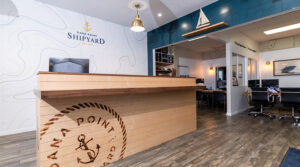
That ability to adapt remains part of how Morris sees the yard’s role in Dana Point Harbor.
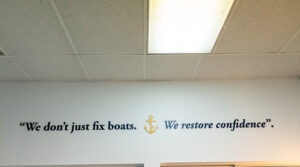
“Our role is to provide excellence in the marine services space,” Morris said. “We don’t just repair boats, we restore confidence in your vessel.”
Some of those relationships now span generations. Morris said the shipyard has customers who have been coming to the yard for 20 or 30 years, including people whose boats were previously serviced by his father.
Getting the Boat Out of the Water
For boat owners, the terminology used around a shipyard can sometimes be less familiar than the maintenance itself. A haul-out, shipwright project or refit may be something an owner knows the boat needs without necessarily understanding everything that happens once the vessel enters the yard.
It often begins with getting the boat out of the water.
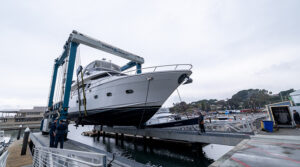
Dana Point Shipyard’s haul-out capabilities can accommodate large recreational and commercial vessels, opening areas normally hidden beneath the waterline for inspection, maintenance and repair.
Haul-outs serve several purposes. A boat may be lifted for a survey, salvage operation, routine service, or transportation. The yard also offers hang time for surveys and can load and offload vessels onto fitted trailers or commercial transport trucks.
For maintenance and repair projects, getting the boat onto land opens the door to much more extensive work.
One of the most common reasons is bottom maintenance.
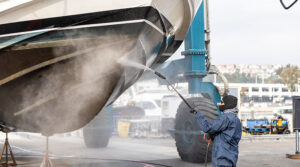
A boat that remains in saltwater is continually exposed to marine growth. Bottom-coating service can include hydro-washing the hull after haul-out, preparing and sanding surfaces, cleaning underwater metals, checking through-hull pickup screens and applying antifouling coatings.
Keeping the bottom clean is more than a cosmetic concern. Accumulated marine growth creates additional drag and can affect a vessel’s efficiency and performance. Proper coatings also help protect submerged surfaces during extended periods in the water.
A haul-out creates an opportunity to inspect components owners rarely see. Running gear, through-hulls, underwater metals and other equipment can be evaluated while technicians have full access to the bottom.
From there, a project can become considerably more involved.
Mechanical work at Dana Point Shipyard covers engines, drives, generators and related equipment. Factory-trained technicians service equipment from manufacturers including Mercury, MerCruiser, Volvo Penta, Cummins, Yanmar, Caterpillar, Yamaha and Rehlko.
Morris said training and continuing education are priorities as marine technology becomes increasingly sophisticated.
“We are big on training our guys, obtaining certifications, and staying current with the latest standards and innovation,” Morris said.
That investment now extends well beyond traditional boatyard tools.
The shipyard recently purchased a CNC router and a Proliner digital measuring system and also uses AutoCAD and 3D printing technology. Morris pointed to one recent Yamaha outboard repair as an example of why those capabilities matter.
A small plastic component the customer needed was facing a roughly nine-month backorder. Instead of leaving the boat sidelined while waiting for the replacement, the shipyard designed and 3D-printed the needed part.
“With the tools we have now, he is back chasing fish instead of waiting at his slip for nine months, missing the season,” Morris said.
For a Southern California angler, there may be no better argument for keeping up with technology.
From Electrical Work to Major Refits
The yard’s shipwright services cover an even broader range of work.
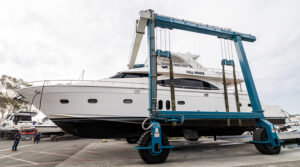
Shipwright work can include bottom painting, blister repairs and varnish, along with through-hulls, valves, plumbing, sanitation systems, transducers, underwater lights, swim steps and keel work. Depending on the vessel and project, a shipwright may be involved in structural work, repairs or finishing throughout the boat.
Electrical systems represent another increasingly important part of maintaining a modern vessel.
Today’s boats may incorporate extensive AC and DC systems, batteries, chargers, generators, navigation electronics, and interconnected onboard networks. Dana Point Shipyard’s ABYC-certified technicians perform troubleshooting and rewiring, charging-system upgrades, electronics and network installations and generator service and replacement.
Fiberglass repairs similarly range from relatively minor cosmetic projects to significant structural work.
Small stress cracks, damaged gelcoat and color matching may fall at one end of the spectrum. Blistering, delamination or damage to a hull, deck or transom can require considerably more extensive repairs. In those cases, the objective extends beyond making the repair visually disappear. Structural integrity must also be restored.
For owners who like their existing boats but find that their equipment has fallen behind, Dana Point Shipyard also handles refits and repowers.
A repower generally involves replacing or substantially upgrading a vessel’s propulsion system. A refit can go much further, modernizing multiple systems while retaining the hull and basic vessel an owner already knows.
Projects can include new engine packages, propulsion overhauls, HVAC improvements, stabilizer upgrades, interior renovations, exterior work and new navigation and helm technology.
For Southern California boaters, the option can be particularly appealing. A well-built hull may remain serviceable long after its original engines, electronics and other equipment begin showing their age. A carefully planned refit can give that vessel another chapter without requiring the owner to start over with an entirely different boat.
 Modernization can also address how a boat feels underway.
Dana Point Shipyard installs stabilizer systems designed to reduce vessel roll, as well as bow and stern thrusters that provide additional lateral control when maneuvering in tight slips or challenging wind and current.
Custom installations can include Seakeeper stabilization systems, Seakeeper RIDE, additional bait tanks and custom plumbing. A Southern California angler, for example, may want to modify a bait system to better support offshore fishing, while another owner may prioritize comfort or vessel control.
Keeping Dana Point’s Working Boats Working
Those capabilities aren’t limited to private recreational vessels.
Dana Point Shipyard regularly services boats belonging to the businesses that put thousands of people on the water from Dana Point Harbor each year.
Morris said the yard works on Capt. Dave’s whale-watching fleet, numerous charter vessels and performs Cummins warranty work on Dana Wharf boats.
“It’s a very important arm of our business, and we are proud to help the commercial guys out, as their boats are the heart of their operation,” Morris said.
That role can become particularly important when a commercial boat develops a problem. A private owner may be forced to cancel a weekend trip when a vessel goes down. For a charter, sportfishing or whale-watching operator, a sidelined boat can mean canceled trips and lost business.
The shipyard also responds to sinking-vessel emergencies and provides in-slip repairs through its mobile service operation. More recently, the company expanded again by starting a marine flooring and decking business.
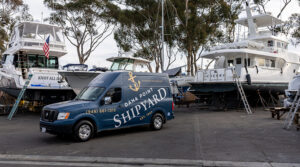
“We just want to be here for the boating community, both recreational and commercial,” Morris said.
And that community extends well beyond Dana Point.
Dana Point Shipyard’s mobile service reaches from San Diego to Ventura, while vessels regularly travel from other Southern California harbors specifically to use the yard.
Morris pointed to a recent repower of a 510 Sea Ray whose owner brought the vessel down from Ventura after previously working with Dana Point Shipyard’s mobile technicians.
“He had options to have it fixed in his area, but in the end, he chose Dana Point Shipyard over the rest,” Morris said.
The yard also routinely hauls vessels coming from Newport Beach, Oceanside, Marina del Rey, and San Diego.
Plan Before the Haul-Out
For customers preparing to bring a boat into the yard, Morris said one relatively simple step can make the process easier for everyone: communicate the entire scope of work before arriving.
“The best course of action is to have a detailed list and scope discussed with one of our project managers ahead of time,” Morris said.
A customer, for example, may schedule what appears to be a routine bottom-paint job and then arrive at haul-out with a much longer list of repairs and upgrades. If the yard does not know about those requests beforehand, Morris said it becomes more difficult to schedule the appropriate technicians and allocate enough time for the project.
As for the harbor construction, Morris said it hasn’t affected the yard’s operations or customer access.
“As of now, nothing has affected us, and I don’t anticipate any delays or problems,” Morris said.
Dredging is currently underway in the back channel, but Morris said boaters have continued to pass through without apparent problems.
Not every project requires a haul-out, either. Dana Point Shipyard’s mobile technicians can make slip visits for inspections, routine maintenance, diagnostics, troubleshooting and certain minor repairs, determining whether a problem can be handled at the dock or requires more extensive yard work.
Taken together, the services illustrate what happens behind the scenes in a working harbor.
A boater may see a vessel disappear into the yard for several days or several months. Inside, that boat could be receiving little more than fresh bottom paint or undergoing a transformation involving engines, electrical systems, fiberglass, plumbing, electronics and propulsion equipment.
For boaters, understanding that process also helps explain why a working shipyard remains an important part of Southern California’s waterfront infrastructure.
Restaurants, shops, and public spaces help make Dana Point Harbor a destination. Sportfishing boats, whale-watching vessels, sailboats, and recreational powerboats give it its identity on the water. Keeping those vessels operating requires another layer of the harbor that visitors may rarely see.
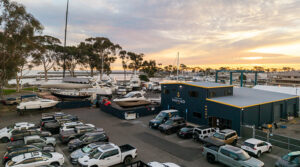
For Dana Point Shipyard, that work has now passed from the generation that arrived at a dirt lot with a homemade dry dock to a third and fourth generation working with digital measuring systems, CNC equipment and 3D printers.
The equipment may have changed considerably since 1971, but Morris said the objective for the future remains much the same.
“We just want to continue to be the go-to for any boater’s needs, stay innovative, and be up to date on what’s available and what’s changing in our industry so we can continue to adapt and change with it,” Morris said.
As Dana Point Harbor transforms around it, the shipyard plans to remain open and continue doing the work it’s done for generations: getting boats back where their owners want them.
On the water.