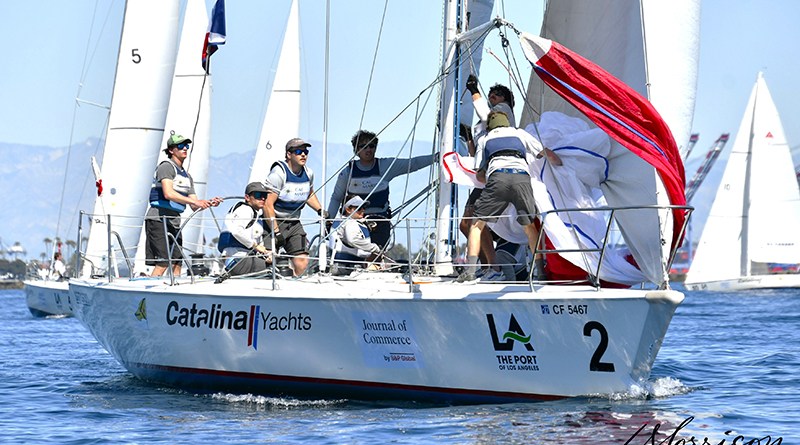
SAN PEDRO — In one of collegiate offshore sailing’s most competitive events, Cal Poly Maritime Academy delivered a determined comeback performance at the Port of Los Angeles Harbor Cup, finishing second overall after three days of racing that tested both skill and composure on the water.
Held from March 6 through 8, 2026, and hosted by the Los Angeles Yacht Club in partnership with the Port of Los Angeles and Cal Poly Maritime Academy, the annual regatta brought together top collegiate sailing teams from across the country to compete in a challenging offshore format aboard matched Catalina 37 vessels. Known for its demanding conditions and high level of competition, the Harbor Cup is widely regarded as a proving ground for the next generation of maritime professionals.
From the outset, Cal Poly Maritime Academy faced an uphill battle. A series of inconsistent starts on the opening day left the team in fifth place after the first seven races, creating a deficit that would be difficult to overcome against a strong field led by the College of Charleston. Charleston established an early advantage with a dominant first-day performance, recording three consecutive race wins and setting the tone for the regatta.
Despite the slow start, Cal Poly Maritime Academy found its rhythm as the event progressed. On the second day, shifting weather conditions kept teams dockside for several hours before racing resumed in blustery winds. When racing continued, the Cal Poly crew began to show signs of cohesion and improved execution, posting two second-place finishes and a fifth that brought them within striking distance of the lead.
The team’s turnaround was driven by stronger communication and improved boat handling, particularly at the start line. Tactician Julian Levash emphasized the importance of consistency heading into the final day, encouraging the crew to stay focused and minimize points through solid finishes.
That strategy paid off on Sunday, as Cal Poly Maritime Academy capitalized on improved starts and strong boat speed. Helmsman Owen Cuyler, a San Pedro native, played a key role in the team’s performance, leveraging local knowledge of wind patterns and currents to gain an advantage on the race course.
In the first race of the final day, Charleston was forced to restart after crossing the line early, opening the door for Cal Poly Maritime Academy to secure a race win on the upwind-downwind course. The momentum carried into the final races, where tight competition among the fleet set up a dramatic finish.
The final race saw aggressive starts across multiple teams, with penalties affecting several competitors. Cal Poly Maritime Academy and the University of Southern California traded positions throughout the course, while Charleston maintained a conservative strategy, needing only a strong finish to secure the overall victory.
Ultimately, Charleston’s fourth-place finish in the final race was enough to clinch the Harbor Cup title with 32 points, edging Cal Poly Maritime Academy by just three points. Cal Poly’s late surge, which included two race wins on the final day, secured second place overall with 35 points in what proved to be one of the closest finishes in recent years.
Reflecting on the team’s performance, Levash credited the collective effort onboard, noting that success came from each crew member executing their role effectively. The team’s ability to adapt, improve communication, and maintain a positive mindset proved critical in their comeback.
The crew represented a mix of experience levels, including seniors Logan Chapman and Chase Englehart, juniors Kole Kammerer and Nick Mueller, sophomore Oscar Perry, and freshmen Indigo Craig and Miles Metoyer. Their combined effort highlighted the depth and development of Cal Poly Maritime Academy’s sailing program, which continues to be a strong presence in collegiate offshore racing.
Elsewhere in the fleet, the Cal Poly San Luis Obispo team finished seventh overall after a competitive showing that included a second-place finish on the opening day. However, inconsistent results on the second day dropped the Mustangs in the standings before a final-day rally helped them regain ground.
The Harbor Cup continues to serve as more than just a competition. For many participants, it is a direct extension of their maritime education, reinforcing real-world skills such as navigation, teamwork, situational awareness, and decision-making under pressure. These are the same skills that translate directly into careers across the maritime industry, from commercial shipping to offshore operations and professional sailing.
For the Southern California maritime community, the event also represents a connection between education and industry. With races taking place just outside the breakwater of Los Angeles Harbor, the regatta unfolds against the backdrop of one of the nation’s busiest working ports, offering a reminder of the broader maritime environment these students are preparing to enter.
As collegiate sailing continues to grow, events like the Harbor Cup highlight the importance of hands-on experience in developing the next generation of mariners. Cal Poly Maritime Academy’s performance this year underscores not only competitive success but also the value of resilience and adaptability — qualities that define both successful sailors and maritime professionals.
While the team fell just short of the overall title, their strong finish and late push demonstrate a program on the rise, one that remains closely tied to the Southern California maritime community and its long-standing tradition of excellence on the water.