This summer marks the 50th anniversary of the film “Jaws,” released June 20, 1975. After five decades, people remain as captivated, and terrified, by sharks as ever. Vilified by Hollywood and misunderstood by many, sharks are typically seen as bloodthirsty monsters when, in reality, they’re more like the ocean’s custodians — helping to keep ecosystems in balance and biodiversity in check.
Find that hard to swallow? Well, chew on this: along the sun-soaked shores of California, where surfers ride the swells and tourists flock for seaside serenity, the coastal waters are home to an impressive array of shark species. The ancient predators’ presence is both a testament to the region’s ecological richness and a critical component of ocean health.
California’s coastal waters host more than 30 species of sharks, ranging from the massive but docile basking shark to the infamous great white. The most notable, include:
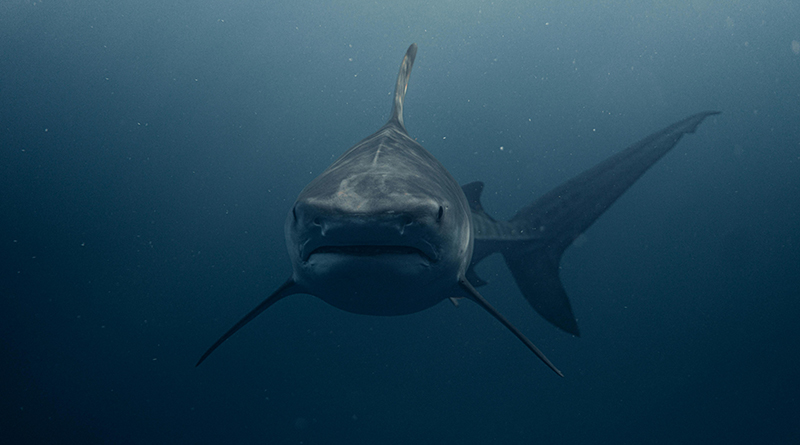
- Great White Shark (Carcharodon carcharias): “Porkers? You talkin’ about Porkers, Mr. Hooper?” “Porkers,” er, great whites, are the stars of shark lore. Great whites frequent Northern and Central California, especially hotspots like the Farallon Islands and Año Nuevo. These apex predators patrol the coast, especially during seal pupping seasons, and are essential to regulating marine mammal populations.
- Leopard Shark (Triakis semifasciata): A common sight in Southern California’s shallows, this sleek, spotted shark is harmless to humans and plays a key role in controlling populations of bottom-dwelling invertebrates and small fish.
- Soupfin Shark (Galeorhinus galeus): Once heavily fished for its vitamin-rich liver oil, this species continues to navigate kelp forests and sandy bottoms, subtly influencing the health of prey species. It is now considered critically endangered in California waters.
- Blue Shark (Prionace glauca): Often found offshore, these elegant, cobalt-colored sharks migrate along California’s coast and serve as important mid-level predators in the open ocean food web.
- Horn Shark (Heterodontus francisci): More sedentary and found in rocky reefs, this small, nocturnal shark feeds on mollusks and crustaceans, shaping the micro-ecology of benthic communities.
Each of these species fulfills a unique ecological niche. Together, they form a tapestry of life that’s far more intricate, and necessary, than their reputation suggests. Predators like great whites function as ocean regulators. They maintain the structure and function of marine ecosystems in critical ways:
- Regulating Prey Populations: Sharks help control populations of seals, sea lions, and mid-sized predatory fish. Without them, prey species can overpopulate and overconsume lower trophic level organisms, triggering a domino effect of imbalance.
- Trophic Cascades: The presence or absence of sharks can lead to dramatic ecosystem shifts. In well-documented cases from other regions, declines in shark populations have led to booms in rays, which then decimate scallop beds, harming fisheries. While direct parallels in California are limited, great whites likely contribute to kelp forest health by indirectly regulating seal populations, which results over-predation on kelp-grazing fish.
- Promoting Healthy Prey: By targeting weak, sick, or injured animals, sharks reduce disease spread and maintain genetic vigor in prey populations. This “culling of the weak” may sound brutal, but it’s nature’s quality control.
- Supporting Biodiversity: Through these regulatory roles, sharks create space and opportunity for other species to thrive. Healthy shark populations are strongly correlated with vibrant coral reefs, kelp forests, and fisheries.
Certain regions of California act as shark nurseries or hunting grounds. The Southern California Bight — a 450-mile stretch of coastline from Point Conception to San Diego — is a biodiversity hotspot, with a mix of shallow bays, kelp forests, and open water that provides ideal habitat for a wide variety of shark species. San Francisco Bay and Tomales Bay serve as estuarine safe havens for juvenile leopard sharks.
In recent years, increasing numbers of juvenile great white sharks have been observed off Southern California beaches, particularly in areas like Santa Monica Bay, Ventura, and Huntington Beach. Research from California State University, Long Beach’s Shark Lab has confirmed this trend. Warmer ocean temperatures, changes in prey distribution, and improved protections are likely contributors. These young whites feed mostly on fish and rays, not swimmers, and their presence signals a recovering population.
Now let’s address the dorsal fin in the room: shark attacks. Sensationalist media coverage has painted a wildly disproportionate picture of the danger sharks pose. And broadcast events like Discovery Channel’s annual “Shark Week” only buoy paranoia and preestablished prejudices.
Statistically, the odds of being bitten by a shark off the California coast are exceedingly low; rough estimates place it around 1 in 11.5 million, though precise figures vary. You’re as likely to be struck by lightning while winning the lottery.
When interactions between shark and human do take place, they’re almost always cases of mistaken identity. To a great white shark peering up through murky water, a neoprene-clad surfer can resemble a tasty seal. Most bites are “exploratory,” and sharks typically release the person upon realizing their mistake. Fatalities are exceedingly rare.
Contrary to summertime blockbusters, sharks aren’t hunting humans; humans are a far greater threat to sharks. An estimated 100 million sharks are killed globally each year, mostly through overfishing, finning, and bycatch. California has made progress to protect sharks, banning the sale and possession of shark fins in 2013 and expanding marine protected areas (MPAs) along its coast. Yet, even with local action, sharks remain under global threat.
Sharks are excellent indicators of ocean health. Shifts in their migration patterns, population density, and breeding behavior often reflect broader trends in sea temperature, acidity, and habitat disruption.
Exacerbated by El Niño events and long-term climate change, California’s warming waters are shifting marine dynamics. Species once rare in the region, like hammerhead sharks, are appearing more frequently, though they remain uncommon. Meanwhile, great white sharks appear to be shifting their ranges northward. These changes reverberate through the food web. By tracking sharks, researchers gain valuable insights into broader ecosystem changes.
The development of smarter beach safety policies and the promotion of coexistence is being supported by scientists, such as those at the Shark Lab at California State University, Long Beach. Emerging as a national leader in shark telemetry, the Lab has tagged dozens of juvenile great whites and mapped their seasonal wanderings along the coast.
The Shark Lab’s Dr. Chris Lowe was quoted by The New York Times, saying, “In those 50 years (since ‘Jaws’), we’ve totally exploded — meaning the scientific community — what we know about this species. So it’s an exciting time, because the tools that we use now didn’t exist back then.” Those tools are unlocking the mysteries of shark movement and behavior, leveraging the use of satellite tagging, underwater acoustic arrays, and drone surveillance.
Sharks off the California coast are more than the sum of their teeth. They are indicators of ecological health, enforcers of natural order, and contributors to the vibrancy of the state’s marine life. Their role in shaping robust ecosystems makes them indispensable allies in the fight for ocean conservation.
The goal isn’t to avoid sharks, but to coexist — intelligently, respectfully, and with a clear understanding of their ecological role. That means backing science-based policies, reducing plastic pollution (which entangles and poisons marine life), and resisting the knee-jerk impulse to demonize every dorsal fin.
With ocean warming, habitat stress, and human encroachment all on the rise, sharks need advocates, not adversaries. The health of the Pacific doesn’t just depend on kelp and coral; it depends on tooth and tenacity, on a lineage that’s survived more than 400 million years.
To vilify sharks is to misunderstand the ocean. To protect them is to protect ourselves, our fisheries, reefs and planet. California’s future lies not in the fear of what lies below its coastal waves, but in the reverence pay for the sanctity of its waters and the delicate balance of its ecosystem. As for sharks, respect their place in the circle of life — and reserve your fear of them for the silver screen.