A major piece of unseen maritime infrastructure is set to take shape beneath Southern California waters, as Catalina Island prepares to be connected to the mainland by a new submarine fiber-optic cable system — an investment state officials say will improve daily life for residents while adding another layer to California’s evolving coastal working landscape.
The California Public Utilities Commission (CPUC) recently awarded $37.5 million for a broadband project that will bring high-speed internet to more than 3,500 residents on Catalina Island, a community where limited connectivity has historically affected healthcare access, education, emergency response, and business operations. The project will be led by AVX Networks, a Catalina-based telecommunications company, and funded through the state’s Last Mile Federal Funding Account program.
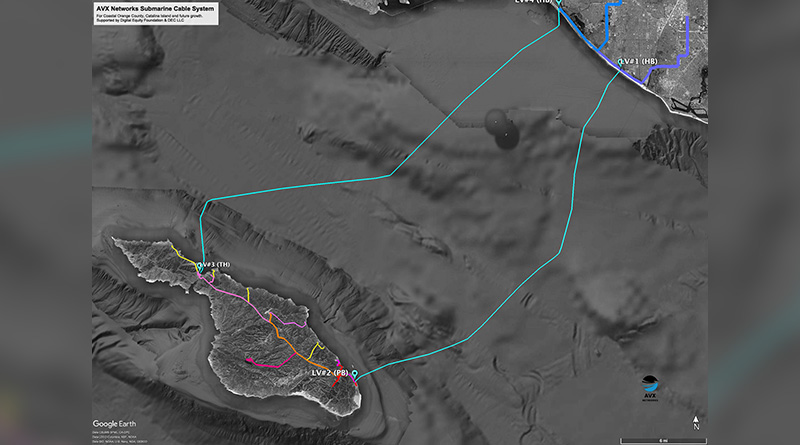
At the center of the effort is a submarine fiber-optic cable that will run along the seafloor between Catalina Island and Huntington Beach, creating a direct, high-capacity digital link to Southern California’s broader communications network.
While invisible to most boaters and beachgoers, submarine cables are a critical part of the modern maritime environment. These cables — containing hair-thin strands of glass that transmit data as pulses of light — carry the vast majority of global internet and communications traffic worldwide. Unlike satellites, which handle only a small percentage of data transmission, undersea cables form the physical backbone of the internet, resting quietly on or beneath the ocean floor.
For Catalina’s project, the route to Huntington Beach was selected based on favorable seabed conditions, reduced geological risk, and proximity to existing mainland infrastructure. Protecting the cable — particularly in nearshore and high-traffic marine areas — has been a central focus of the project’s design.
Lance Ware, CEO of AVX Networks explained that multiple installation methods will be used to ensure the cable is protected from anchors, fishing gear, and vessel traffic. “The submarine cable will be installed using several methods to protect it from potential interruptions by boat anchors or fishing activities,” Ware said.
Near shore, where wave energy and human activity are highest, AVX plans to use Horizontal Directional Drilling (HDD) to avoid disturbing the beach and surf zone. “HDD will be used to install a conduit under the beach and surf zone to house the cable,” Ware said. “Using HDD allows the conduit to be installed without impacting the beach or other obstructions.”
Once offshore, the cable will be buried beneath the seafloor using specialized marine equipment. “In the ocean, the cable will be buried using a sea plow towed by the cable ship or a remotely operated vehicle that will jet the cable to the designed burial depth of approximately four feet,” Ware explained. “This depth will be deeper than what fishing gear can penetrate and deeper than vessel anchor penetration.”
Ware also noted that the project may incorporate existing offshore infrastructure in innovative ways. “There’s also a significant possibility we will repurpose clean, idle oil and gas assets on the Huntington Beach side,” he said. “This is a mission I’ve been passionate about since the project began. It will save time and money, and it’s a great opportunity to continue innovating on infrastructure that has provided energy for Californians for decades.”
For the maritime community, submarine cable installations are more than a technical exercise — they become a permanent part of the working seascape. Cable routes are charted, anchoring restrictions may be established, and installation activities require coordination with vessel traffic, fishing operations, and harbor authorities.
AVX Networks emphasized that boaters will see only temporary, localized impacts during construction. According to Ware, the project’s design, environmental review, and permitting phase is expected to take approximately two years, followed by a relatively short marine construction window. “The construction will take approximately three months to install the marine cables,” he said.
During installation, cable-laying operations will move steadily across the route rather than remaining fixed in one location. “The marine installation is a localized activity that will take up approximately 1,000 linear feet at a time,” Ware said. “We ask other vessels to stand clear by one mile.”
That safety buffer will move as the project progresses. “The restriction zone of approximately two miles in diameter moves with the cable installation, which progresses at approximately ten miles per day over a 24-hour period,” Ware added.
For Catalina Island, the long-term implications of the project extend far beyond faster internet speeds. Hernández described the new connection as transformative for daily life on the island. “For Catalina Island, this is a sea change for businesses, school kids — K through 12 and beyond — healthcare, public safety, and hospitality,” he said.
The project is also being viewed as a model for future coastal and island connectivity throughout California. “For Coastal California, this represents the future,” Ware said. “These same cables can provide seismic activity monitoring, perimeter security, and bring connectivity and compute for AI back to California with exceptional efficiencies for energy and cooling.”
That broader vision aligns with the goals of California’s statewide broadband initiative established under Senate Bill 156, which committed $2 billion to expanding internet access across hard-to-reach communities. The program is designed to connect local “last mile” projects, like Catalina’s, to the state’s expanding “middle mile” broadband backbone.
Beyond its immediate benefits for residents, the Catalina project is also being positioned as a proof point for scalable public-private partnerships tied to offshore technology. AVX Networks’ parent company, DEC LLC, has identified the project as an early demonstration of its Ark Genesis platform, which explores offshore computing, environmental sensing, national security applications, and next-generation connectivity.
For boaters transiting the Santa Barbara Channel and surrounding waters, the project serves as a reminder that maritime infrastructure now extends well beyond docks, breakwaters, and navigation aids. Beneath the surface, the seafloor increasingly supports systems that underpin modern coastal economies and island communities.
As construction moves forward, Catalina’s new cable will join thousands of miles of similar infrastructure already resting on the Pacific seabed — largely unseen, but increasingly essential. In an era when the ocean supports both physical and digital connections, the project represents a modern chapter in the long relationship between the sea and the systems that depend on it.