Most of the Southern California coastal and inshore waters provide enough depth for us to stay clear of rocks and kelp as we sail or motor our vessels. However, even though we aren’t in Biscayne Bay, Florida, which has an average depth of only 10 feet, we still have to take care as we navigate close to land or look for that perfect spot to drop anchor. A depth sounder, or even better, a fish finder that shows us bottom contour, is a vitally important piece of navigation equipment every coastal boat needs for safe, secure anchoring.
If you search online or visit your local chandlery, you’ll find a wide assortment of brand names and models of fish finders and depth sounders, which employ sound waves that produce visuals in real time to what lies beneath our boats.
Depth Sounders
Imagine sitting on your boat only a few hundred feet from the rocks along the north side of Catalina Island and seeing some kind of activity near shore, perhaps a school of dolphins playing or an interesting formation in the rocks attracting our attention. As we dare to move in a bit closer, sharp, giant rocks appear menacingly below our hull, and we throw the transmission into reverse to pull away from the submerged obstacles, perhaps even scratching the bottom of the hull in our mad rush to escape the rocks.
Fiberglass hulls on small coastal boats can be only a quarter-inch thick, and when we consider how much weight is pushing down on the hull, we realize a sharp boulder can cut through a thin hull like a hot knife through butter. The only effective way to prevent this kind of disaster is to see what’s below, which is why we need a depth sounder on our boats.
To provide a brief description, a traditional depth sounder consists of a transducer mounted either on the transom or inside the hull near the keel, plus an analog needle gauge or digital number screen, a cord to connect the two components and two wires to the electrical panel.
Be aware not all depth sounders double as fish finders. There are still several high-quality, stand-alone depth sounders on the market, and even if you do opt for a combination sounder/fish finder, having a back-up sounder for extra safety is always a good idea.
Equip your vessel with a Faria, Lowrance, NorCross or Raymarine traditional depth sounder, each of which is easy to install and use. They all feature weather-resistant, digital LCD screens, which you can mount on a bulkhead or other exterior surface for easy viewing, and they range in price from $100 to $300.
Faria offers a plastic through-hull transducer, which reads up to 54 fathoms (312 feet), but the unit is priced low enough for budget-minded coastal cruisers to enjoy an extra measure of safety. Another inexpensive, entry-level sounder is NorCross Marine’s Hawkeye 1B, available with either a transom-mount or hull-mount plastic transducer. The Hawkeye features an upper and lower depth alarm system consisting of an audible alarm, a red LED and an LCD message.
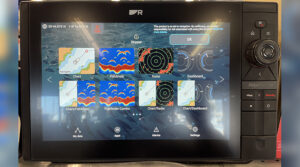
(Credit: Bill Morris)
The Raymarine i40 Depth Instrument is a popular option for smaller vessels lacking a fully networked instrument array. The kit includes a dedicated, IPX6 waterproof instrument screen and thru-hull transducer, along with power and interface cables with SeaTalk data interface. Priced at roughly $300, the Raymarine i40 is a rugged, dependable instrument that will serve well on any yacht.
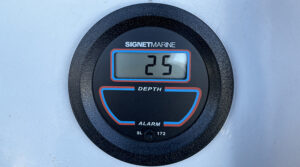
The Signet SL172 LED screen has a classic look with its black, round bezel and simple design, which matches the analog SL254 Wind Indicator, SL11 Knotmeter and other devices in this series. The SL172 detects up to 200 feet depth and is available with either a plastic mushroom or bronze wedge transducer. My 1966 Cal 30 Saltaire has had a Signet SL172 with plastic through-hull transducer for over 25 years, and after a circumnavigation of the planet and dozens of trips to Catalina Island, the monitor finally needed replacement two years ago, but the transducer still functions like new.
Fish Finder/Sounders
If you spend most of your boating time near the coast and do a fair amount of fishing, you’ll best be served by a combination depth sounder and fish finder. This strategy offers much added convenience, especially if you have limited space for overlapping electronics and displays.
Assuming you already have a chartplotter mounted near the helm, you can add a depth transducer to the bottom of the hull and run the provided cable to the pilot house to complete the installation. Furuno, Garmin, Raymarine and other marine electronics manufacturers offer installation kits that include thru-hull depth sounders.
Owners of small power boats now can take advantage of a new depth-sensing strategy, which is a transducer mounted to the transom, eliminating the need to cut through the bottom of the hull. To install one of these units, drill the installation holes near the bottom of the transom, apply waterproof sealant liberally and bolt on the transducer. Then run the power wires to the battery and the cable to your chartplotter, and your depth sounder/fish finder is ready to go.
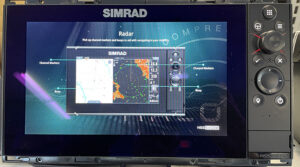
One popular transom sensor unit is the Lowrance Eagle 5 sounder/fishfinder combo, which comes complete with chartplotter display unit, external transducer, C-Map charts, hardware and cables. The whole package is available for under $400. If you own a larger yacht and have decided to add a permanent thru-hull transducer, consider a higher-end unit, such as the Simrad NSS9evo3S chartplotter, which includes detailed bottom imaging, vector navigation charts and 1kW CHIRP-enabled sonar. This level of technology permits you to study not only fish passing under your hull, but also the finer details of bottom structure, including rocks, seaweed and sunken vessels.
Is your main vessel a skiff or canoe you use for inshore fishing? If so, then all you need
is an inexpensive fish finder, such as a wireless device like the Erchang F13 wireless fishfinder, which comes with a floating sensor and digital, handheld monitor. Or you can choose their F12 model, which looks like a flashlight you stick in the water while viewing the fish on a small digital display. Each is available for under $100, affordable for even the humblest of anglers.
The choice between a traditional, stand-alone depth sounder or a modern sounder/fish finder will depend on the specific needs of crew and vessel. Discussions regarding depth sounders, aside from fish finders, usually revolve around submerged dangers. While underway on open ocean, you can generally rely on your charts for depth. However, when it comes to anchoring, we require accurate depth-sensing capability.
When I’m motoring in circles, looking for my ideal anchoring depth of 20 to 40 feet, my eyes are fixed on the depth sounder, not the chart. If you can measure depth reliably up to 200 feet, then you can scan the anchorage for a spot to drop the hook for the night. Decide what you truly need in a depth sounder for your vessel and choose the model best suited to your needs.