On July 30, 2025, a massive 8.8 magnitude earthquake off Russia’s Kamchatka Peninsula sent shockwaves not only through the earth but also across the Pacific Ocean, triggering a tsunami warning that extended as far as the West Coast of the United States. Though California did not experience the towering, destructive waves often associated with tsunamis, the event created significant harbor surges in Southern California—including one in Dana Point Harbor that caused noticeable damage and disruption to boating activity.
Log image
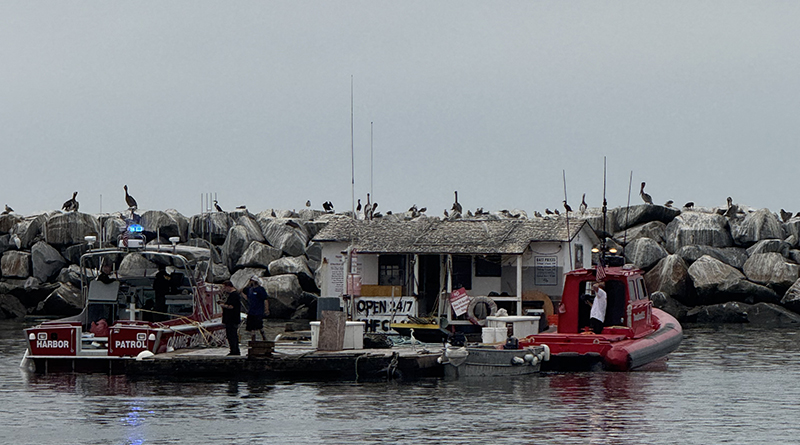
Among the most notable impacts locally was the damage sustained by the Everingham Brothers bait barge, a floating bait receiver that services both commercial and recreational anglers in Dana Point. The surge forcefully dislodged the barge, breaking it into three sections. As of August 4, repairs are still underway, and while temporary service has resumed, the barge is unable to operate at full capacity. For several days after the incident, bait sales to private boaters were temporarily paused and the landing itself only received about half of the usual bait load. During repairs, boats are anchoring up next to the Cougar, a separate bait boat, to retrieve bait—an adjustment that underscores the surge’s disruptive effect on harbor operations.
Log image
Tsunami activity was felt in various locations up and down the Pacific Coast. In Hawaii, residents were evacuated to higher ground, while coastal advisories were issued across Alaska, Oregon, Washington, and California. By the morning of August 1, tsunami warnings and advisories had been lifted in all U.S. locations, including Crescent City in Northern California, which saw wave activity peak at around 3.5 feet.
Though Dana Point and other harbors along the Southern California coast did not experience devastating flooding or structural failure, the tsunami highlighted the vulnerabilities that can exist even in well-protected harbors. Understanding how a harbor is designed to defend against powerful wave activity—and why it sometimes isn’t enough—is essential for boaters and coastal residents alike.
A tsunami is a series of large, powerful ocean waves generated primarily by undersea earthquakes, but they can also be triggered by volcanic eruptions, landslides, or even meteor impacts. When the seafloor abruptly shifts, it displaces an enormous volume of water. This movement sends energy outward in all directions, forming waves that can travel across entire oceans at speeds of 500 miles per hour according to the National Oceanic and Atmospheric Administration.
In the open ocean, tsunami waves can go unnoticed because their amplitude is small and the wavelength is long. But as they approach shallower waters near coastlines, the waves slow down and dramatically increase in height. These waves do not behave like regular surf—they affect the entire water column from surface to seafloor and are more like a rapid, high-energy tide than a crashing breaker.
The word “tsunami” originates from a combination of the Japanese words, “tsu,” for harbor, and “nami,” meaning wave. When a tsunami enters a harbor, the water behavior can be both dramatic and dangerous. Often, the first observable sign is a sudden drawdown of water, a rapid retreat that exposes normally submerged seafloor, docks, or moorings. This is caused when the trough of the first tsunami wave arrives before the crest. That drawdown is soon followed by an equally sudden inflow of water — the surge — that floods the harbor. This cycle of drawing out and rushing back in may repeat for several hours, depending on the number and frequency of tsunami waves.
Dana Point Harbor, like many others along the California coast, is engineered to protect boats and infrastructure from regular ocean swell and storms. Several key structural features make this possible.
Foremost among these is the breakwater — a massive structure made of rock or concrete that forms a barrier between the open ocean and the harbor entrance. By absorbing and deflecting wave energy, breakwaters are crucial for maintaining calm waters inside the harbor and thus the safety of docked vessels. Dana Point’s outer breakwater is a prime example of this type of defense.
Jetties, which are long, narrow structures that extend from the shoreline into the ocean, are also used to stabilize harbor entrances and prevent sediment buildup. These structures can deflect waves and reduce the formation of sandbars, ensuring safe navigation for vessels.
The layout and orientation of the harbor also play a major role. Many harbors are positioned to face away from prevailing wind and wave directions. Natural landforms such as cliffs or peninsulas may provide additional shielding. Inside the harbor, depths are carefully managed through dredging to avoid sudden changes in current or water flow that could destabilize boats.
Despite these measures, harbors are not immune to tsunamis. In fact, the very shape and containment that make a harbor calm under normal circumstances can amplify the effects of a tsunami. Wave energy can reflect off walls, bounce between docks, and resonate within the enclosed space. This sloshing, known as a “seiche,” can turn a normally placid harbor into a churning cauldron.
This is what occurred on July 30 in Dana Point Harbor. While the tsunami didn’t produce visible walls of water, the harbor experienced strong, repetitive surges that overwhelmed mooring lines and dislodged structures. The bait barge, anchored near the harbor’s commercial fishing area, bore the brunt of the surge’s force, leading to a breakdown in a critical part of the harbor’s fishing economy.
Fortunately, the incident didn’t result in injuries or widespread vessel damage, and beach areas remained open. But it served as a stark reminder that even well-engineered harbors can be vulnerable under extreme conditions.
For boaters and harbor users, the takeaway is twofold: understand the warning signs of a tsunami and respect the infrastructure designed to protect against it. If you’re near the water and notice it suddenly pulling away from the shore, that’s a critical red flag. Seek high ground immediately. Sirens, phone alerts, and Coast Guard notifications should always be taken seriously, especially following seismic activity anywhere along the Pacific Rim.
While events like these are rare, they offer a useful opportunity to review harbor infrastructure and emergency response procedures. Harbor commissions and engineers regularly assess the effectiveness of breakwaters, dredging practices, and safety protocols to ensure facilities continue operating smoothly and safely.
At Dana Point Harbor, repairs to the bait barge are underway, and bait service is expected to return to normal soon. The July 30 surge didn’t cause widespread damage, but it did serve as a reminder that even well-protected harbors can experience unexpected conditions from time to time. With thoughtful planning and situational awareness, boaters and harbor users can continue to enjoy safe access to the water.