DANA POINT — Even well-maintained boats can experience minor setbacks that interrupt a trip, prompting the need for professional on-water assistance. A dead battery, an overheated engine, a wrapped prop, or even running low on fuel can quickly interrupt a day on the water. When that happens, professional towing services follow established procedures designed to assist boaters safely and efficiently — without escalating the situation into an emergency response.
According to Scott McClung, Owner of TowBoatU.S. Dana Point and Oceanside, the process of providing non-emergency assistance starts the moment a boater makes the call. He clarified the terminology up front by noting, “To be clear, BoatU.S. contracts with our company, Tow Boat U.S. Dana Point to offers non-emergency towing, jumpstarts, and fuel delivery to its members. We do offer salvage, wreck removal, and sunken boat recovery but these services are generally contracted through insurance companies.”
The first step is gathering accurate information, which is critical for a safe and efficient response. McClung explained that his team must confirm a vessel’s exact position before anything else. As he put it, “We need a clear understanding of where the boater is. We gather their GPS coordinates and geographical location. We often run across boaters that give coordinates that differ from their geographical location. This difference allows us to ask further questions to determine accuracy in their location. Often, they are reading an old way point on their instrument.”
He added that they also require details about vessel description, number of passengers, and the nature of the problem. “In addition to knowing their location, we need a description of the boat to include, make, length, color and type. We also want to know how many people are on board. This ensures we can keep a head count during the tow. We then determine the reason for the tow. Sometimes we can walk the boater through fixing the issue to prevent having to be towed. Lastly, we determine if the boater is our member. If they are, they receive priority over non-members.”
While many boaters assume recoveries are dramatic events, McClung said most calls stem from preventable issues. He explained, “The most commonly reported issue is generically defined as ‘engine issues.’ This can be an overheating engine due to lack of transmission fluids, lack of regular maintenance, old fluids, etc. It’s always good to flush your systems and use fresh fluids if your boat has been unused for a long period. We suggest always keeping additional fluids on board.”
Prop entanglements are another frequent problem — especially during lobster season. McClung added, “Secondly, we respond to numerous wrapped props. This is most common during lobster season. The traps are easily identified with a buoy and light attached to them. BoatU.S. will cover your tow into your slip if you get wrapped, however if you require a diver to free a trap from your prop, that is an out-of-pocket expense.”
Once a situation is dispatched, crews begin coordinating with the vessel. McClung detailed the step-by-step process: “Once the case is dispatched to us, or after we gather their info on CH 16, we take them to a working channel or establish cell service with them. We provide an ETA. We request all passengers wear a PFD while the boat is being towed and to have them ready when we arrive.”
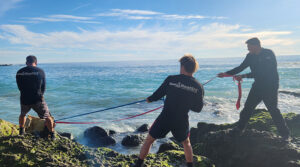
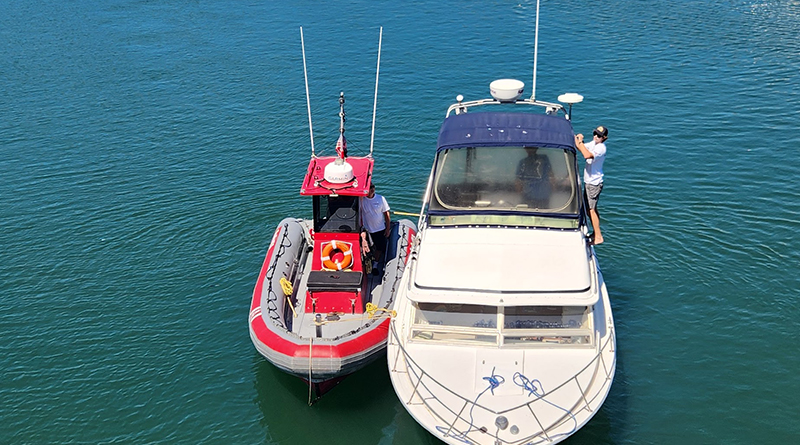
Upon arrival, crews focus on securing the vessel safely. As McClung explained, “Upon our arrival we will check the cleats, D-ring and/or determine the strongest points to attach a tow line. If the boater can maneuver safely on the deck, we show them where to attach our tow line. If they cannot safely assist, we attach the line for them.” He added that communication continues throughout the tow: “We establish communication once again to provide safety information during the tow. The boater is informed to stay seated, and to respond to our safety check-ins every 30 minutes. An ETA to their destination is provided.”
Navigating back into the harbor involves a shift to a more controlled technique. McClung described the final stage: “Once we arrive in the harbor, the vessel is transitioned to a hip tow. This allows us to maneuver both our vessels as one unit. When we arrive at their slip or ramp, we ease them into their slip, untie our lines, and let the passengers know when it’s safe to step off the boat and onto the dock.”
Many boaters also misunderstand what qualifies as vessel assistance versus salvage. McClung clarified this distinction clearly: “It is intended to assist boaters back to their slips or to a repair facility after suffering mechanical issues. If we can prevent a tow by providing a jumpstart or delivering fuel or oil, we can offer that too at no charge. Vessels that are hard aground, sunken, or in a collision, are generally an insurance claim. Any vessel in immediate peril is considered a salvage operation and also would be handled through the boater’s insurance, not their towing membership.”
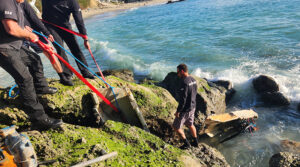
While waiting for help, boaters should take specific steps to stay safe and avoid worsening the situation. McClung emphasized the importance of conserving battery power and anchoring when possible. He noted, “Reserve your battery use for VHF radio communication. If your boat battery is dead, reserve your cell phone battery. Any time you can drop anchor, do it. Do not hesitate to drop the anchor.”
Communication is equally important. McClung warned, “If you get your engine running and no longer need service, notify us immediately. When you’re not at the location provided, and you don’t answer our communication attempts, we notify the United States Coast Guard. We have several cases a year when time and assets are wasted trying to locate a boater that was no longer in distress.”
More serious responses involve vessels taking on water or at risk of sinking. McClung described the initial actions in these scenarios: “Several factors determine the resources needed for a sinking vessel. Some vessels can sink in their slips, others at sea. First, we notify the United States Coast Guard with our ETA and share what assets we’re sending to the scene. The safety of the passengers is most important.”
He added that passenger rescue always comes first. “If the passengers have already entered the water, we retrieve them. If they are still onboard, we transfer them to our boat.”
From there, dewatering and damage control begin immediately. McClung explained, “Dewatering pumps are placed on the boat. Damage control materials are used to plug scuppers, vents, through holes or any areas that could allow water in. We attempt to locate the intrusion site and address it with packing materials.”
Dive teams may also be deployed. As McClung noted, “If required, flotation bags are attached to the boat by our dive team. Arrangements are made with the local yard to haul the vessel out for inspection.”
For recreational boaters, understanding how vessel recoveries work can provide reassurance long before assistance is needed. Mechanical failures and groundings can happen to anyone, but knowing that a structured, professional process exists helps turn an unexpected problem into a manageable situation rather than a costly emergency.
For more information, visit boatus.com/towboatus/dana-point-.