By Captain Obvious
There are many debates in boating. Single-engine versus twin. Gas versus diesel. Paper charts versus electronics. But there’s one topic that remains blissfully free of controversy, disagreement, or nuance:
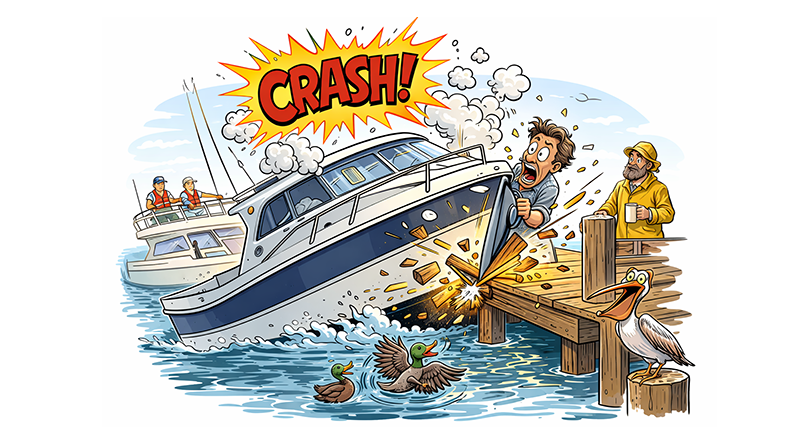
Crashing your boat is bad.
This may come as a shock to some, particularly those who believe fiberglass is tougher than docks, rocks, or other boats simply because it costs more. It is not. The dock will win. The rock will absolutely win. And the other boat will win while its owner films the whole thing.
Let’s start with the obvious downside: boats are not designed to stop suddenly. They are built to glide, plane, drift, and occasionally wallow, but never — under any circumstances — to come to an abrupt halt against something solid. When that happens, physics steps in and begins issuing invoices.
The first invoice goes to your gelcoat. It arrives immediately and is written entirely in scratches, spider cracks, and gouges that somehow manage to be both cosmetic and deeply personal. This is followed closely by an invoice to your rub rail, which was never meant to be “load-bearing,” despite how often it is asked to perform that role in tight marinas.
Next comes the emotional damage. This one is free, but long-lasting. It usually manifests as silence at the helm, followed by statements like, “I don’t know how that happened,” or, “The wind really grabbed us,” spoken to no one in particular. Crew members will nod politely while mentally updating their group chat.
Then there’s the financial aspect, which arrives later and much heavier. Boat repairs are priced according to a special marine formula in which time slows down, parts become rare artifacts, and labor is measured in “boat units,” roughly equivalent to one month’s mortgage per hour. What looked like a “small bump” will soon be described by a yard as “while we’re in there….” and “you’re going to want to address this now.”
Crashing your boat is also bad for your reputation. Marinas have memories. Dock neighbors have binoculars. Harbor staff have radios. Within minutes, your incident will be upgraded from “minor mishap” to “Did you hear about….” By the end of the week, someone else will be blamed for something you did, which is the true mark of a boating legacy.
Insurance companies, meanwhile, will respond with great enthusiasm and paperwork. They will ask thoughtful questions like, “Can you explain the events leading up to the incident?” and “Why were you going that speed?” You will answer honestly, except for the part where you were absolutely sure you had it under control.
There’s also the time cost. Crashing your boat turns a pleasant day on the water into a multi-week project involving adjusters, yards, part delays, and repeated explanations that begin with, “So what happened was….” Every retelling somehow makes it sound worse.
And let’s not forget the universal boating truth: crashing your boat is never just your problem. It becomes the dock’s problem. The other boat’s problem. The harbor’s problem. And eventually, everyone within earshot’s problem. Nothing draws a crowd faster than a boat doing something it absolutely shouldn’t be doing.
In fairness, no boater sets out planning to crash. Most incidents begin with confidence. Confidence that quickly escalates into optimism. Optimism that is then betrayed by wind, current, misjudged throttle, or the belief that reverse will respond faster this time.
So consider this your gentle reminder.
Slow down. Take a breath. Set your lines early. Use your fenders correctly — and remove them when you leave. Ask for help. There’s no shame in backing out and trying again. There is, however, paperwork in pretending everything is fine while the boat continues to drift sideways.
Because, while crashing your boat may provide a memorable story, a valuable lesson, and content for everyone else’s dockside entertainment, it remains one of the least efficient ways to spend time, money, and pride.
And that, perhaps, is the most nautical truth of all.