Carrying extra jerry cans of fuel to ensure enough power for a main engine alternator and perhaps a power generator costs extra money and space that could be dedicated to better use. Fortunately, one energy source we can always count on is the sun, which we can harness with one or more solar panels.
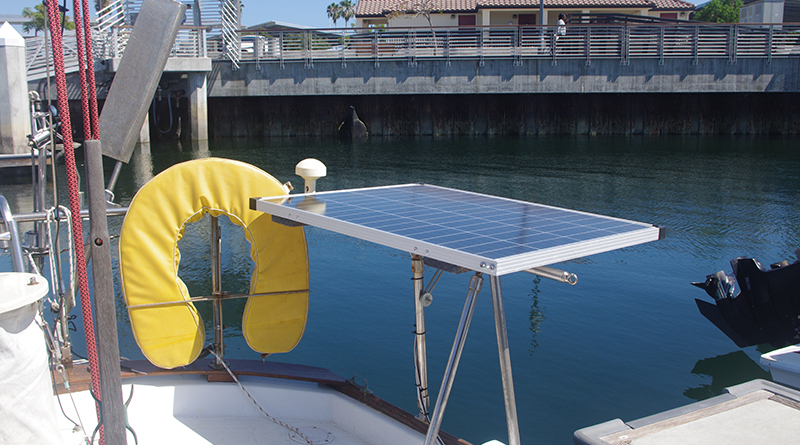
A solar panel has no moving parts, no bearings or bushings to wear out, no liquids to top off, no maintenance protocols to follow and no chance of blade cavitation, as with some wind generators if the apparent wind rises above 30 knots. The unassuming, flat, gray panel just lies there facing the sun, pouring pure DC power into the batteries.
The main job of solar panels is to top off the house battery bank, leaving the main engine alternator to charge the starter battery. Of course, larger yachts with extensive navigation systems and large refrigerators and freezers will need a large house bank of two or more 8D batteries charged by a separate diesel generator to keep up with the large power demand.
Rigid Solar Panels
Top-of-the-line, marine-grade rigid solar panels, like those produced by Siemens, are constructed of monocrystalline cells with a thick polymer coating on the back of the panel. These panels are secured to a strong, anodized aluminum frame that can be mounted on a fixed structure.
While Siemens is still an industry leader in rigid solar panels, Sunsei is also a prominent player in the marine electrical industry, producing a wide range of rigid panels for different sizes of vessels and varying levels of demand for electrical power.
The Sunsei 100W solar panel is an affordable entry-level system ready to keep your battery banks topped off for your next jaunt, whether it’s to the Channel Islands or Tahiti. This kit features a rigid aluminum frame plus a blocking diode to prevent discharge at night. For a few extra bucks you can include an 8.5A charge controller, which will prevent overcharging.
After 20 years of service on the aft pulpit of my 1966 Cal 30 sloop Saltaire, enduring frequent dousing in tall, breaking seas during a five-year circumnavigation, the Siemens 38W solar panel was still in good condition when I gave it to a fellow sailor and installed a new, 100W panel I picked up at Harbor Freight for $125 and a new monitor with LED readout a couple of years ago. The new panel and monitor worked flawlessly during a sail from Los Angeles Harbor to Hanalei Bay, Kauai, and back last spring — and will probably outlast me!
While Saltaire’s mounting system consists of only a couple of PVC pipe mounts around the one-inch stainless steel pulpit tubing, there are a variety of other creative ways to mount solar panels. You can use fixed or swivel mounts with tubes mounted to the rear deck, or you can install them over the spray dodger, which offers the added benefit of insulating the pilothouse from excessive heat on sunny days.
Flexible Solar Panels
Another type of photovoltaic cell, amorphous thin-cell silicon, is less efficient than the rigid panels but is capable of being mounted on curved surfaces, such as an aft deck cover or, while at anchor, over the boom on a sailboat.
Some flexible panels are thin enough to be rolled up for easy storage until they are needed for back-up while the crew is away from the vessel for an extended period. However, because these are used primarily as trickle chargers, most of the flexible and semi-flexible panels you see slung over mainsail covers in cruiser anchorages are limited to 25 watts, although a few are rated as high as 50 watts. Owing to their complex construction, a flexible panel of a given amp hour rating generally costs twice the price of a rigid panel of the same power.
Despite their greater expense, flexible solar panels pay for themselves through their high impact resistance and the creative ways in which they can be installed. Whereas an errant spinnaker pole could shatter the tempered glass covering of a rigid solar panel, it will bounce off a well-constructed flexible panel. Flexible panels may be attached to weather cloth, dodgers, biminis, mainsail covers and dinghy covers, completely out of the way of crew traffic.
Uni-Solar, Spectra, Nature Power and Renogy all produce flexible solar panels with cruising sailors as their primary market, although many coastal sailors and shore-bound campers also take advantage of the convenience of these battery-charging wonders.
Renogy offers several different sizes of flexible panels for “caravan, RV, boat and uneven surfaces.” Renogy’s 200W, 12V flexible solar panel kit is comprised of two 100W monocrystalline panels and a 20A waterproof controller, a very effective package for boats stored or anchored for long periods.
Electrical Installation
The steps to installing a solar panel are fairly straightforward and easy to follow. On the back of any marine-grade panel you will find a junction box where you connect the positive and negative wire leads. The junction box, generally hidden from direct sunlight, is constructed of a highly UV-resistant polymer. The lid joins the box with a rubber seal to prevent water intrusion, and the wire ports are rubber-sealed in like manner.
Inside the junction box there should be diodes to keep electrical current from seeping pack into the panels and discharging the battery at night. You will also find wire clamps to connect the leads to the house battery. Make sure you use high-quality, tinned, marine-grade wire and connectors, such as those produced by Ancor/Marinco — NOT the cheap stuff you find at a home hardware store — and the size recommended by the panel manufacturer.
Undersized wire, especially over long runs, can get hot enough to melt the plastic sheath, short out and cause a fire. For long runs, you might want to step up the size, probably from 18 gauge to 16 gauge wire, just to be on the safe side. Also, there should be no wire splices, not even with heat-shrink butt connectors, anywhere outside the cabin for any electrical installation.
Finally, the leads from the solar panel array need to pass through a charge controller to prevent fire and overcharging. If the panel kit does not come with a controller, you can pick one up at your local chandlery or order one online. AC/DC Marine, Mastervolt, Flexcharge, Sunsei, and Nature Power are some of the better-known brands of battery charge controllers and other marine electronics.
Choose the battery panel array and controller that best fits your budget and your vessel’s needs and rest comfortably, knowing your vessel’s solar charging system is doing its job safely and effectively.