One year ago, The Log introduced readers to a small catamaran with a big mission in our feature, Keeping Newport Harbor Pristine One Clean Sweep at a Time. The Good Seamaritan trash boat, created by Newport Beach resident Tim Smith and brought to life with the help of team member Greg Blake, set out with a simple but ambitious goal: remove trash from Newport Harbor before it could sink, scatter, or harm marine life.
What started as a privately funded grassroots idea has now become one of the harbor’s most visible and impactful environmental efforts. After its first full year on the water, there is a clearer picture of how much one boat, and one captain, can accomplish.
When the project launched, The Good Seamaritan was still new, operating only a couple days a week and learning the patterns of the harbor. Its design originally included a debris basket mounted between the catamaran hulls, allowing it to skim trash from the surface as water flowed through the vessel. A hand net supplemented the system, creating an efficient routine that quickly proved capable of collecting everything from plastic wrappers to bulky hazards. At the helm was Robert Sloan, experienced mariner and US Coast Guard 100-ton captain, who committed to taking the boat out three times a week on a consistent cleanup route.
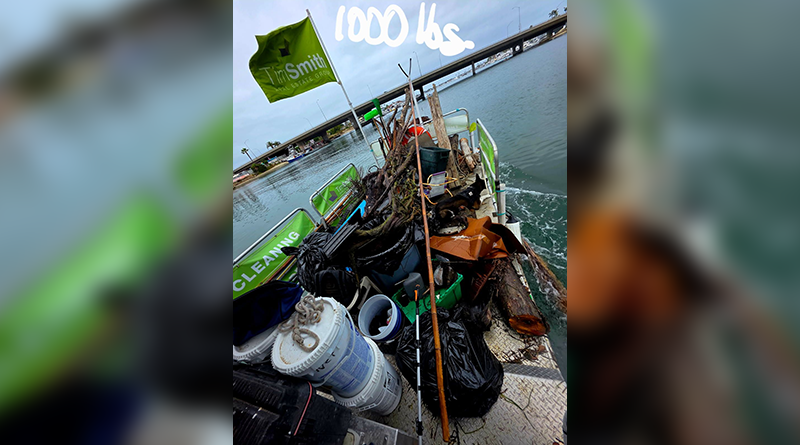
As the project matured, Sloan gained a comprehensive view of what truly floats, or sinks, through Newport Harbor. To illustrate the scale of the operation, Sloan explained in an email to The Log, “Twenty tons of trash collected, weighed in, and dumped in the dumpsters at Marina Park. Four tons dumped in various other dumpsters around the bay and a 1000-pound single day record. That was too much volume and weight to be dumped at once!” The variety of debris has also been striking. As he put it, “Hypodermic needles, human waste, rotting fish, dead animals…”
Some of the most surprising finds have been large enough to rival salvage operations. Sloan shared that he has removed “full sized offroad truck tires and wheels, full sized couches, huge logs up to 27 feet, parts of docks, lots of shoes, purses, backpacks, water bottles, barrels, wooden and plastic pallets, boat covers and batteries on the bottom of the bay, traffic cones, furniture, bicycles, half of a boat that had been hit by another boat, lots of bayfront restaurant menus…” These discoveries underscore just how much human activity and storm runoff can impact even a well-maintained harbor.
Weather and tides continue to influence the workload. Sloan noted that “Extreme tides, rain and wind very much add to the volume of trash collected. On Mondays I usually collect trash in the various marinas that overflows out of the trash cans there.” The winter storms proved especially demanding. He shared, “My biggest month was February with the rains. Over one ton of trash was collected last February alone.” Certain parts of the harbor consistently accumulate more debris than others, as Sloan explained: “I see the most trash by the Bayside bridge exiting the Upper Newport Bay just after a very high tide and rains.”
Even disposal presents logistical challenges. Sloan described how high volume days push the limits of available infrastructure: “Most recently, with the rains and the large tides, the problem has been that there’s not enough dumpster space and weight capacity at Marina Park. In the future, we may have to find additional places to dispose of the trash on some days.”
The job requires routine, persistence, and an eye for timing. Sloan shared, “I collect trash twice a week. I try to go out when there’s more trash, after strong tides and rain.” Volunteers continue to support him as well. As he put it, “I have a volunteer about 30% of the time for at least part of the day.”
Technology plays only a small role in the operation. Instead, Sloan relies on handmade tools and ingenuity. Describing his setup, he explained, “Technology!? I made two 14-foot gaffs out of Calcutta bamboo and stainless-steel meat hooks that are strong enough to pull up very heavy items off the bottom, usually at low tide. I have pulled up car batteries from the bottom of the bay. I make or modify the pole nets that I use to be stronger and be able to scoop into the mud on the bottom of the bay. I have a new Rubbermaid big wheel cart that I’m very excited about. I really don’t use much technology, just experience and hard work!”
Coordination with local agencies has become essential. Sloan described those relationships clearly: “I do work closely with the Harbor Patrol (Sherriff) and The Harbor Department (Harbor Master). I’ve called in several diesel and gasoline spills. I always try to help the Harbor department and they help me. One time a 60-foot boat sunk at its mooring, and I was able to collect much of the items that floated up from the sunken vessel. I also report people fishing illegally to the Department of Fish and Game, and to the Harbor Department and occasionally to the Sherriff. The Sheriff and the lifeguards will sometimes keep heavy and large items for me at their dock for me to take and dispose of. Sometimes I just take items from them directly from their boats, especially large logs.”
Although partnerships with volunteers and organizations have been limited so far, Sloan is exploring options. He explained, “Community Partnerships and Volunteer Programs … none as of now. I am talking to the OCC and UCI rowing about volunteers and internships for the future.”
Safety remains central to each cleanup trip, though the team operates informally. Sloan said, “Safety and Compliance training: We don’t have and formal training except for my instructions, plenty of life jackets accessible and covers for the hooks on the gaffs.”
The project remains entirely private, with no external grants or funding. In Sloan’s words, “Cost and Funding and Grants … none.”
As for growth, Sloan emphasized that the focus remains on Newport for now. He stated, “Expansion Plans … none as of now.”
Looking at the operation as a whole, Sloan reflected that the year unfolded largely as expected. He shared, “I would say, overall, that operations have gone as planned. There are always surprises as to what we will find and where. That translates into a certain degree of unpredictability, but we do plan for that, and we have the flexibility of scheduling to account for that unpredictability.”
One notable modification involved the collection method. Sloan explained, “The only change in design that we have made is that I took out the litter basket that was used to collect trash by skimming. I have found that trash in Newport, unlike in Long Beach and other places, is not concentrated enough to skim. I use pole nets, gaffs and grabbers to collect trash from the surface, the bottom and the shoreline. Generally, I don’t collect any plant material unless it’s a hazard to navigation. Skimming would be 90% plant material.”
Dockside assistance has also helped the mission. Sloan said, “Lots of organizations have helped me by letting me tie up to their docks, and by grabbing trash out of the water, and leaving it for me to collect.”
Despite the hard work and unpredictable finds, Sloan’s enthusiasm for the job remains unwavering. As he put it, “I love this job, at least partly because everyone is happy to see you. It’s not like writing parking citations. I have met so many people while collecting trash, especially when you have a huge pile of trash on deck! Every pile of trash has a story behind it, and people like to hear the story!” He added later, “This job is like fishing (I’m not going to say like a box of chocolates!) you never know what you are going to find.” And with characteristic humor, he concluded, “As well, it’s so much fun, in a messy kind of way.”
After its first full year, The Good Seamaritan has proven that dedication, community awareness, and consistent effort can dramatically transform a harbor. The initiative has removed tens of thousands of pounds of debris from Newport’s waterways, intercepted hazardous items before they could cause environmental damage, and inspired residents to view harbor stewardship as a shared responsibility.
As the initiative enters year two, Sloan’s firsthand accounts offer a vivid and unmatched look into the health of the harbor and the ongoing need for cleanup work. The mission continues, powered by one captain, one catamaran, and a community that benefits from every pile of debris lifted from the water.